Summary
- Chemicals that can cause harm to people, property and the environment must be stored and handled safely.
- CFA provides advice to businesses by request on fire risk and emergency management for the storage and handling of dangerous goods.
- CFA and Fire Rescue Victoria work closely together in this space.
- Document and display key information about potential risks and hazards on site in an Emergency Information Book (EIB).
- This book must be available to keep firefighters safe and allow them to do their job more effectively.
What are dangerous goods
The Dangerous Goods Act 1985 defines which substances are dangerous goods. Examples of common dangerous goods:
- flammable liquids (petrol, kerosene, turpentine, flammable paints)
- corrosives (hydrochloric acid)
- flammable gases (LP Gas, hydrogen)
- non-flammable non-toxic gases (CO2, nitrogen)
- explosives
Toxic and hazardous chemicals need to be stored and handled safely. This improves the safety of the community and firefighters when they are responding to emergencies on site.
When you need written advice
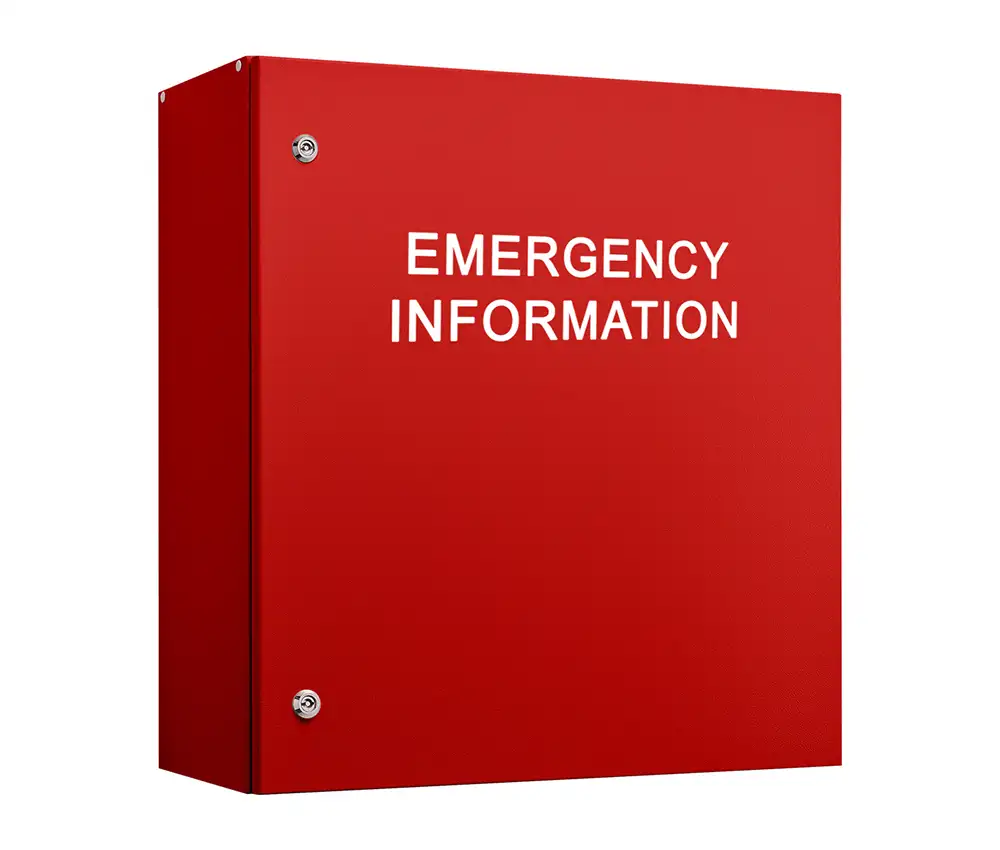 Store your emergency information at vehicle entrances to the site, or elsewhere where agreed by CFA. Often the box is red like this so it can be easy found.
Under the Dangerous Goods (Storage and Handling) Regulations 2022, Regulation 52 and 53, you may be required to formally request written advice from fire services—CFA or Fire Rescue Victoria–as per the following sections of the regulations:
Applications for written advice
CFA works closely with Fire Rescue Victoria to provide written advice on dangerous goods.
What must be included in your application for advice
The following information must be provided with your application:
- completed application form (PDF 271 KB)
- site Emergency Plan
- site Emergency Information Book
- site plans
- dangerous goods manifest
- fire service test results
If you can't provide all this information, please contact CFA’s Specialist Risk and Fire Safety Unit for advice: risk-info@cfa.vic.gov.au.
What you can expect from the process

When you apply for written advice, CFA will:
- Arrange a visit to your facility to discuss fire risk management for your dangerous goods storages and operations, verify fire protection systems and equipment, and discuss emergency arrangements.
- Assess whether fire protection systems on site are suited to the hazards and risks at your facility.
- Assess whether fire services can safely access the facility and important information in a emergency
- Review your Emergency Plan, Emergency Information Book, and other relevant documents.
- Provide written advice on these matters in a ‘Fire Protection Report’
Emergency Information Books
In an emergency, it's critical that CFA fire fighters can quickly understand the hazards at sites that pose additional risk to firefighters through their infrastructure or operations.
To facilitate this, Emergency Information Booklets must be created, kept up to date with key information and made available to emergency services at sites where there are additional hazards such as:
- dangerous goods
- combustible recyclable waste materials (including tyre storages over 500 EPUs*)
- renewable energy facilities
The information contained in the EIB helps fire fighters respond safely in an emergency.
The CFA Guideline for the Provision of Emergency Information (PDF 1.9MB) is designed to ensure that this information is presented in a standard format, and is current, correct and relevant.
Emergency Information Books are to be developed, regularly updated, and provided within Emergency Information Containers.
*An equivalent passenger unit (EPU) is a standard passenger car tyre. The weight of an EPU for a new standard passenger car tyre is standardised as 9.5kg; and the weight of an EPU for an end-of-life standard passenger car tyre is standardised as 8 kg.
Resources
CFA Guideline for the Provision of Emergency Information
This guideline outlines the content required in an Emergency Information Book. This information will need to be developed by your organisation and fully customised to reflect your site.
CFA recommends that the information contained in this Guideline be presented in the following format: An A4-size, two-ring binder that allows for the cover to be inserted on the front. Coloured five-tab dividers to insert between sections. Safety Data Sheets (in Section 5) stapled at the top left corner.
Page last updated: Tuesday, 29 September 2026 4:14:04 PM