Summary
- Keep your lawn and garden well-irrigated over summer
- Choose low flammability trees and plants
- Do not have trees within 10 metres of the house
- Use large features like dams, driveways and tennis courts to create separation between house and paddocks
- Avoid using organic mulch
- Don't plant flammable shrubs under windows or near doors
- Locate anything flammable away from the house, including sheds, woodpiles and chemicals
Factors to consider in a rural garden
Grasses can dry rapidly over summer, causing fire to spread easily from paddocks to the garden, threatening your home. Consider the following when planning a rural garden.
Fire spread
Grassfires travel fast through paddocks that could be near your house, so it's important to create areas of separation and low vegetation between the house and the most likely location of a fire. Consider using lawns, gravel surfaces and kitchen gardens.
Windbreaks
On rural properties, well-placed plants and trees with low flammability (catch fire more slowly) might help protect houses by:
- protecting the house from radiant heat
- reducing direct flame contact on a house
- reducing wind speed around a house and catching embers.
Locate windbreak trees more than 10 metres away from the house.
Dams
Dams can help provide separation between the house and a fire. They can also be a useful source of irrigation for the garden which should be kept well-hydrated over summer.
Flammable structures and substances
All flammable structures and substances like fertiliser, hay or chemicals become fuel for fire, increasing the chance your home catches on fire.
Move flammable structures and substances at least 10 metres away from your home, if not more.
Make sure the area around your house has very few flammable objects or vegetation such as woodpiles, sheds and vehicles.
Garden design principles
Below are the general principles to follow when designing a garden for fire:
1. Reduce vegetation in the area immediately around your home (create defendable space)
2. Remove flammable objects near your home
3. Break up vegetation with gravel, paths or grass between garden beds (create fuel breaks)
4. Carefully select, locate and maintain trees to be useful in a bushfire
Learn more about designing a garden for fire.
Model rural garden design
Key principles for rural garden design:
- Use decorative paving around the house to keep plants away from windows, doors and other vulnerable parts of the building.
- Locate areas of low fuel such as lawn, dams and tennis courts between the house and the most likely direction of a bushfire.
- Avoid planting shrubs under trees. Instead use groundcovers with low flammability and low growing succulents under trees to provide maximum separation between ground vegetation and tree tops.
- Plant trees a distance of at least 1.5 times their mature height from the house. Prune branches so they don't overhang the building.
- Use lawn and gravel paths to provide separation between garden beds. This breaks up the vegetation within the garden to prevent 'fuel corridors' which lead towards your home.
- Locate landscaping features with low flammability like dams, tennis courts and well-maintained lawn between the house and the most likely direction of a bushfire.
Example: Rural model garden
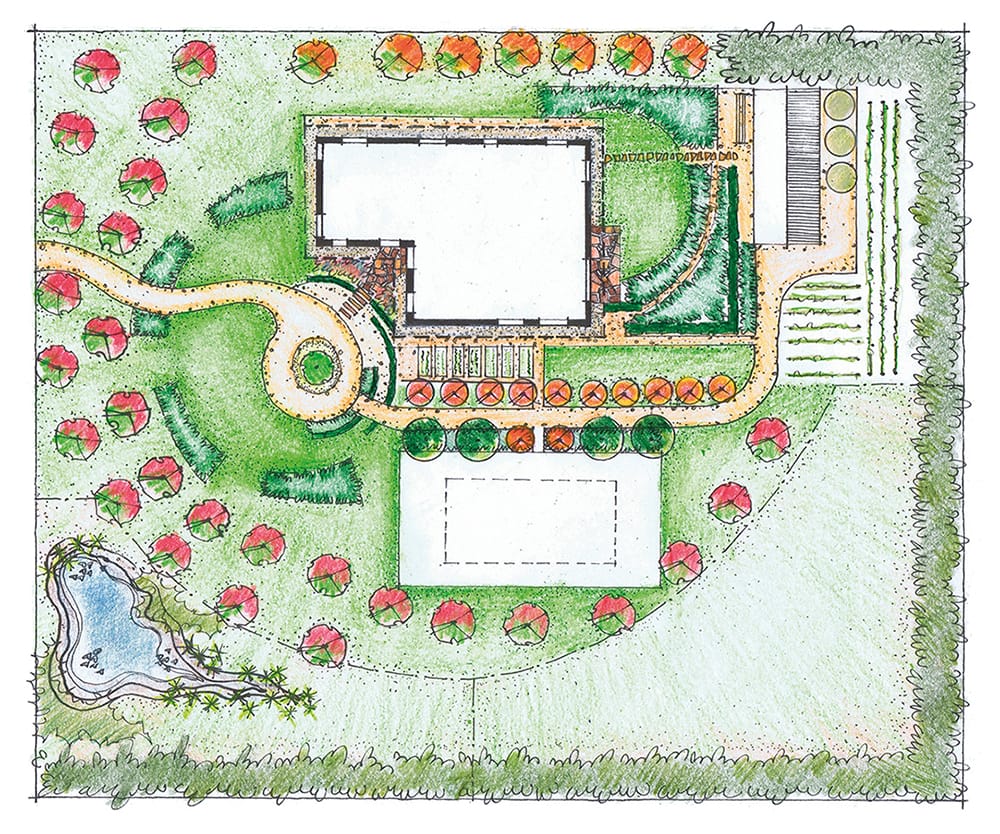
Dam
The dam has been positioned to create a barrier between the most likely direction of a fire and the house.
Fire direction
A fire is most likely to come from this direction.
Front lawn
The front lawn creates an area of low fuel (very little vegetation) between the fire and the house. It is well watered in summer.
Tennis court
The tennis court creates an area of low fuel between the fire and the house.
Driveway
The front driveway and turning circle create an area without vegetation between the fire and the house.
Kitchen garden
The irrigated kitchen garden, which is slower to catch fire and burn, helps create separation between the house and a potential fire threat.
Orchard trees
Irrigated ornamental orchard trees act as a windbreak and help stop embers reaching the house. they are pruned regularly so that there is space between the ground and the branches. Japanese Plum and Sweet Cherry.
Gravel paths
Gravel paths create space between the house and vegatation which could catch on fire.
Succulents
Low growing succulent plants have been used near the driveway to provide softness, but planted away from the house to reduce fire risk.
Windbreak
Tree species which don't catch fire as easily have been used as a windbreak on the southern and western boundaries. The grass beneath them is kept short and well-watered throughout summer. Lily Pilly and River Oak.
Shed
The shed with chemical stores, clothes line and fire wood are located far away from the house.
Vineyard
Well-watered grape and berry plants are at the back near the shed. They are kept green and well-watered over summer so they catch fire more slowly.
Entry garden
Beds of drought tolerant succulent plants at the front door, chosen because they are colourful, low-growing and fleshy, due to high moisture content. Tree Aeonium, Swans Neck Agave, Pigs Ears, Hen and Chickens, Purple Heart, Blue Chalk Sticks and Jelly Beans.
Low hedge
A low Dutch Box hedge has been chosen here because it doesn't contain high levels of oil, wax or resin. It also doesn't hold onto dead braches and leaves after pruning. It does require regular maintenance.
Low hedge
This low growing Pink Pixie hedge has fleshy leaves all year round and doesn't contain high levels of oil, wax or resin, making it a firewise choice. It requires regular maintenance.
Flowering plants
This perennial display towards the rear of the garden is made up of drought-tolerant flowering herbaceous plants. The bed is mulched with pea gravel which doesn't catch fire and it is irrigated throughout summer to keep the plans lush and moist. Yarrow, Mexican Lily, Blue Fescue, Dahlia 'Le Coco', Compton Ash, Salvia and Society Garlic.
Herbaceous plantings
Around the edge of the lawn are four clumps of herbaceous plants which are drought-tolerant and stay green and lush over summer. Blue Fescue, Paroo Lily, Spiny-headed Mat Rush, New Zealand Flax, Bird of Paradise.
Hotspots on the bird's eye view of the property highlight the fire safe design features of this property.
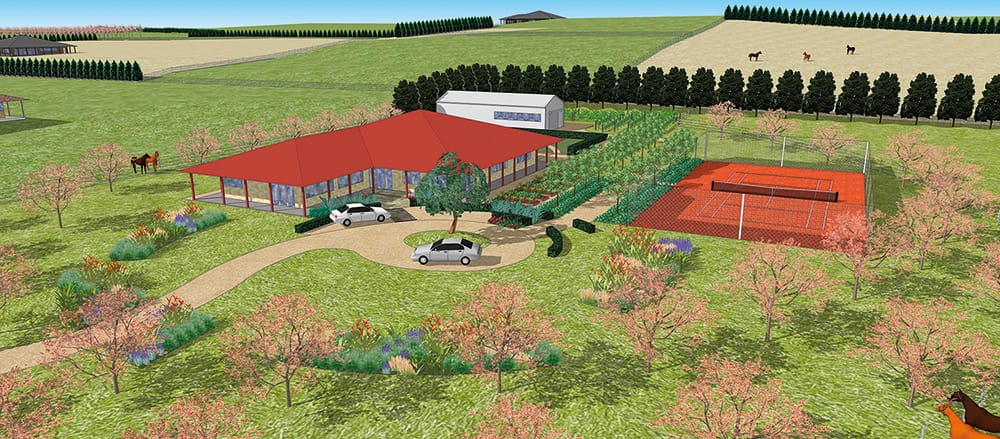
The same garden is seen below, looking from the north toward the house.
Fire direction
A fire would most likely come from this direction toward the house.
Front lawn
The front lawn creates and area of low fuel (very little vegetation) between the fire and the house. It is well-watered over summer.
Tennis court
The tennis court creates an area of low fuel between the fire and the house.
Driveway
The front driveway and turning circle create an area without vegetation between the fire and the house.
Orchard trees
Irrigated ornamental orchard trees act as a windbreak and help stop embers reaching the house. They are pruned regularly so that there is space between the ground and the branches. Japanese Plum, Sweet Cherry.
Windbreak
Tree species which don't catch fire as easily have been used as a windbreak on the southern and western boundaries. The grass beneath them is kept short and well-watered throughout summer. Lily Pilly and River Oak.
Shed
The shed with chemical stores, clothes line and fire wood which catch fire easily are located far away from the house.
Vineyard
Well-watered grape and berry plants are at the back of the property near the shed. They are kept green and well-watered over summer so they catch fire more slowly.
Entry garden
Beds of drought tolerant succulent plants at the front door, chosen because they are colourful, low-growing and fleshy due to high moisture content. Tree Aeonium, Swans Neck Agave, Pigs Ears, Hen and Chickens, Purple Heart, Blue Chalk Sticks and Jelly Beans.
Low hedge
A low Dutch Box hedge is planted either side of the pathway at the front of the house. It was chosen because it doesn't contain high levels of oil, wax or resin. It also doesn't hold onto dead branches and leaves after pruning. It does require regular maintenance.
Herbaceous plantings
Around the edge of the lawn are four clumps of herbaceous plants which are drought-tolerant and stay green and lush over summer. Blue Fescue, Paroo Lily, Spiny-headed Mat Rush, New Zealand Flax, Bird of Pardise.
Separation between house and paddocks
This design aims to reduce the spread of grassfire to the house from the surrounding paddocks and properties.
The most likely direction of the fire is from the north-west. The dam has positioned to create a barrier between the house and a fire from that direction. The front lawn, tennis court, front drive way, turning circle and kitchen garden are also creating separation between a potential fire and the house.
Ornamental fruit trees
A large planting of ornamental fruit frees including Sweet Cherry, Japanese Plums and European Plums have been planted as a windbreak and to provide protection from ember attack in the home paddock.
There is irrigated lawn beneath the fruit trees, and they will be pruned regularly to keep them apart from one another.
Shrub plantings
There are a few plantings of shrubs, far enough from the fruit trees that they don't spread fire into the tree tops. The shrubs are also planted in clumps with space between each planting, breaking them up so they don't create a continuous fuel for the fire.
Boundary windbreaks
On two sides of the home paddock are windbreak plantings of low flammable species, Lily Pilly and River Oak. These trees have a moderately dense habit and don't retain a lot of dead leaves or twigs. The grass beneath these trees is mowed low and is well-watered during summer.
Gravel
Gravel pathways have been used to provide separation between house and plantings. Pea gravel has been used for mulch in areas as a replacement for organic mulch.
Lawn
The lawn (Kikuyu grass) is tough and hard wearing, and will be well-maintained, kept short and irrigated over summer, to help create a low vegetation area around the house.
Perennials
There is a mix of perennials planted towards the rear of the house garden, chosen because they are drought-tolerant. They will be irrigated over summer to ensure they retain moisture.
Hedges
Hedges have been chosen for their low flammability. They don't contain much oil, wax or resin and they don't hold onto dead branches and leaves after pruning. There is a Dutch Box hedge at the front of the house along the pathway, and at the rear of the house is a taller Pink Pixie hedge which has fleshy leaves. Both need regular maintenance.
Front door plantings
There are two garden beds of drought-tolerant, low flammability succulents by the front door. They are colourful, low growing, have high moisture and easy to grow.
Herbaceous plantings
Around the edge of the lawn area are four clumps of herbaceous plants. They will grow up to 1 metre tall, and are drought-tolerant plants which stay green and lush over summer.
Shed, clothesline and fire wood
Flammable objects and structures are positioned well away from the house. Grapes and berry plants are planted near the shed and are kept well-watered over the summer months.
Water tanks
Non-combustible concrete or corrugated iron water tanks provide an additional water source during a fire.
Resources
Rural Garden - Landscaping for bushfire
Download a PDF version of the Model Rural Garden Design, including species names and locations.
Landscaping for Bushfire: Garden Design and Plant Selection
Download a PDF version of the Model Rural Garden Design, including species names and locations.
Page last updated: Friday, 4 September 2026 4:19:05 PM