Summary
- Create separation between house and vegetation
- Place 'firewise' plants and trees in strategic locations to catch embers
- Use gravel, stone and lawn to provide good separation between garden beds, and between house and garden
- Plant vegetable gardens and fruit trees on the side of the home the fire is most likely to come from.
- Trees and garden beds kept separate to slow spread of fire.
- Keep flammable plants and structures well away from house.
- Keep garden well-watered and maintained.
Factors to consider in a coastal garden
When you're planning a coastal garden, it's important to consider the local conditions and the kind of plants that will grow well in that specific environment. Below are some of the challenges coastal gardens face.
Soil
Sandy, shallow soils which don't hold onto water make keeping the soil moist a challenge.
Topography
Gardens located on sloping land will be exposed to strong winds.
Aspect
North facing gardens are more likely to dry out on hot summer days.
Nearby vegetation
If there is flammable vegetation near your property, it could be a fire risk and needs to be considered in your design.
Garden design principles
Below are the general principles to follow when designing a garden for bushfire:
1. Reduce vegetation in the area immediately around your home (create defendable space)
2. Remove flammable objects near your home
3. Break up vegetation with gravel, paths or grass between garden beds (create fuel breaks)
4. Carefully select, locate and maintain trees to be useful in a bushfire
Learn more about designing a garden for bushfire.
Model coastal garden design
Key principles for a coastal garden design:
- Create space between tree canopies to help prevent fire spreading from tree to tree and reaching the house. Make sure there is at least two metres between mature canopies.
- Use gravel paths and lawn to provide separation between garden beds. This breaks up the vegetation within the garden to prevent 'fuel corridors' which lead towards your home.
- Put areas without much vegetation between the house and the most likely direction of a bushfire. For example, a well-maintained lawn or veggie garden.
- Keep plants away from windows, doors and other parts of the building where embers could get in. Use paving, gravel or stone around the house instead to create a non-flammable barrier.
- Avoid planting shrubs under trees as the fire can easily move up into trees, becoming more intense as it climbs. Instead, use groundcovers with low flammability and low-growing succulents under trees to provide. This provides good separation between vegetation on the ground and the tree canopy.
Example: Coastal model garden
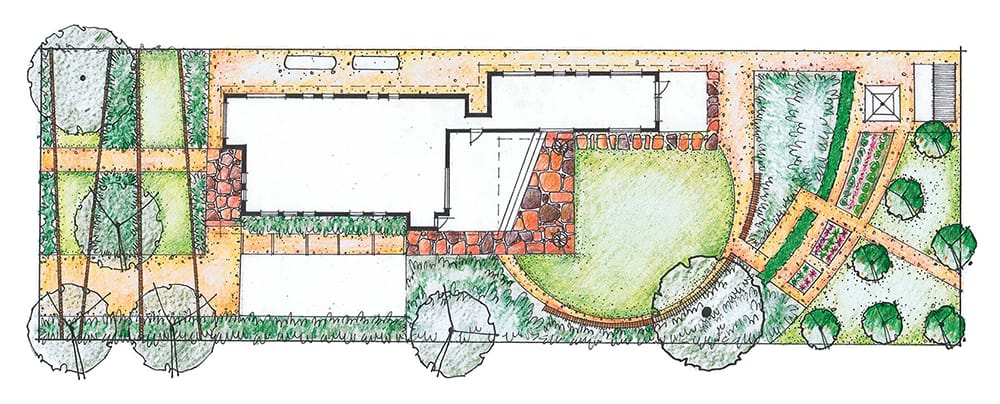
Water tanks
Water tanks are located in the service area on the south side of the house.
Shed
Kept well away from the house.
Separated lawn
The front garden includes strips of lawn between beds of low shrubs which reduces fire potential.
House
A house built using bushfire resistant materials and techniques, resists embers.
Stone porch
Stone offers better bushfire protection than a wooden deck.
Vegetable garden
Planted in smaller blocks, separated by gravel paths.
Outdoor sitting area
Paved with stone, this provides separation between the house and the direction of the most likely fire hazard.
Lawn
Kept short and well watered, the Buffalo lawn provides separation between the house and the fire hazard.
3 small trees
Small decorative Crepe Myrtle trees planted away from the house.
Hedge
A fleshy leaved hedge of Karaka is managed as a long, barrier planting which will also help catch embers.
Steel pots
These large pots planted with upright succulent plants soften the paved area and can be moved in summer.
Low growing succulents
Garden beds on the north side of the house are planted with small succulents like Flap Jacks, Blue Chalk Sticks and Jelly Beans.
Carport
The low growing succulents minimise the flammable material near the steel carport.
Citrus orchard
Good separation between the lemon and orange trees help slow the spread of fire.
Driveway
4m wide and 4m clearance above to allow fire truck access.
Small tree
This Hybrid Flame Tree is well away from the house. It provides shade and may catch embers. Plantings beneath are kept short.
North West
A fire is most likely to come from this direction, heading toward the house.
Hotspots on the bird's eye view of the property highlight the fire safe design features of this property.
The same garden is seen below, looking from the north toward the house.
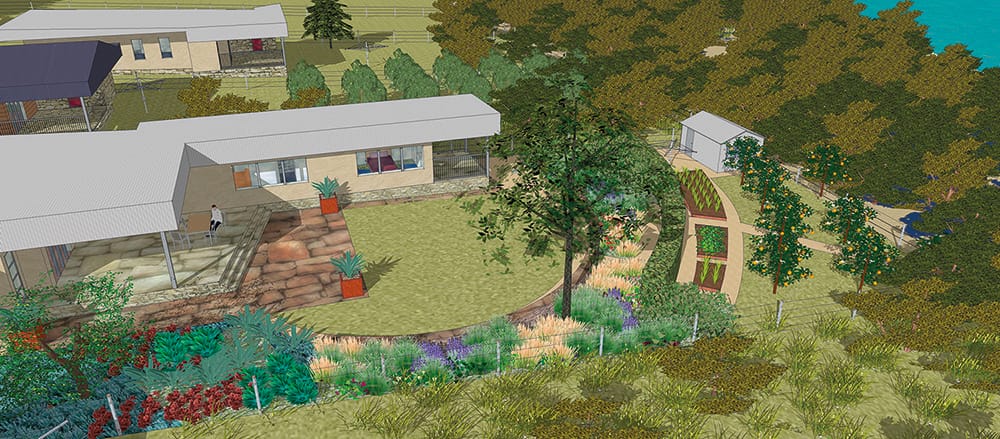
Shed
The shed is kept well away from the house.
Vegetable garden
Planted in smaller blocks, separate by gravel paths.
Small tree
This Hybrid Flame Tree is well away from the house. It provides shade and may help catch embers. Plantings beneath the tree are kept short.
Citrus orchard
Good separation between the lemon and orange trees help slow the spread of fire.
Hedge
A fleshy leaved hedge of Karaka is managed as a long barrier planting which will also help catch embers.
Outdoor sitting area
Paved with stone, this provides separation between the house and the direction of the most likely fire hazard.
Lawn
Kept short and well watered, the Buffalo lawn provides separation between the house and the vegetation.
Steel pots
These large pots planted with upright succulent plants soften the paved area and can be moved away from the house in summer.
Low growing succulents
Garden beds on the north side of the house are planted with small succulents like Flap Jacks, Blue Chalk Sticks and Jelly Beans.
North West
A fire is most likely to come from this direction, heading toward the house.
Firewise plants have been chosen and they have been arranged with bushfire risk in mind.
The driveway and carport also have 4 metres vertical and horizontal clearance for vehicle access in case of an emergency.
Vegetation is planted away from house
The paved sitting area, lawn and low-sitting wall provide separation between the house and the most likely fire direction.
Place plants and structures that catch fire easily well away from house
- The carport and pergola against the house are made of steel, so they won't catch on fire.
- The shed (containing chemicals and other items which can catch fire) and washing line have been put in the garden’s southwest corner.
- Large steel pots with upright succulent plants soften the paved area and can be moved away from the house during summer.
- Smaller growing succulents that reduce the amount of flammable material near the carport have been planted in the area north of the house.
- Small deciduous trees have been planted well away from the house and carport. This ensures there are no overhanging branches and the don't get in the way of the driveway.
- There is good separation between the tree canopies to stop fire spreading between tree tops. Smooth bark and an open habit (appearance) contribute to the low flammability rating of these trees.
Plants in strategic locations to catch embers
A small 'ember catching' tree is located well away from the house. It provides shade and could also catch embers during a fire. This reduces the amount of embers reaching the house. The lower branches of the tree are pruned up to 2 metres from ground level to prevent a fire from moving into the canopy. Planting beneath the tree has been kept very low and short.
Behind the tree, a fleshy-leaved hedge is managed as a long, barrier planting. This hedge is a 'firewise' plant, with very little dead foliage and low oil, wax and resin levels. It will also help catch embers.
Landscaping designed to slow fire spread
- The area most likely to be impacted by fire first has been designed to be an area without much vegetation, such as a well-watered vegetable garden and orchard with high moisture content.
- The gravel driveway and portions of the front garden include bands of decorative stone as a design feature which also act as fuel breaks.
- The front garden also includes strips of lawn between the beds of low shrubs and groundcovers. This provides good separation between plantings and reduces potential fire movement across the garden.
Natural barriers to radiant heat
The low stone wall acts as a radiant heat barrier and forms an attractive garden feature.
Trees and garden beds separated
Good separation is provided between all trees and garden beds to help slow fire spread.
Well-watered
The entire area is irrigated to keep plants lush over hot summer days.
Resources
Coastal Garden - Landscaping for bushfire
Download a PDF version of the Model Coastal Garden Design, including species names and locations.
Landscaping for Bushfire: Garden Design and Plant Selection
This downloadable booklet provides further information on garden design and plant selection which can be used for new or existing gardens in high-risk bushfire areas.
Page last updated: Thursday, 3 September 2026 1:41:21 PM