Summary
- The Black Summer Fires of 2019-2020 ntense, widespread fires across Australia, fueled by heatwaves and dry conditions, caused massive ecological damage, with megafires especially in Victoria and New South Wales.
- The fires burned over 1.5 million hectares in Victoria, destroying homes, wildlife, and businesses, causing billions in economic losses, particularly in tourism. The CFA mobilized thousands of volunteers to combat the fires.
- The town of Mallacoota was cut off and evacuated by boat and air in one of Australia’s largest maritime evacuations as fires threatened the area. Over 120 homes were lost, but no lives were claimed thanks to extensive firefighting efforts.
- Over 8,200 CFA volunteers, including those impacted by the fires themselves, worked tirelessly to protect communities, receiving global recognition and $25.9 million in donations for their efforts.
Black Summer 2019-2020
Across Australia, fires raged as the effects of heatwave and prolonged dry conditions created a perfect storm during the period known as Black Summer 2019 to 2020. So intense, numerous, widespread and fast-burning were these fires across Victoria and New South Wales, they were described as ‘megafires’. They caused some of the most extensive damage to ecosystems, forests and public land in generations.
In Victoria, most of the significant fire activity occurred in Gippsland and Hume regions, particularly on the border of New South Wales where fires were burning close by.
Dry lightning strikes in East Gippsland started three fires which grew to the widespread bushfire disaster that burned for months on end.
Elsewhere across the state, challenging and complex fires arose in Plenty Gorge, South Morang, which escalated rapidly and threatened houses in Bundoora. Fires also raged in Budj Bim National Park in the South-West.
Loss and destruction
The 2019–20 Victorian bushfires resulted in the loss of five lives and destroyed more than 400 homes and 6,800 livestock animals. The fires burned more than 1.5 million hectares of public and private land, including 1.39 million hectares of forests and parks, plantations and native timber assets, critical animal habitats and water catchments.
The economic damage to Victoria, estimated to be billions of dollars, hit the tourism sectors hard.
Mallacoota - the world watches
In Mallacoota, as holidaygoers and locals were preparing to ring in the new year, mayhem struck. An Emergency Warning was issued for Mallacoota at 4.40pm on 30 December 2019.
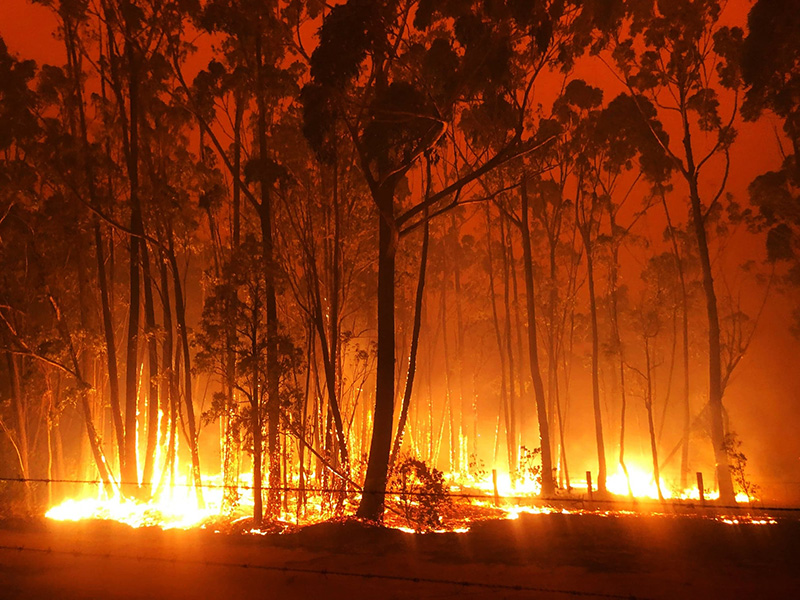
With the town cut off from the highway, the Australian Defence Force (ADF) undertook the largest ever domestic maritime evacuation in Mallacoota. Thousands of people were evacuated by boats and by air over several days, as the fires surrounded and threatened to destroy the town.
A few days earlier, a lightning strike had started a fire north-west of Mallacoota at Banana Track and had run rapidly to the coast. Crews defended the perimeter of the township, to protect residential houses, often hamstrung by fallen power lines and exploding gas bottles.
The severity of the fires was unlike anything even the most seasoned firefighter had seen before. It burned ferociously among vegetation with high fuel loads and spread from structure to structure.
At its peak during the first days of January 2020, smoke and haze blocked out the sun and plunged the region into darkness. 4000 people gathered on the Mallacoota foreshore as the fires came closer and 5000 left their homes and sheltered in relief centres. These scenes of the blood red skies, blazing bush and thousands huddling on the shore as they waited to be evacuated astonished people across the world.
The Mallacoota fire destroyed 123 houses, including five owned by CFA members, and 65 sheds. The epic firefighting effort and extensive emergency preparation meant that no lives were lost. However, the event took an enormous financial, physical cand emotional toll on locals and tourists alike. Businesses were lost along with future income and the potential for growth. The Abalone Cooperative building, a major employer in town, was partially destroyed. The region continues to recover, with communities and agencies working together in the weeks and years since the fires.
Our volunteers
More than 8,200 CFA staff and volunteers rose to the challenge and responded to the fires in Victoria’s time of need. More than 2280 CFA staff and volunteers had been deployed to fires interstate. Volunteers worked over weeks, even months, to the point of exhaustion, both on the firegrounds and behind the scenes as peer support workers and arranging logistics and supplies.
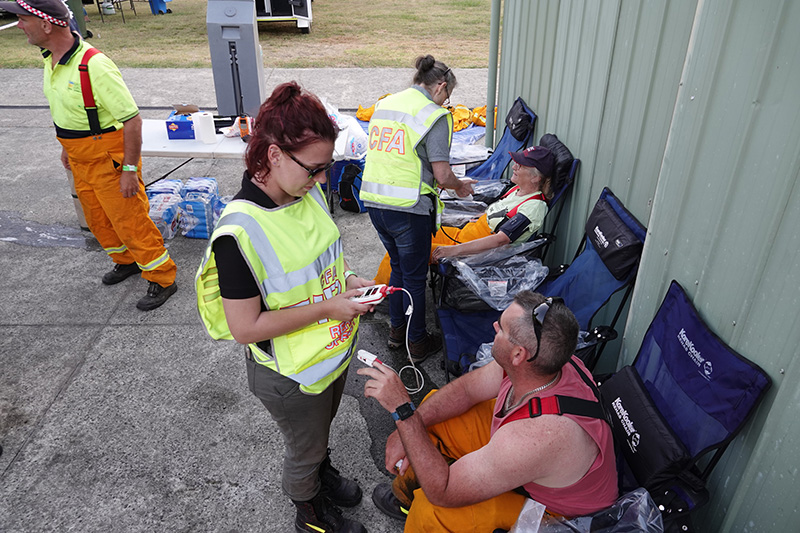
Many CFA brigades were directly impacted by the raging fires that burned in their local areas, threatening their people, properties, animals and communities. Some lost their own homes and livestock as they fought to save those of others.
Their professionalism, dedication and hard work were recognised the world over, and CFA were inundated with $25.9 million in donations, as well as hundreds of in-kind contributions and well wishes. Find out more in our Annual Report.
Timeline of activities
21-22 November 2019
On 21 November, a Code Red fire danger rating was declared for the Mallee and Northern Country and there was a statewide Total Fire Ban (TFB). Lightning storms caused more than 50 fires on 22 November. Local CFA crews worked closely with Forest Fire Management Victoria (FFMVic) crews. The majority of fires were contained within a day and no homes or lives were lost.
24 December 2019
Three large fires remained out of control and on 24 December various CFA districts supported the existing firefighting efforts by supplying 14 strike teams on an ongoing basis. Each strike team comprised five fire trucks.
29 December 2019
The Talmalmo fire from NSW entered Victoria northwest of Corryong and became known as the Upper Murray Walwa Fire.
30 December 2019
The state had extreme fire danger ratings in seven out of nine districts and a statewide TFB. The fires in East Gippsland and the Upper Murray Walwa fire, plus a new fire from the previous day in Cann River, burned extensively during the day and overnight, driven by hot temperatures, high winds and extremely flammable fuels. Many communities and townships were threatened and impacted including Sarsfield, Buchan, Mallacoota and Corryong. The size of the combined fires grew by about 200,000 hectares overnight with many fires merging.
Also, a fire started which burned into Budj Bim National Park near Bessiebelle. It threatened World Heritage-listed Aboriginal cultural sites but was contained in 17 days. Lightning storms continued to hit Victoria over the following days, with more fires in the forested areas of Gippsland and Hume regions. During the following weeks, many communities were isolated and continued to be threatened by fire. A massive multi-agency logistical effort moved personnel and essential supplies in and out of affected areas, as well as evacuations of communities via boat and helicopter.
2 January 2020
A State of Disaster was declared by the Victorian Government and 63,000 people heeded advice to leave the area. Significant smoke in the affected areas impacted human health and caused the grounding of many aircraft used to move fire and emergency management crews around the state.
Summary of the major bushfires in 2019-2020
| Date |
Incident location |
Description |
| 11/09/2019 |
Queensland deployment |
|
| 06/10/2019 |
NSW deployment |
|
| 12/11/2019 |
Queensland deployment |
|
| 21/11/2019 |
Strathallan – Burgoine Road |
|
| 22/11/2019 |
Snowy Complex |
- Cann River - Banana Tk fire and W Tree - Yalmy fire
- 97 days duration
- 662,500 hectares.
|
| 22/11/2019 |
Tambo Complex |
- Ensay - Ferny Creek fire, Marthavale - Barmouth Spur fire and Gelantipy - Never Never Creek fire
- 89 days duration
- 324,739 hectares.
|
| 20/12/2019 |
Lexton - Ben Major |
- 10 days duration
- 2,792 hectares
|
| 20/12/2019 |
Taplan - Settlement |
|
| 25/12/2019 |
Crawford River - Boulevard |
|
| 29/12/2019 |
Upper Murray Walwa |
|
| 30/12/2019 |
Budj Bim |
- 10 days duration
- 6,369 hectares
|
| 30/12/2019 |
Plenty Gorge |
|
| 31/12/2019 |
Cobungra - Dinner Plain Tk |
|
| 31/12/2019 |
Abbeyard - Yarrabula South |
|
| 31/12/2019 |
Hotham Heights - Blue Bag Range |
|
| 31/12/2019 |
Shannonvale - McNamara Hut |
|
| 01/01/2020 |
Buenba – Pheasant Creek Tk |
|
Page last updated: Monday, 15 June 2026 4:05:11 PM