Summary
- Follow the rules if the Fire Danger Period or a Total Fire Ban is in place
- Don't BBQ or cook outside when it's windy
- Check gas hoses and connections for damage and leaks before using
- Don't use damaged or old gas cylinders
- Make sure the space around where you're cooking is clear
- Make sure someone is watching at all times
- Make sure you turn off any cooking equipment or put the fire out when you finish
Can I have a BBQ or cook outdoors?
Solid fuel cooking equipment like BBQs, spit roasts, pizza ovens and some smokers can create sparks and embers which can start a fire.
Learn the rules around using BBQs and other outdoor cooking appliances during fire restrictions in the video below.
[Can I BBQ?]
[On screen text]
Can I barbecue?
[Gentle music builds]
[Woman 1]
Can I barbecue? During a Fire Danger Period I can't.
[Woman 2]
Unless I make sure it's not a windy day and there's a clear area around and above the barbecue.
[On screen diagram]
Barbecue with clear area measuring 3 metres above grill and 3 metres from centre of barbecue to all sides
[Woman 2]
There must be a person in attendance at all times and the barbecue should be turned off when finished.
[Woman 2]
On a Total Fire Ban Day I can only use a gas or electric barbecue.
[Woman 2]
I must also have access to water.
[Woman 1]
I can't use barbecues with wood or eat beads or similar.
To learn more about how to conduct a barbecue lawfully go to cfa.vic.gov.au/can
[Music ends]
Before you use a BBQ or light a fire to cook outdoors, check:
If so, there are special rules you need to follow which are explained below.
Fire Danger Period
If where you are is in a declared Fire Danger Period, you are not allowed to light a fire or use a BBQ for cooking unless:
- the wind is less than 10 km/h (if leaves on trees are constantly moving around in the wind it's too windy)
- 3 metres around and above the fire is clear of anything that can burn
- the fire or BBQ is supervised and watched at all times by a person who can put out the fire
- the BBQ is completely turned off or the fire put out when finished
Learn what you can and can't do during the Fire Danger Period.
Total Fire Ban days
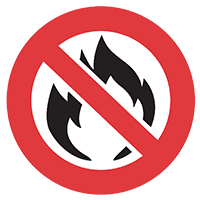
On a day of Total Fire Ban it is illegal to use any solid-fuelled (wood, coals, heat beads etc) outdoor cooker, anywhere in Victoria.
You can use a gas (including LPG) or electric outdoor cooker on a day of Total Fire Ban, but you must follow the same rules as during the Fire Danger Period, as well as an additional rule:
The fire must be in a properly constructed 'fireplace' or BBQ
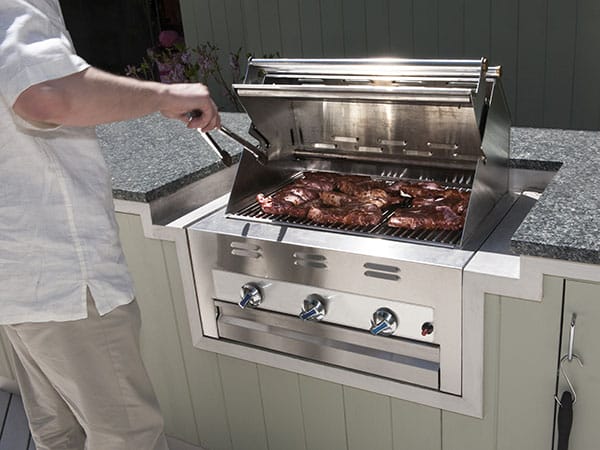 A permanently fixed, built-in gas BBQ.
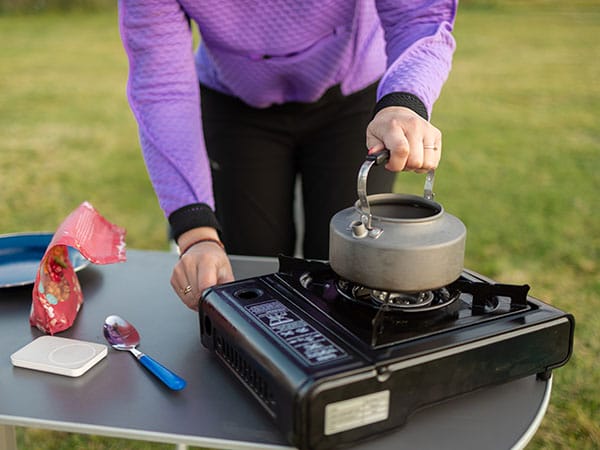 A commercially manufactured, portable butane gas stove in a stable position.
This must be either be:
a) A permanently fixed structure constructed of stone, metal, concrete or any other non-flammable material, which must be designed exclusively for meal preparation. For example, a built-in BBQ.
OR
b) A commercially manufactured BBQ or outdoor cooking appliance (including a portable gas stove), designed exclusively for meal preparation, which must:
- be used in a stable location when lit
- be located clear of anything that can burn - clear area within 3 metres of the cooker—around and above.
- watched and supervised by a capable adult at all times when the cooker is on
- be completely put out before you leave it.
Breaking these rules can result in more than $46,000 of fines, or 24 months in prison, or both.
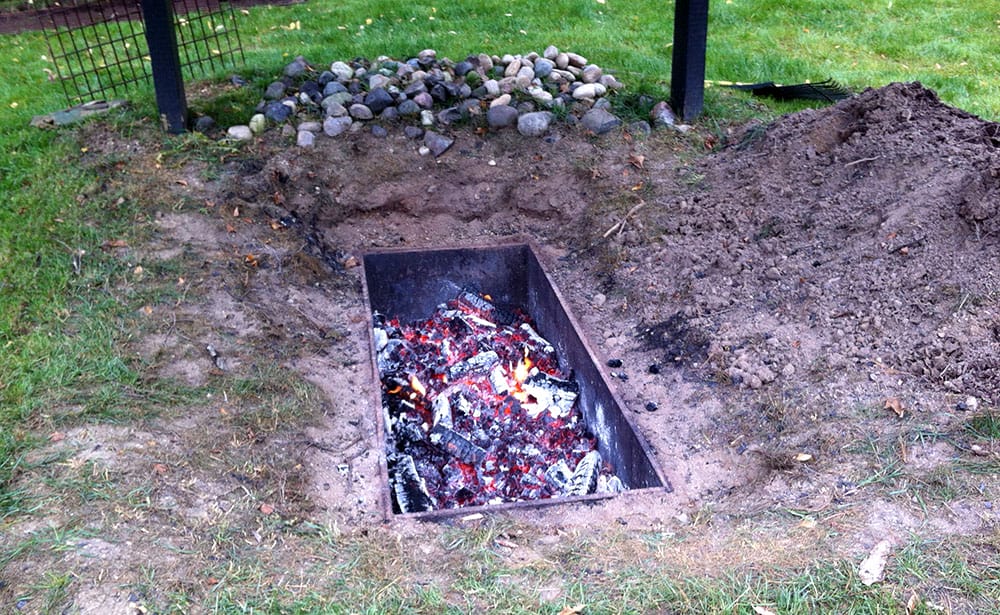
Using a Hangi during fire restrictions
Fire Danger Period
The following restrictions apply to Hangis being used in country or semi-urban Victoria during any declared Fire Danger Period:
- the wind is less than 10 km/h (if leaves on trees are constantly moving around in the wind it's too windy)
- the fire must be lit in a trench that's at least 30 centimetres deep
- the fire is no bigger than 1 square metre
- the solid fuel is appropriately sized for the purpose
- 3 metres around and above the Hangi is clear of anything that can burn
- the fire is supervised and watched at all times by a person who can put it out
- the fire is completely extinguished before the person leaves
Breaking these rules can result in more than $23,000 fines, or 12 months in prison, or both.
Total Fire Ban days
It is illegal to use a Hangi to cook meals anywhere in Victoria on a day of Total Fire Ban.
Breaking the rules can result in more than $46,000 fines or 24 months in prison or both.
hide
Gas BBQ safety
[Gas BBQ Safety]
[On screen text]
Gas BBQ Safety
Our Community - Our CFA
cfa.vic.gov.au
[Upbeat music]
[Presenter]
BBQs are a great way to enjoy good food and good company, but safety should always be a priority. Whether you're grilling in the backyard or on a deck, knowing how to properly handle your gas BBQ is essential to keep everyone safe.
In this video, we’ll guide you through, key safety tips for cooking on a gas BBQ outdoors. A lot of this information can also be applied to other backyard gas appliances such as patio heaters and pizza ovens.
[On screen text]
Fire restrictions and Total Fire Ban days
[Presenter]
When planning to have a BBQ outside, always check for any fire restrictions and Total Fire Bans in your area. Is the Fire Danger Period in place? Is it a Total Fire Ban day? You can do this by downloading the VicEmergency app or check the CFA website.
If where you are, is in a declared Fire Danger Period, Fire Danger Period restrictions you are only allowed to use a BBQ for cooking if, the wind is less than 10 kilometres per hour. Look up at surrounding trees, if leaves and small twigs are in constant motion, the wind is stronger than 10 kilometres per hour.
Three metres around and above the BBQ area must be clear of anything that can burn, the BBQ needs to be supervised and watched at all times, and the BBQ should be completely turned off when finished.
On a Total Fire Ban day, you can only use a commercially manufactured gas or electric BBQ if you follow these rules. Plus have at least 10 litres of water on hand to put out any fire that may start. On Total Fire Ban days, the use of all solid fuel BBQs that use fuels like wood, or heat beads is banned.
[On screen text]
Check your gas BBQ is safe to use
[Presenter]
Before lighting your gas BBQ, first, check the age and condition of your gas cylinder. If it's been more than 10 years since the last test, or if it's damaged, don't use it. Using a reputable cylinder exchange service like you'd find at a hardware store or your local outlet is a great way to be sure your cylinder is safe to use.
Check the hose, connectors and O-rings on your gas cylinder and BBQ for signs of wear, perishing or cracks. If left unchecked, these damaged parts could lead to dangerous gas leaks which could cause a fire or explosion. Don't use the gas BBQ until repairs have been made. If all parts look to be in order, make sure the connections are tight.
[On screen text]
Check for leaks with soapy water.
[Presenter]
You can easily check for leaks using soapy water. Mix water and dishwashing liquid into a spray bottle or onto a sponge. Turn on the gas cylinder, but leave the BBQ off. This will pressurise the system. Then spray or wipe the soapy mixture on the entire valve, regulator and hose assembly. If you see bubbles or smell gas, there's a leak.
If so, turn off the gas immediately. Refit, replace or tighten all connections. Then repeat the soapy water test to check if it's still leaking. No bubbles, no troubles.
The connections on any new BBQs currently being sold are designed to prevent gas leaks, but it's still a good idea to check for leaks anyway.
[On screen text]
Setting up for cooking safely
[Presenter]
Make sure your BBQ is clean. A build-up of grease and fat can mean that a flare-up can spread easily and become a dangerous fire. Make sure the space around your BBQ and where you are cooking is clear, by removing rubbish, clutter and flammable items.
Always cook in a well-ventilated area. Never BBQ indoors or in an enclosed space like a garage or shed. Carbon monoxide fumes, which cannot be smelled, can build up to deadly levels indoors.
[On screen text]
Cooking and supervision
[Presenter]
Be careful when cooking fatty meats like sausages or chops, which can cause flare-ups and grease fires. Aways wear an apron and use proper BBQ tools to protect yourself and your clothing.
Never leave a BBQ unattended. Make sure someone responsible is always watching. Finally, never leave children unsupervised around a BBQ while it's cooking.
[On screen text]
What to do if your BBQ catches fire
[Presenter]
If a fire does start, and if safe to do so, turn off the gas at the cylinder. Turning off the gas will, in most cases, allow the fire to burn itself out. If a fire starts and the situation is unsafe, call Triple 000 immediately.
[On screen text]
Turning off and storing gas BBQs
[Presenter]
When you're finished cooking and before you leave the BBQ unattended, make sure you turn off both the BBQ and the gas cylinder. Make sure the BBQ is completely cooled before cleaning up off any grease and fat build-up. If you're storing the BBQ, always store the gas bottles upright, away from heat sources and direct sunlight.
A BBQ is a great way to enjoy good food and great company in your backyard. But remember to check your equipment first, and BBQ safely!
Cheers!
[On screen text]
Enjoy a safe BBQ
[Presenter - softly]
Who's up for some food?
[Music fades]
Replace old hoses and connections
Regularly check and replace old or cracked hoses, O rings and hose connections on your gas cylinder. Make sure connections are tight.
If left to wear down, these parts can create dangerous gas leaks. Gas leaks could cause a fire or explosion.
Test for leaks
Check for leaks with soapy water following these steps:
- Mix water and dishwashing liquid into a spray bottle or on a sponge
- Spray or wipe soapy mixture on the BBQ gas connection and hose
- Turn on the gas cylinder but not the BBQ burners. This will pressurise the system
- If you see bubbles, smell gas or rotten eggs, there is a leak
- If there is a leak: turn off the gas
- Re-fit or tighten all connections
- Repeat soapy water test to check if it's still leaking
"If it bubbles, you're in trouble."
Check the age of the gas cylinder
Don't refill a gas cylinder if it hasn’t been tested for more than 10 years, or if the cylinder has been damaged.
We recommend using a reputable cylinder exchange service so you don't need to worry.
Regularly clean grease and fat build up
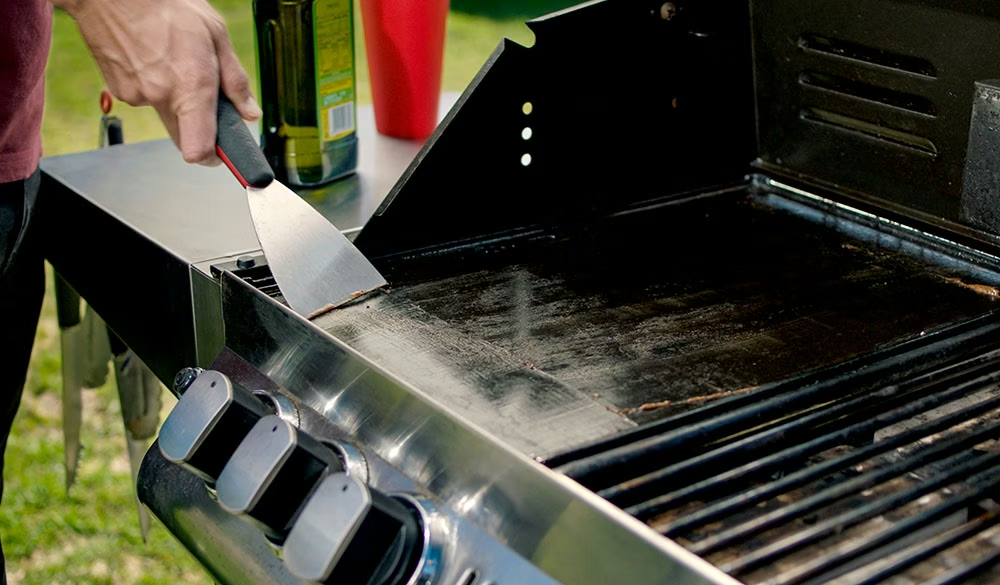
Regularly clean your BBQ to remove grease and fat build-up, including the drip tray. BBQs can start fires due to fat spatter and flames from fatty meat like lamb chops and sausages.
Wear an apron and use BBQ tools to protect yourself from hot oil and fat when cooking.
Store gas cylinders upright
Always store gas cylinders upright and away from heat sources. Turn off when not in use.
Turn your BBQ off properly
Leaving your BBQ on could start a fire, like it did in the video case study below.
Chris forgot to turn the BBQ off after using it, which accidentally started a fire. Luckily, the smoke was detected by their smoke alarm and they called Triple Zero [000] before more damage was done.
[BBQ Safety - Chris and Jo]
[On screen text]
Chris and Jo Fowler
Merricks residents
Bunurong Country
[Chris Fowler - Merricks Resident]
On the 5th of July this year, I just came back from a trip and decided to have a barbecue for dinner that night. Unfortunately I forgot to turn the barbecue off.
[Jo Fowler - Merricks Resident]
I was woken at about 4:30 in the morning by the smoke detector. I came downstairs, got to the landing on the stairs and could smell the smoke.
[Chris]
You know, this, this barbecue, was that hot it went through the bricks and combusted.
[Jo]
It's absolutely life-saving,
[Chris]
Life-saving,
[Jo]
without a doubt. The fact that the smoke detector was so quick to pick up the smoke and the fact it gave us the time to react very quickly, to call the CFA. I think it's really important to make sure that if, you know you're having a barbecue, that you do actually, you know, back one another up. Someone checks that the gas is actually off, then you're not going to end up in this situation.
[music ends]
Don't use portable gas cookers or BBQs inside
Cooking or lighting fires and BBQs inside, including in your shed or garage isn't safe. Use BBQs, gas cookers and fire pits outdoors with lots of air around for ventilation.
BBQs and portable gas cookers also produce poisonous (carbon monoxide) gas, which is dangerous in enclosed spaces.
Learn more about garage and shed fire safety.
Be careful when barbecuing on a balcony
You need to be particularly careful when barbecuing on a balcony because of the limited amount of space available.
- BBQ at least 50cm (half a metre) away from walls and fences
- Remove rubbish, clutter and flammable items around BBQ, including outdoor furniture
- Keep a dry powder fire extinguisher nearby. Use only in case of a small fire and if you feel physically and mentally able.
Learn more about apartment fire safety.
Page last updated: Tuesday, 6 October 2026 11:34:57 AM