Summary
- Defending your property is extremely hard and dangerous work.
- It can take hours or even days of non-stop physical effort.
- Prepare yourself mentally for the stress and potential trauma of a bushfire.
- Prepare yourself physically to work long hours in heat, smoke, and noise.
- Get your house and garden ready well before bushfire season starts.
- Learn how to upgrade your home to better withstand ember attack, flame contact, and radiant heat.
- Never plan to stay and defend on Catastrophic days.
Only stay and defend if you are fully prepared and physically capable
Only plan to stay and defend your property during a bushfire if you are fully prepared to actively defend your home. Actively defending takes a huge amount of physical and mental stamina. You will need to work hard for many hours before, during, and after the fire front arrives.
To actively defend your property, you will need to:
- patrol outside your home for many hours before the fire front arrives
- patrol inside your home, while also watching what's happening outside, for as long as necessary when the fire arrives
- continue to patrol inside and outside of your home for many hours after the fire has passed.
Even if you have the right equipment and have prepared well, defending your home is still extremely dangerous. Do not expect a fire truck.
Four key things to consider:
- Personal capacity—know how strong and capable you are, and how well you handle stress.
- Property preparation—prepare your home and garden before and during bushfire season, and .
- House design and construction—make improvements to your home to improve its chances of surviving a fire.
- Water, equipment and resources—know what equipment you need to defend your property.
No matter how ready you think you are or how well you have prepared your property, staying to defend your home always involves the risk of getting seriously injured, enduring emotional trauma, or dying.
Never plan to defend your property on days of Catastrophic fire danger—even homes built to a high Bushfire Attack Level (BAL) are unlikely to survive in these conditions.
Ask yourself these questions:
Do I have:
- at least two fit and determined adults who are physically and mentally prepared to work in difficult and demanding conditions?
- at least 10,000 litres of water?
- a firefighting pump?
- firefighting hoses that can reach around my home?
- personal protective clothing (PPC) for each person defending my home?
Have I prepared:
- my home and garden before bushfire season?
- my home and garden during bushfire season?
- my bushfire plan and backup plans?
CFA and the Victorian government do not recommend staying to defend your property during a bushfire. Not all homes are defendable, and not everyone has the physical and mental strength needed to defend their property.
"I'll never do that again"
People who defended their properties during major Victorian bushfires reflect on how their experiences have changed their future bushfire plans.
Actively defending your property will be:
- dark—thick dense smoke from the fire combined with dust and ash means you may struggle to see your own hand
- noisy—the roar of an approaching fire is often compared to the sound of a jet plane taking off
- hot—bushfire conditions can cause heat exhaustion, dehydration, and heatstroke
- stifling—bushfire smoke is thick, acrid, and filled with toxic fumes
- traumatic—people who directly experience bushfire can live with severe ongoing trauma
- exhausting—emotionally, mentally, and physically.
"All I could feel was unbearable heat and the air around me was not even really air anymore. Just smoke. I was choking. The window went completely black."
- Anonymous
Real life bushfire experiences
In this video you will see and hear real life experience of what it's like to defend your property.
Do not stay and defend if you have:
- asthma
- a heart problem
- other illness/disability.
Do not stay and defend if you are with a person who:
- has a physical disability or temporary injury
- has an intellectual disability
- has emotional or mental health problems
- is sick
- is elderly
- is a child less than 16 years old.
Preparing your property to the highest level
If you plan to stay and actively defend your property, you will need to put in a lot more work to prepare your house and garden than someone who plans to leave early.
Start by ember-proofing your home and any other buildings, planting fire resistant gardens, and clearing any plants or debris around your property. Most of this work needs to be done before bushfire season starts and must be maintained throughout the summer.
Be prepared to defend your property
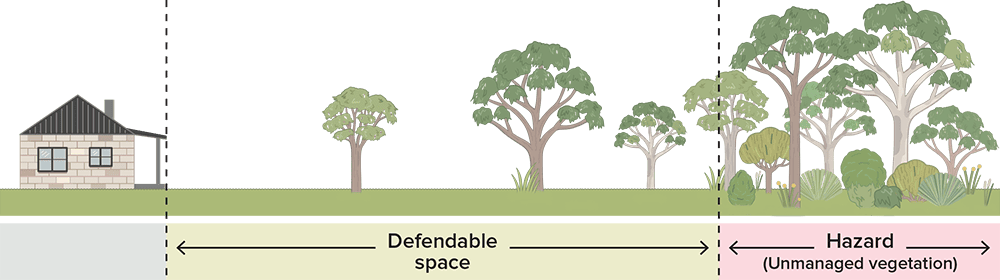
- Create a defendable space around your home. This must be maintained throughout each fire season to be effective.
- Clear trees and vegetation close to your home and fence line. This will require ongoing management.
- Design your garden with bushfire safety in mind. Choose plants and landscaping materials that have low flammability.
- Before the Fire Danger Period is declared each year, dispose of any green waste safely.
Retrofitting your home for better bushfire protection
After the Black Saturday bushfires in February 2009, the Victorian government introduced new building regulations to make homes in bushfire-prone areas safer. Now, all new homes are built for better bushfire protection.
These building regulations can also help make existing homes safer. The Victorian Building Authority (VBA) have created a guide that shows how to upgrade your home to protect it from embers, ember attack, direct flame contact, and radiant heat. It suggests some simple improvements you can make to your home, including:
- Underfloor spaces
- Walls and roof edges
- Windows (including skylights)
- Outside doors
- Vents and weepholes
- Roofs
- Gutters and downpipes
- Carports, decks, verandas and pergolas
- Garages and sheds.
Resources
A Guide to retrofit your home for better protection from a bushfire
The Victorian Building Authority and CFA have partnered to help homeowners make their houses safer from bushfires. To prepare your home for a bushfire, check out the building and renovation tips.
Understanding how bushfires spread
Bushfires and grassfires spread in three main ways:
- Ember attack
- Radiant heat
- Direct flame contact.
The Fire Danger Rating (FDR) and the distance of your home from vegetation and the fire front will determine whether you experience all three of these ways, just some of them, or only ember attacks during a bushfire.
Knowing how bushfires might behave on your property can help you decide how to best prepare and which building upgrades could offer the most protection.
Learn how bushfires start, how they spread, and what factors make them more intense.
Even well-prepared homes can be destroyed by a bushfire
Preparing your property should form part of your bushfire plan, whether you intend to stay and defend or leave early. A home that is well-prepared is more likely to survive a bushfire.
However, even well-prepared homes can be attacked and destroyed by bushfires and grassfires. If you plan to stay and defend your property, it is essential to do extra work around your home and invest in appropriate firefighting equipment to increase your chances of survival.
Always have backup plans in place to keep yourself safe.
Explore what you need to know about defending your property
Resources
CFA Fire Ready Kit
Our Fire Ready Kit is an essential resource to help you plan for survival. It covers the basics—how fire behaves and how Fire Danger Ratings work—through to the practical steps needed to prepare your property before bushfire season.
The kit also explains what to do if a fire is in your area and you can’t leave. Downloading this resource is an important first step in getting prepared.
Defending your property - Bushfire survival planning template
This template is designed for people living in bushfire-prone areas. This template helps you make a clear bushfire plan, prepare different plans based on Fire Danger Ratings, and check off important tasks to get your property ready throughout the year.
If you choose to stay and defend, the template also guides you through the actions needed to actively defend your home and helps you understand the serious risks and unexpected problems that can arise, even if you are well-prepared.
Page last updated: Thursday, 30 July 2026 1:50:33 PM