Summary
- Embers are small pieces of burning twigs, leaves and debris.
- Embers can start spot fires if they land on dry grass, leaves, mulch or timber.
- Embers start fires on homes and buildings.
- Ember-proof your home and remove vegetation and other flammable things from around your buildings.
What are embers?
Embers are small pieces of burning twigs, leaves and debris.
This short animation explains what embers are and how they are able to travel long distances and start new fires.
[Ember Attack]
The following may be distressing to some viewers.
During a bushfire, embers will reach your home long before the flames do.
Ember attacks are the most common way that houses catch fire.
Embers are burning leaves, twigs and pieces of bark. They help the bushfire spread by starting spot fires ahead of the main fire front.
Short distance ember attacks happen when leaves and small pieces of bark are blown from burning trees. The intense shower of sparks that forms fills the air with hot burning embers which will land on nearby vegetation and properties.
The hot embers can easily land and get into your clothes and burn your skin, eyes, and airways.
Small fires will start all around you, and quickly become uncontrollable.
The resulting chaos creates confusion, as the fire seems to come from many directions, meaning it will be difficult to make good decisions about your safety. The experience will be physically exhausting, and emotionally traumatic.
Long distance ember attack is caused by large bushfires that generate intense heat.
As the hot air rises, it forms a column of smoke that sucks in air like a vacuum, increasing the intensity of the fire. The updraft in the column lifts embers like large pieces of burning ribbon bark, hundreds of metres into the air, where strong winds can carry them many kilometres beyond the fire front.
On Black Saturday, embers travelled more than 30 kilometres ahead of the main fire.
When these embers land, they often start fires where leaves naturally accumulate, like in gutters, doorways, and garden beds.
So, while you might think you're safe when a bushfire is far away, embers can fall from the sky and land around your home long before you even know there's a fire.
But remember, your home isn't the only thing under threat during an ember attack.
By the time you realise the danger, it might be too late, as escape routes become jammed.
Embers can also start fires on roads and block them completely, making late evacuation dangerous or impossible.
That's why leaving early, before a fire starts, is always your safest option.
Why are they so dangerous?
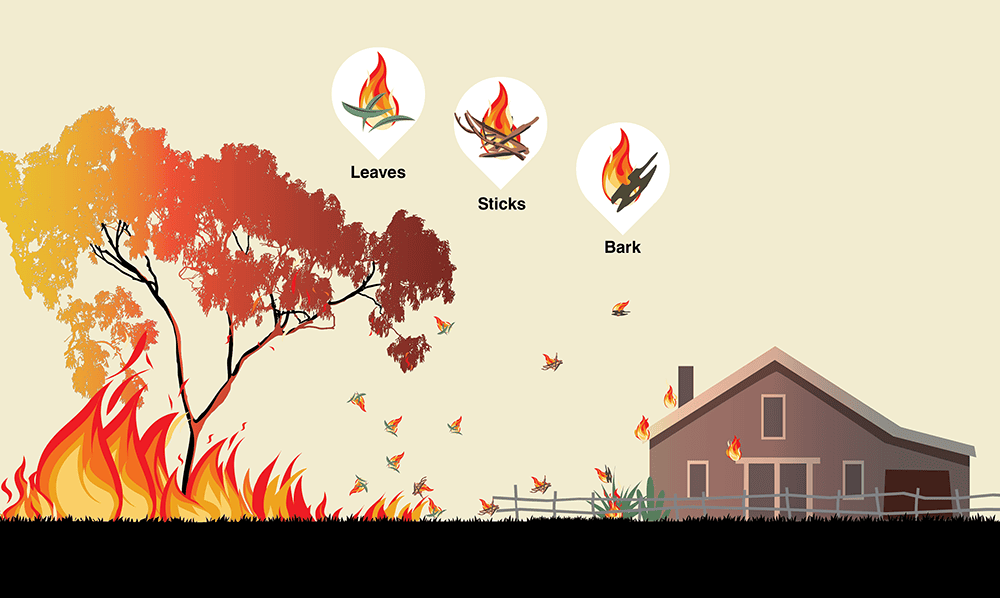 The wind can carry small burning pieces of leaf, sticks and bark away from the main fire front, threatening homes and other property.
Wind can carry embers a long way from a fire front. On Black Saturday in 2009, embers were carried up to 30 kilometres away from the fire front. The distance they would normally travel is around 10 kilometres.
When carried by the wind, embers can start spot fires when they land on dry grass, leaves, mulch or timber.
Embers are the main reason houses catch fire during a bushfire. They can set fire to your house when they land on your garden, your doormat, or your gutters.
What is an ember attack?
The below video shows what an ember attack looks like during a major bushfire before the flames arrive.
[Ember Attack]
Vision taken from inside a firefighting vehicle driving down a suburban street on the edge of Canberra. It gives a real life understanding of what it is like being caught in a severe ember attack. Masses of embers can be seen blowing across the road from left to right. Visibility is extremely low due to the amount of smoke and it appears to be night time even though it is the afternoon.
A garbled radio message can be heard but not understood. The camera moves to film outside the right hand window where all that can be seen is a vast amount of orange light as embers flash past. In the background trees and nature strips can be seen completely alight with fire.
The scene the cuts to looking out the left side of the vehicle at cars driving through an intersection with headlights beaming through the smoke and embers flying around. The sky is dark and orange.
[Someone on the two way radio]
"there is nothing we can do now."
The next scene looks out the front of the vehicle as it speeds as fast as it can given the low visibility. All outside is dark and orange with embers flying into the windscreen and fire is all around. The vehicle's siren sounding loudly.
The video cuts to a scene taken a little later from a vehicle driving down the same street. It is a little brighter now, and fire can be seen clearly on nature strips and around houses.
Next we see it has become dark again as smoke thickens while the firefighting vehicle continues to drive with it's siren sounding loudly.
The video ends as we look through very thick, orange lit smoke at flames coming from the roof of a house.
An ember attack is when large numbers of burning embers are carried by the wind and land on or near a building or property.
Embers cause bushfires to spread quickly and unpredictably. It can feel like fires are coming from all directions as spot fires can surround and threaten communities.
This can happen before, during or after the main front of a bushfire passes.
Protect your home from an ember attack
Ember-proof your home
An important part of preparing for bushfire season is ember-proofing your home through fire resistant home improvements, such as:
- covering any gaps in your roof, walls, door frames
- using non-combustible materials in your home where possible.
Learn about how you can stop embers easily setting fire to your home
Cut back vegetation
It's also important to remove and reduce vegetation close to your house that could easily catch on fire.
If you live in a rural or regional area, check first, but you might not need a permit to clear trees, branches and scrub from around your home.
Learn more about removing vegetation on your property
Bushfires where embers have travelled the furthest
The furthest we know embers to have travelled was during the Black Saturday fires of 2009. The Churchill fire in South Gippsland produced embers which travelled 23 km from the top of the Strezlecki Range into the Yarram area. On the same day, a fire at Kilmore East sent embers from Mt Disappointment about 35km toward an area north of Healesville.
These distances were reached during some of the most extreme bushfire conditions—45oC and winds of approximately 100 kilometres an hour after a prolonged drought. Topography also played a part with the embers being released from tops of ridges.
Page last updated: Wednesday, 16 September 2026 10:01:06 AM