Summary
- Heat and spark-producing activities can start fires.
- There are rules you must follow during the Fire Danger Period when doing activities that create heat and sparks outside.
- Welding, grinding, metal cutting and other 'hot works' are completely banned on Total Fire Ban days.
- Only very essential work can be done on a Total Fire Ban day, if a permit is granted.
- Penalties for breaking the rules include hefty fines and prison sentences.
Heat and spark-producing activity can start fires
A single spark is enough to start a fire in the right conditions. Restrictions are in place to reduce the chance of a fire starting when conditions are hot, dry and windy.
Learn what you can and can't do at different times in the video below.
[Can I perform Hot Works?]
[Sizzling sounds]
[On screen text]
Can I perform hot works in the Fire Danger Period?
[Upbeat music]
[Voice over]
Can I perform hot works in the Fire Danger Period?
[Man 1 - Can't]
I can't use welding, metal cutting, grinding and other heat or spark producing tools.
[Man 2 - Can]
Unless a fire resistant shield is in place, and hot cutoffs are placed in fireproof containers.
[On screen diagram]
Explaining area is clear 1.5 metres above and to all sides.
[Man 2]
The area is clear of anything that can catch fire, and I have a hose connected to water.
[Man 1]
On Total Fire Ban days, I can't use any tools that create heat or sparks.
You need to know a lot more than this, to ensure you're within the law.
Visit cfa.vic.gov.au/can
[On screen text]
cfa.vic.gov.au/can
[Music ends]
Rules during the Fire Danger Period
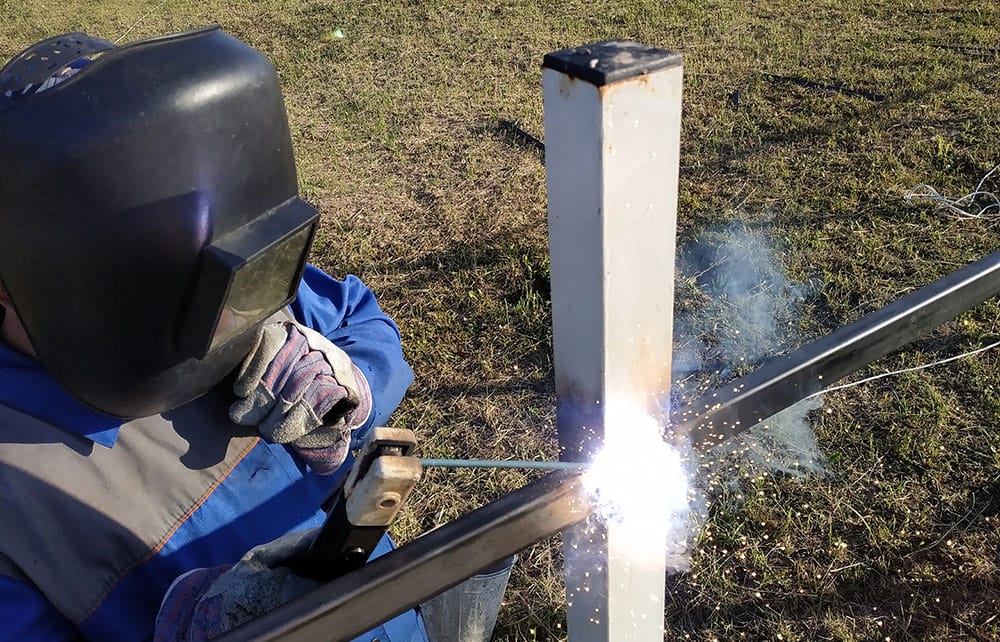 Any activity that can produce heat and sparks is restricted at certain times during the warmer months, to reduce the chance of a fire starting and spreading.
During the Fire Danger Period, heat and spark-producing work such as welding, soldering, grinding, charring, gas cutting, rail maintenance, heating bitumen, bee smoking or honey extraction using heat are not allowed outdoors unless:
- A fire-resistant shield or guard is in place to stop sparks, hot metal or slag.
- An area at least 1.5 metres from the work is clear of anything that can burn, or wetted down enough to prevent the spread of fire.
- You have a hose connected to a tap, a water extinguisher or a knapsack containing at least 9 litres of water.
- All cut-offs and hot materials from the work are placed in fire-proof containers.
These rules apply to work done in the 'open air', which is 'any place other than within a permanent structure'.
A permanent structure includes houses, buildings, caravans and sheds, but does not include a shed that is open on one side, or a tent or marquee.
Rules on Total Fire Ban Days
On Total Fire Ban Days, welding, grinding, and other hot work activities that create heat and sparks are banned.
In very limited circumstances, CFA, the Department of Energy, Environment and Climate Action or Fire Rescue Victoria may issue a permit for essential activities to go ahead on a Total Fire Ban day.
Permits are only granted in extreme circumstances, for example, when safety or the upkeep of essential public services are at stake. Even in these cases, a permit is still required.
If your work is essential and cannot be delayed, apply for a permit at Fire Permits Victoria.
Penalties and consequences
Breaking the rules during the Fire Danger Period can result in a $23,000 fine, 12 months imprisonment or both.
On a Total Fire Ban day these penalties are doubled to $46,000 or 2 years imprisonment, or both.
Worse still, you could start a fire which endangers you and your community.
Protect lives and assets and apply for a fire fire permit.
Can I or Can't I?
Get the details around what you can and can't do in the Fire Danger Period or on a Total Fire Ban day and stay safe over the warmer months.
Page last updated: Wednesday, 2 September 2026 3:20:18 PM