Summary
- Careful garden design can help protect your home from bushfire
- Reduce the amount of vegetation within 10 metres of your home
- Use paths, driveways, lawns, pools and ponds as fire breaks near your home
- Keep clumped garden beds and plantings separate from one another
- Separate garden beds with paths made from material like gravel, clay or pebbles
- Make smart swaps like using stone or iron instead of timber
- Move flammable objects and materials away from your home
Garden design is only one aspect of planning for bushfire. On Extreme and Catastrophic days, leaving early is the safest option to protect yourself and your family.
Garden design impacts bushfire behaviour
Learn about landscaping and design choices you can make to reduce bushfire risk to your home in the video below.
[Designing your garden for bushfire]
[On screen text]
Garden Design for Bushfire
[Gentle music and the sound of birds singing]
[Presenter]
The landscaping and design choices that you make for your gardens and backyards can significantly affect the bushfire risk to your home. So, you need to make sure you're making the right decisions.
[Music]
There are three main reasons that houses burn down during fire. Embers landing on or near the house which is the most common way houses catch fire. Radiant heat from burning vegetation near the house or direct flame contact.
[Music]
[On screen text]
Create Defendable Space
[Presenter]
Start by creating defendable space. You should have an inner zone immediately around your house, where you reduce, remove or rearrange vegetation. This can limit the impacts of radiant heat and direct flame contact. It would normally be about 10 meters out from the house.
You should also have an outer zone where vegetation is managed to a more moderate level. Use driveways and paths to create separation between vegetation and the house. Trees and vegetation should not be located close to vulnerable parts of the building such as windows, decks and eaves.
[Music]
[On screen text]
Remove Flammable Objects
[Presenter]
Concrete or pave up to the edge of the house or replace flammable mulches such as tanbark with inorganic alternatives such as river pebbles or gravel.
Keep grass cut to five centimeters within the inner zone and 10 centimeters within the outer zone.
[Music]
[On screen text]
Break Up Fuel Continuity
[Presenter]
Locate shrubs away from trees. Shrubs and surface vegetation can act as a ladder fuel to carry fire up into the trees. To limit a fire's ability to spread, clump trees together so they don't form a continuous canopy and keep garden beds separated. Both can be achieved by clever placement of gravel paths or mowed grass. Elements in any good garden design.
[Music]
[On screen text]
Select, Locate and Maintain Trees
[Presenter]
There are no fireproof trees or plants. All vegetation can burn under the right conditions. However, some are less flammable than others, so it's important to carefully select and properly maintain vegetation. Avoid trees with loose, ribbon or stringy bark, that could shower your house with embers during a fire.
Locating trees a safe distance from the house will reduce the chance of limbs falling and damaging the structure. If this happens, embers could get inside and set fire to your home.
[On screen text]
Home Improvements
[Presenter]
Back at the house you can strengthen the building against the risk of embers, by sealing any gaps and making improvements to the structure. Seal around windows, doors and eaves to prevent embers lodging in any gaps and ensure painted surfaces aren't flaking.
You can prevent leaf litter and embers getting under the deck and into the underfloor space by sealing any vents or gaps using a steel mesh. More expensive options including sprinklers on the roof, can make a big difference to house survivability.
[Music]
Fire burns wherever there is fuel. If you reduce the fuel around your home, you can reduce how hot and destructive a fire is as it passes through your property. We have only touched on a few actions for you to consider.
CFA has extensive information on designing your garden for bushfire, and don't forget the final part of preparing your property, a big cleanup before summer and maintenance throughout the season.
[Music]
[On screen text]
cfa.vic.gov.au/prepare
[Music fades]
Fire burns whatever flammable materials (vegetation and other objects) are in its path.
Strategic garden design is about choosing suitable plants and landscaping materials, and arranging them so that your home is better protected from flames, embers and radiant heat. Doing this can reduce how hot and destructive a fire is as it moves across your property, which gives your home the best chance of survival.
Designing a garden for bushfire involves:
- keeping the space around buildings relatively clear and free of plants and material which could catch fire
- keeping more flammable plants and elements in the garden separate from each other
Explore these concepts in more detail below.
Bushfire resistant garden design principles
There are a number of garden design principles we recommend following to reduce the risk of fire spreading from your garden to your home.
The following principles are based on the bushfire protection requirements within the Bushfire Management Overlay and can be followed in all different types of gardens.
1. Reduce vegetation around your home
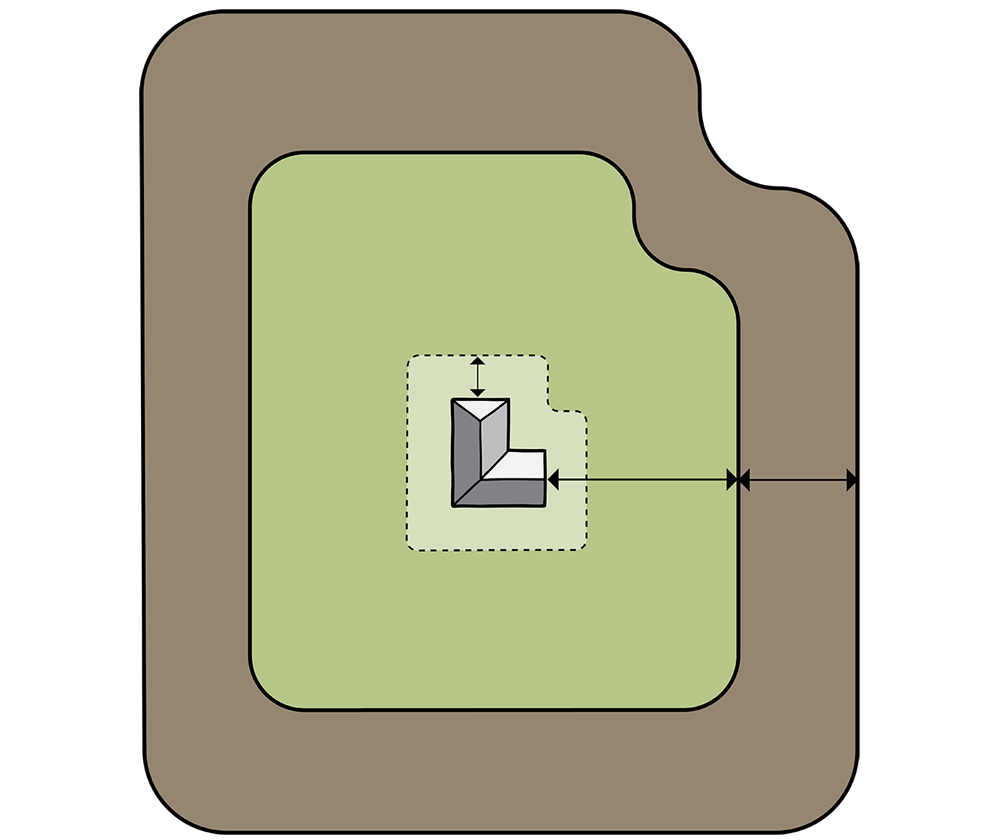
Within 10 metres
Avoid flammable objects near vulnerable parts of the building.
Inner zone
Intensive fuel management reduces radiant heat, eliminates direct flame contact and reduces effects of ember attack.
Outer zone
More moderate vegetation management between the inner zone and the unmanaged vegetation away from the house. Decreases the ground fuel and restricts the fuels available to an approaching fire.
Keep vegetation and flammable materials to a minimum within 10 metres of your home. Manage vegetation in the inner and outer zones.
Trees, shrubs, plants and other flammable materials are fuel for bushfires.
Plants that are near or against your home can catch fire and create enough heat for your home to catch on fire.
Create 'defendable space' around your home, to reduce the effects of radiant heat, ember attack and flames.
‘Defendable space’ refers to a clear area around your home where vegetation is managed and flammable objects are removed, to reduce the risks of bushfire.
Within 10 metres of your home - the inner zone
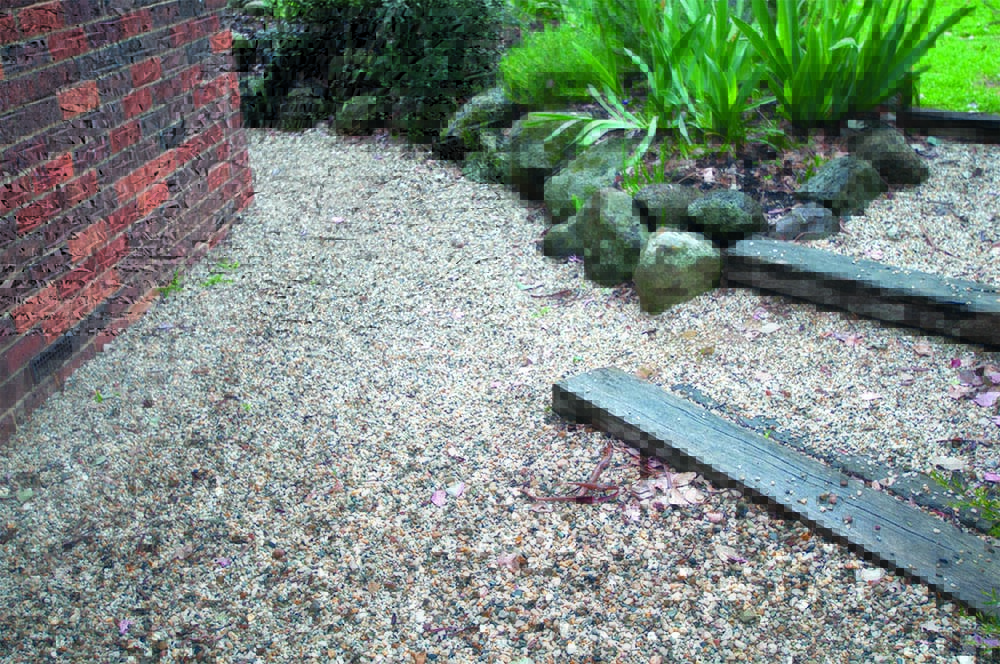 Put paths, driveways and paved areas against your house to act as a fire break.
Keep vegetation to a minimum within 10 metres of your home.
Avoid having:
- plants, organic mulch or fences near windows, decks and eaves
- trees touching or hanging over or close to your home
- shrubs under trees as it can spread fire from the ground up into the trees
The area immediately next to your house is ideal for gravel, paths, driveways, paved areas, pools, ponds and tennis courts. These act as fire breaks, protecting your home from flames and radiant heat.
Smart swap: Use gravel, lava rocks (scoria), pebbles, shells or recycled crushed bricks instead of mulch.
Maintenance:
- Keep area within 10 metres of the house clear of leaves and sticks
- Keep grass short - no more than 5 centimetres tall within 10 metres
Learn more about garden maintenance before and during bushfire season.
Beyond 10 metres - the outer zone
Vegetation doesn't have to be managed as intensively in the space beyond the 10 metre 'inner zone', but it's still important to design and maintain this 'outer zone' in order to slow the movement of fire towards your home.
In the outer zone:
- Keep grass less than 10 centimetres high
- Remove leaf litter and other debris
- Separate trees and shrubs so they don't form a 'continuous canopy'
- Cut back tree branches so they are at least two metres from the ground
- Where trees are touching, make sure only 30 per cent of the tree canopy is overlapping when tree is fully grown
- Avoid putting shrubs under trees
- Shrubs should be in clumps—no more than 10 square metres in size and separated from each other by at least 10 metres
2. Remove flammable objects
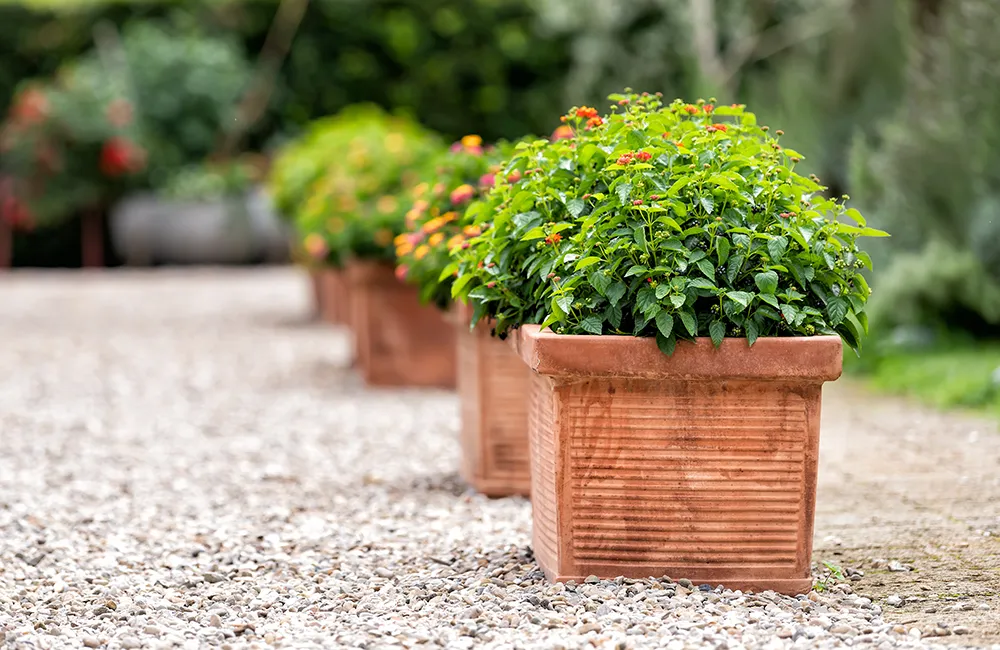 Use terracotta or ceramic pots instead of plastic pots for your plants and move plants away from your home during the hotter months.
A single ember landing on a doormat could lead to your house catching on fire.
Move flammable objects away from your home to give your house the best chance of survival, including:
- outdoor furniture
- plastic plant pots
- BBQs
- gas bottles
- doormats
- woodpiles
- organic mulch
- cars
- caravans
- farm machinery
- sheds
- poison
- flammable liquids
Smart swap: Avoid garden beds under windows. Put plants in terracotta pots that you can move away from your home during bushfire season.
3. Break up vegetation
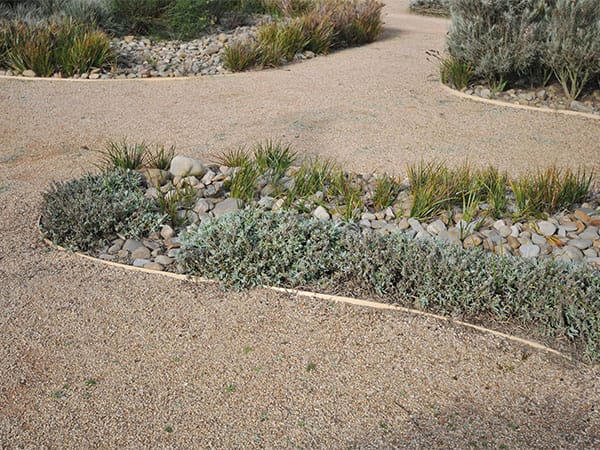 Paths and mown grass can provide separation between garden beds and slow down fire spread. This example is at the Australian Garden, Royal Botanic Gardens, Cranbourne.
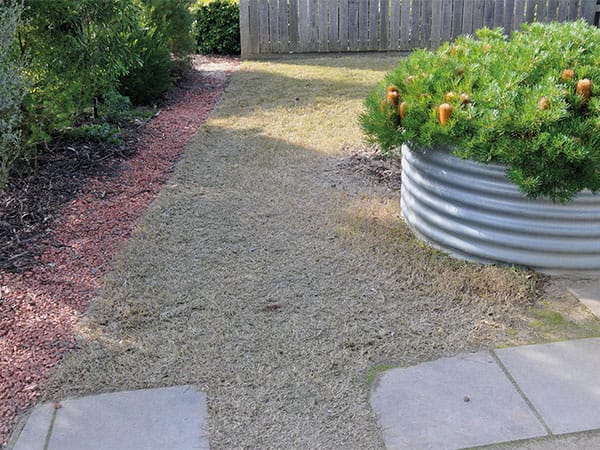 You can create the same effect in your own backyard by keeping grass very short and using pavers or gravel between garden beds.
One way to reduce the speed and heat of a fire is to create spaces without any fuel. If you space out plants, garden beds and tree canopies, the fire can’t spread as easily through your property. Fire needs a path of fuel to travel along.
Break up the 'fuel continuity' of vegetation on your property by separating garden beds with paths made from non-flammable material like clay, concrete, gravel, bricks or pebbles. This can help stop or slow fire moving towards your house in a bushfire.
How to break up vegetation:
- Clump shrubs and trees together in garden beds or plant groupings
- Have gaps between plant groupings and garden beds
- Use gravel paths, non-flammable mulch and mown grass between plant groupings and garden beds to reduce the chance of fire spreading
- Keep branches at least two metres off the ground. This reduces the chance of fire spreading from the ground up into the tree tops.
- Don’t have shrubs under or near trees. They can carry fire into the treetops and keep them burning.
4. Choosing trees
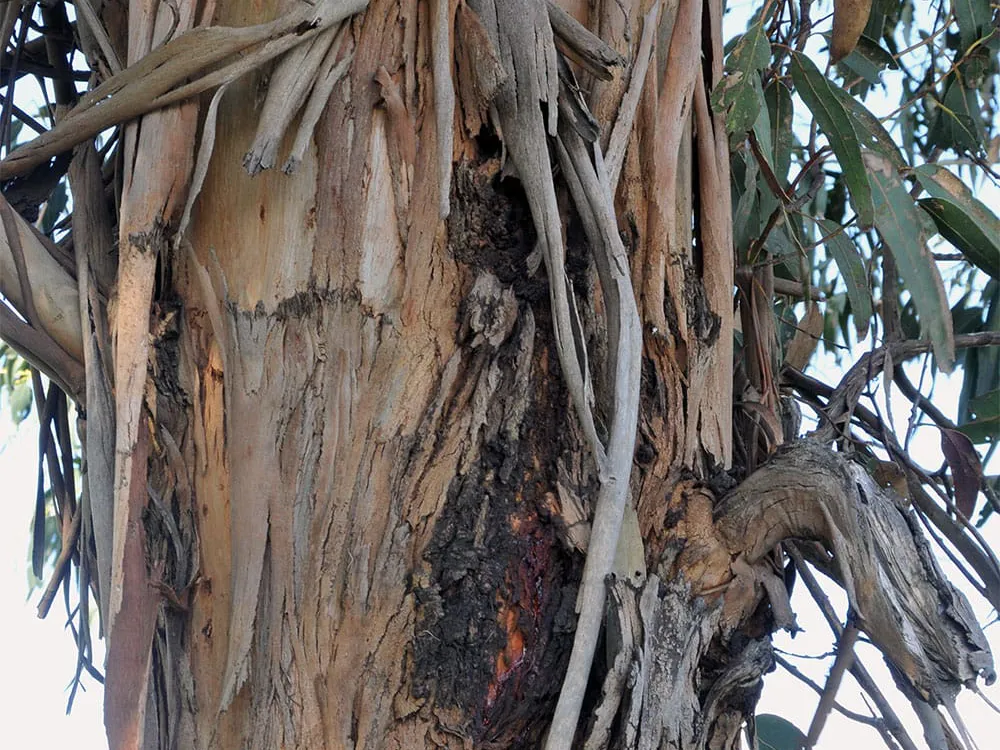 Avoid trees with loose, stringy or ribbon bark as they can increase the fire risk.
The right tree in the right position can be useful in a bushfire. They can reduce wind speed to slow fire spread, stop radiant heat from reaching your home and filter embers so they don't land on your home.
Trees must be carefully selected, maintained and located well away from your home and assets. This is because trees can blow over in strong winds, catch fire, burn through or fall over.
Principles for selecting, locating and maintaining trees for bushfire:
- Avoid trees with loose, stringy or ribbon bark.
- Make sure the tops of trees are at least 2 metres apart.
- Prune branches so they are at least 2 metres off the ground.
- Locate trees well away from your home. Their canopy should cover less than 15% of the 10m zone around your home.
- Don't plant trees closer than 1.5x their mature height near buildings, driveways, water supplies and powerlines. For example, a 5 metre high tree should be 7.5 metres away from buildings.
- Do not plant shrubs under trees, as shrubs can carry fire into tree tops.
- Get rid of dead leaves, bark, branches and leaf litter underneath trees and around the house.
Vegetation shouldn't block access to and from the house and property.
Fire resistant landscaping features
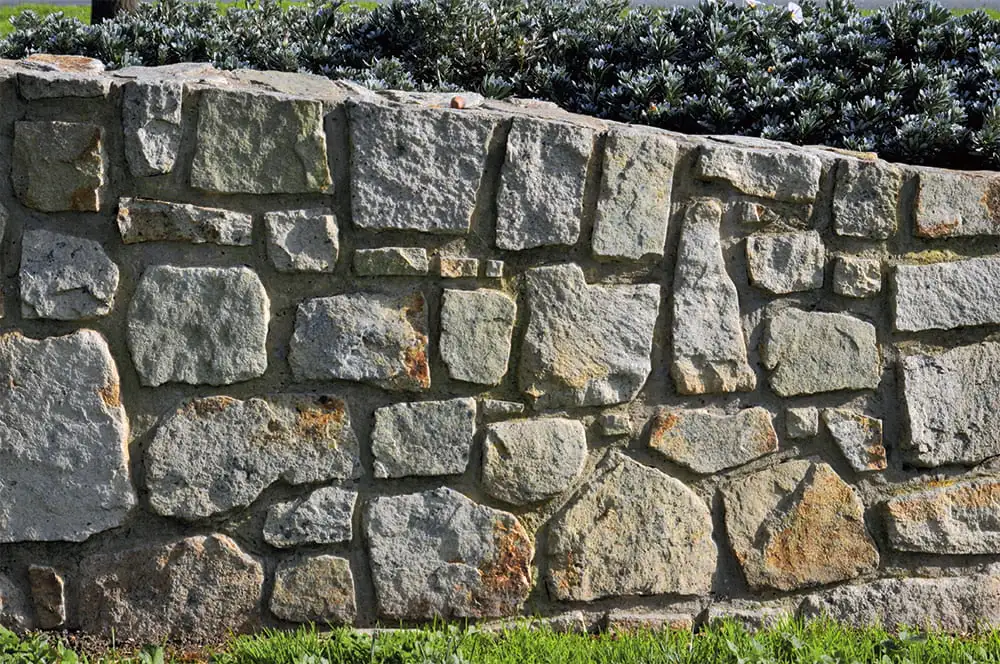 Stone walls are an effective way to reduce the effects of fire around your property.
Use non-combustible landscaping features to reduce wind, radiant heat and embers on your property.
Consider using:
- stone walls and non-combustible fences
- driveways and paths
- brick, earth, stone, concrete and galvanised iron
- pools
- ponds
- maintained lawns
- non-combustible water tanks
Smart swap: use earth, galvanised iron, concrete, brick or stone instead of timber sleepers or other timber products.
Plant selection
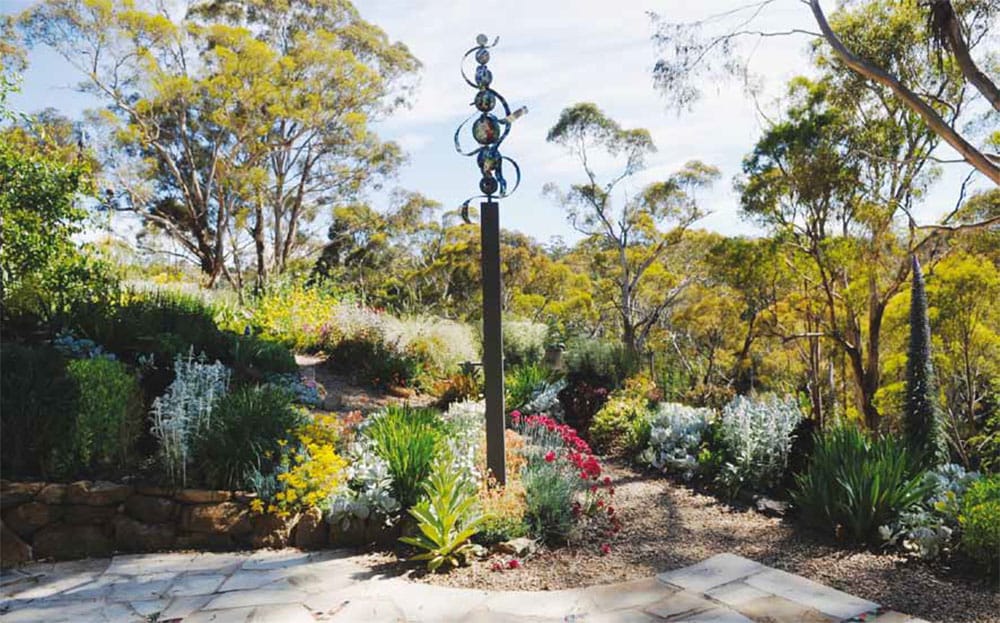 Sedum garden in the Victorian goldfields, designed to manage bushfire risk to the home.
All plants will burn under the right conditions, but some plants are less likely to catch fire than others.
Choosing plants with low flammability and putting them in the right location will help reduce bushfire risk within a garden.
Less flammable plant characteristics:
- Leaves are thinly spread and sparse - able to see through the plant
- Coarse texture - large leaves, can see branches
- Wide, flat and thick leaves
- Soft and fleshy with a high moisture content
- Low oil, wax and resin content
- Bark that isn't papery or loose
- Doesn't shed large amounts of leaves or needles
- Short grasses
- Evergreen trees
Learn more about choosing suitable plants for your garden.
Case Study: Sedum Garden, Goldfields
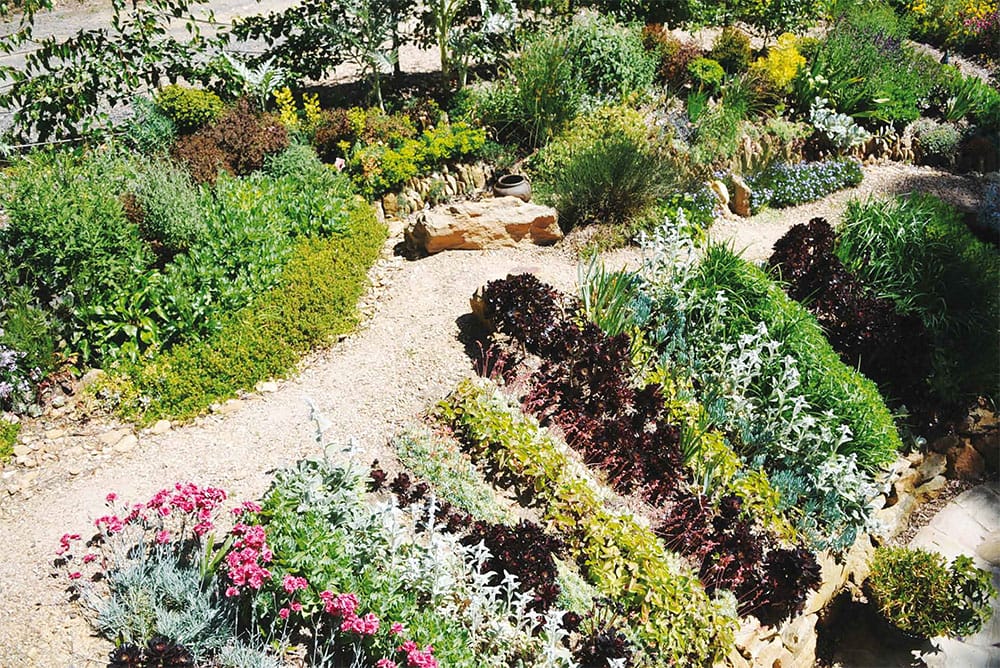 A garden in the Victorian goldfields that has been designed to manage bushfire risk near the home. Plants have been carefully selected and garden beds separated to help slow fire spread.
When the owners were building a new home on their existing block of land, they decided that bushfire risk should be a core element of both house and garden design.
The environment and fire risk
There is a native forest on public land to the north of the site, making the site at high risk of bushfires. These forested areas contain a mix of remnant eucalypts with a dense cover of weeds including gorse, blackberry and broom. In a bushfire, there is potential for a fire in the native forest to spread south under northerly winds down a steep gully and then laterally uphill into Sedum and adjoining properties.
Landscaping goals
The owners prepared a list of landscaping goals based on family needs, research and garden visits.
They wanted the garden to be beautiful, full of colour, affordable, not require watering and cope with extremes of weather and not compromise the bushfire safety of the house.
Preparing the site
The owners cut, raked and dug weeds from the block and from the neighbouring gully with help from the public land manager.
Gypsum and large amounts of mushroom compost were incorporated into the heavy clay soil.
Harvesting local rock
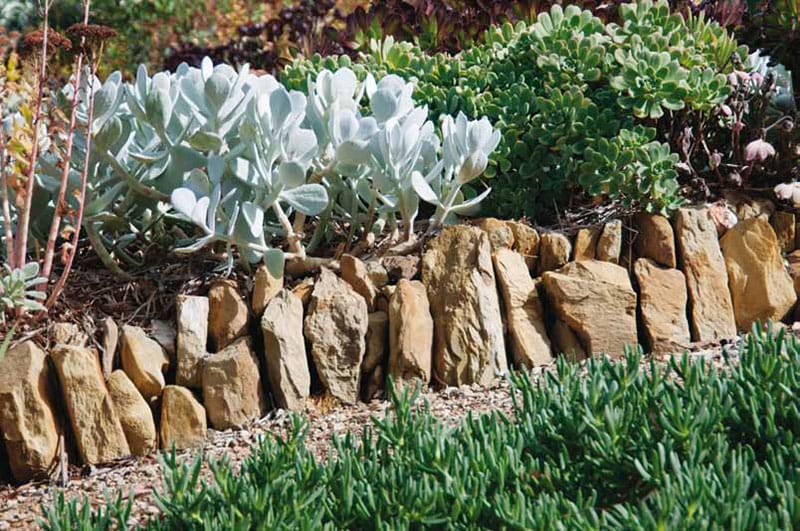 Local stone creates fire resistant garden edging.
While excavating for the house site, all the large rocks were piled up in one accessible place.
Smaller rocks were collected to create retaining walls and garden bed edges. These rocks were also used to construct a dry creek bed to carry rainwater under the deck and through the garden. The creek bed doubles as a path in some places.
River pebbles and a gravel base with tuscan toppings were used for the paths.
Design features
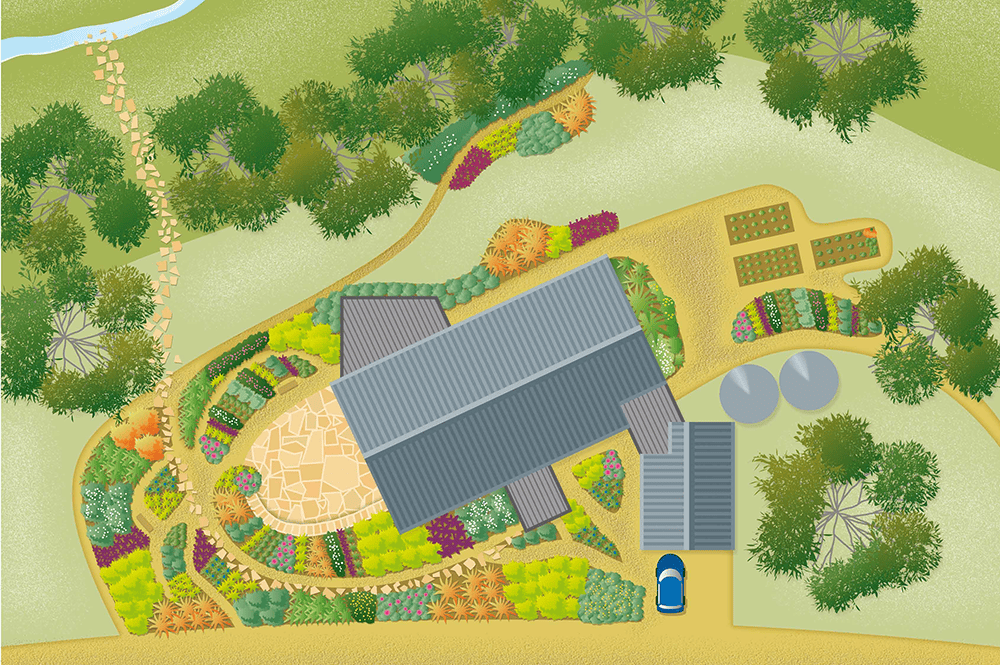
Creek gully
Any fire coming from the direction of the creek would race up the hill to the property.
Lawn
A well watered lawn, kept short, provides separation between the house and the bushfire hazard.
Retained eucalyptus
Native trees retained for their beauty and located well away from the house. Thoughtfully located to screen the house from embers. Bark and leaf litter are managed.
Vegetable garden
Well separated from the house by an expanse of attractive Tuscan toppings.
Garden beds
Kept low to allow light into the house, and reduce bushfire risk. Also limits the possibility of tree branches overhanging the house.
Artificial dry creek bed
Carries rainwater to other parts of the garden and provides a fire break effect.
Deck
Screened to prevent embers from starting a fire underneath.
House
A house built using bushfire resistant materials and techniques, resists embers.
Thoughtful plant selection
Dominated by succulents, herbs and bulbs that have low flammability. Avoid plants that can become stressed during drought, increasing their flammability.
Water tanks
Separate drinking water supply and another reserved for fire fighting. Firefighters can use this even if your plan is to leave early.
Sandstone paving
Separates larger parts of the garden from the house reducing radiant heat and flame contact in the event of a fire.
Garden separation
Flammable garden elements are separated from each other and the house by attractive gravel paths.
Garage
Built to the same standards as the house.
Paths
Strategic placement of attractive Tuscan toppings paths help slow the spread of fire toward the house.
A garden designed with bushfire safety in mind can still be beautiful.
From a bushfire safety perspective, many design features stand out.
- Flammable plants are separated from each other and the house using gravel paths, local stone and paving.
- Low garden and slashed grass perimeter provide excellent separation between the house and flammable vegetation.
- Succulents, herbs and bulbs have been chosen for their low flammability, minimal need for water and ability to withstand drought.
- Native trees such as Manna Gum and Yellow Box have been retained for their beauty and habitat values. They are located well away from the house and the bark and leaf litter are well managed.
- Local stone provides a strong structural element that links all aspects of the garden visually and provides fire resistant edging for garden beds.
- Low lying garden lets light in and to accentuates views, but also reduces bushfire risk.
- Slashed lawn perimeter provides separation between house, garden and nearby forests. It also enhances views from house and reduces weeds.
Case Study: Briars Nursery native garden
CFA worked with the Mornington Peninsula council to redesign the garden at the entrance to the Briars nursery in Mount Martha for bushfire.
The 750-square-metre garden showcases firewise local indigenous plants. It also offers habitat for local wildlife and beautiful, tranquil space for visitors.
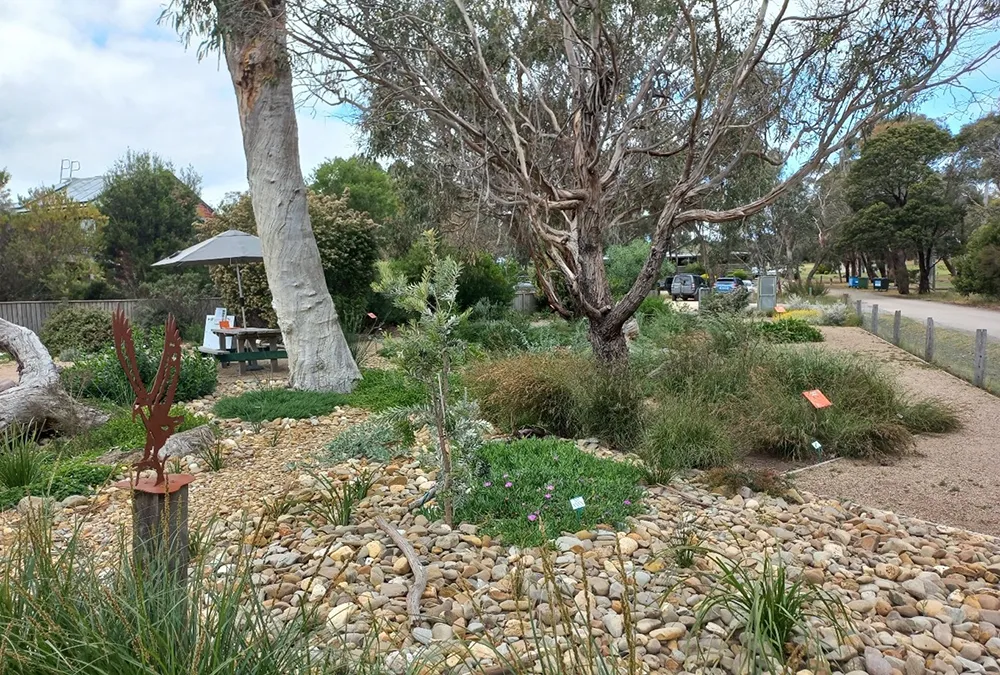 The garden uses rocks, gravel and river stone to break up vegetation.
Design features
Space between vegetation
- a dry creek bed runs through the garden, breaking up vegetation and flammable organic mulch
- paths are made of crushed rock with stone borders provide separation between garden beds
- seating area has non-combustible crushed rock base
Less flammable plants and garden elements near building
Close to a building materials should be less likely to catch fire. This way the building is better protected from an approaching fire:
- rock mulch (can't catch fire) and succulent plants (high moisture content) lower fire risk near building
- natural water run-off area lowers fire risk near building while providing an attractive water feature and frog habitat ('frog bog')
Flammable bark and shrubs removed
- hanging bark on existing stringy and ribbon bark trees is regularly removed - to avoid creating a path for fire to travel up to tree canopy
- ribbon bark on the ground raked up to reduce amount of dry vegetation available for a fire to burn
- shrubs near the building removed to reduce fire risk
Fire wise plants chosen
Plants have:
- high moisture content - slower to burn
- low growth - flame height low so fire doesn't spread to tree tops
- very little build up of highly flammable dead material - less fuel for fire
Feature species: Kangaroo Grass can be burned to remove dead material and kept green over summer.
Wildlife-friendly design
Features have been created to encourage wildlife into the garden:
- large logs provide habitat and protection for wildlife
- water run-off creates bog area for frogs
- ponds provide drinking water for wildlife
Resources
Landscaping for Bushfire: Garden Design and Plant Selection
This downloadable booklet provides further information on garden design and plant selection which can be used for new or existing gardens in high-risk bushfire areas.
Landscaping for Bushfire: Case Study Sedum
Case study about a family in the Victorian Goldfields who used landscaping for bushfire design principles when they built their new home.
Page last updated: Tuesday, 1 September 2026 1:07:31 PM