Summary
- People with additional needs may find it hard to get out of their home safely during a fire.
- Older adults and people with disability are at the highest risk.
- Make a home fire plan for yourself or someone you care about using our Home fire escape plan template (PDF, 355MB).
- Talk to your family, friends, and carers about your plan.
- Make improvements to your home to reduce your risk of fire.
- Learn about fire safety at home with our free online Prevent Detect Escape module.
Plan ahead for a fire in your home
Making a fire escape plan can help you and the people who support you know what to do if a fire starts. You know what you need best, and with the right help, you can identify the fire risks in your home and create a plan that works for you.
You can make your plan by yourself or with a family member, friend, support worker, or health professional who visits you. People with additional needs who live in apartments or big buildings can ask their Building Manager or Owners Corporation for help and information.
Who are people with additional needs?
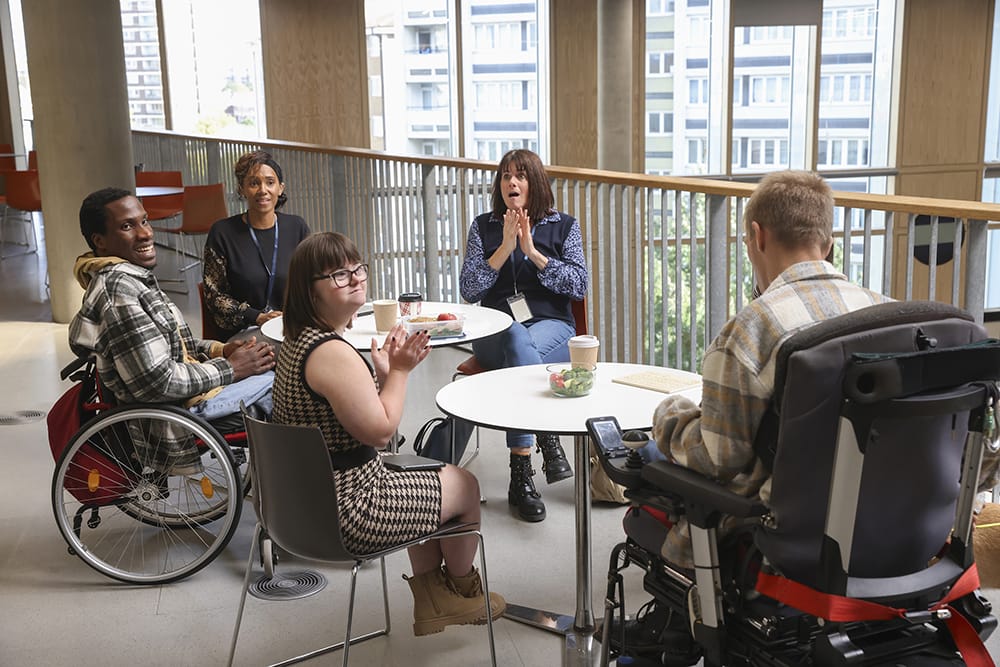
People with additional needs may be:
- people who have a short-term or permanent disability
- people who have a chronic or acute medical condition
- people who are older
- younger children.
Older adults are at the highest risk of injuries or death
Older adults, especially those 65 and older, are at the highest risk of serious injuries or death from home fires. This risk increases with each passing year.
Changes in mobility, hearing, vision, and even mental clarity can make it easier for a fire to start and harder for older adults to escape safely. The best way to prepare is to take action to prevent fires, have working smoke alarms, and know how to escape if there is a fire.
Fires can start at any time, and the smoke, heat, and flames can be deadly. CFA recommends that older people and people living with a disability should not try to fight a fire. Instead, they should get out, stay out, and call Triple Zero (000) for help.
People with disability are also at a higher risk
People with disability are also at a higher risk during home fires for several reasons:
- They can be slow or unable to identify that a fire has started.
- They can be slow or unable to escape to a safe location.
- Emergency plans don’t include enough details about their specific support needs.
- They receive less information and training about fire safety compared to others in the community.
- They are often left out of important decisions about evacuation plans.
A 2019 report on Preventable Residential Fire Fatalities in Australia found that 62% of people who died in house fires between July 2003 and June 2017 had a disability.
Make a plan that works for you
Different people have different support needs. For example, a person who uses a wheelchair or mobility device will have a different home fire plan to someone with intellectual disability or developmental disability.
Think about how easy or hard it is for you to move around your home. You may have made changes to help you get around better, but what would you do if there was a fire?
Make your plan with others
Talk to the people who support you with daily activities to make your home fire plan. Use our home fire escape plan template for people at higher risk (PDF, 355 KB) to help you work out what steps you and others will need to take if there’s a fire in your home.
You can start your home fire evacuation plan with a simple chat about what to do if there's a fire in your home, including how to get out safely and who can help you. It's okay to spread these chats over a few weeks, and doing so may even improve your plan.
Ask the people who support you for help with:
- Making your fire escape plan
- Practising your fire escape plan
- Installing, testing, and maintaining your smoke alarms.
When you finish filling out your plan, make copies and share these with important people in your life.
Know your risk
Some factors that can put older adults at higher risk include:
- Smoking inside their home
- Temporary or permanent disability
- Drinking alcohol or taking medications
- Living alone
- Needing help to live at home
- Clutter and hoarding around the home.
Think about the choices you need to make to stay safe. For example, smoking in bed is dangerous. If you smoke, don't do it when you're in bed. Learn more about smoking and fire safety.
Fires are more likely to start and be more dangerous in a home where there is clutter and hoarding. If you or someone you know has a very cluttered home and finds it impossible to throw things away, they may need some support. Check out our tips for people affected by hoarding.
Install smoke alarms where you sleep
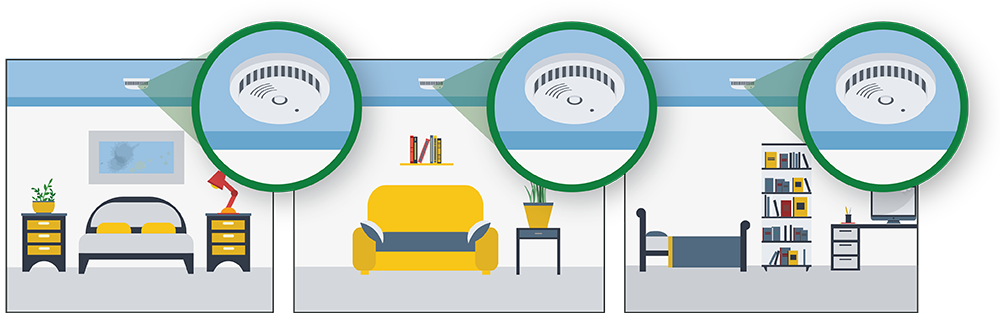 CFA recommends a working smoke alarm in every bedroom and living area.
CFA recommends going beyond what's required by law. The more smoke alarms you have, the sooner you know there's a fire, and the sooner you can escape.
This is because we know that fires in bedrooms are the most deadly—more people die in house fires which start in the bedroom than anywhere else in the home.
We also recommend putting smoke alarms in rooms where you charge devices and equipment, such as the garage.
Only working smoke alarms save lives. If you don't have a working smoke alarm, you are more likely to die in a home fire, so install a smoke alarm in the room where you sleep. And include smoke alarm maintenance in your plan.
Smoke alarms for people with additional needs
Can you hear or respond to a smoke alarm? If you are Deaf, hard of hearing, or sometimes have trouble waking up, there are specialist smoke alarms (including smart devices) that can help.
Learn about different types of smoke alarms and use this guide to selecting a smoke alarm to make sure you buy what's right for you. We recommend interconnected smoke alarms for people with additional needs.
Apply for a Smoke Alarm Subsidy
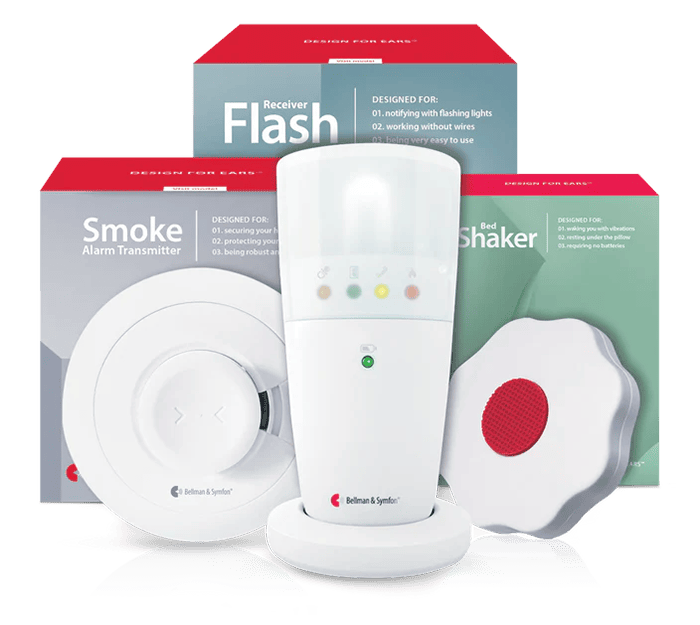
The Victorian government helps pay for specialist smoke alarms for Deaf and hard-of-hearing people. Find out if you are eligible for a Smoke Alarm Subsidy via Expression Australia.
Make it easier for you to escape if you have mobility issues
Do you find it hard to get out of your home quickly? If you move slowly or need help getting out of bed, you can reduce your risk by moving your bedroom to a lower floor or putting in a ramp or handrail. These simple changes can help you escape your home safely when you have only a few minutes or even seconds.
Tell your local firefighters
If you know you cannot leave your home without support and you live alone, discuss your situation with the firefighters at your local fire station. CFA and Fire Rescue Victoria, work together to support people with additional needs. To help find your local fire station contact us by emailing communityprograms@cfa.vic.gov.au.
Jeanette puts home fire safety first
Jeanette, who uses a wheelchair, was alarmed by the high statistics of people with disability dying in house fires. Watch her talk about her experience completing the 'Prevent, Detect, Escape' module and what she learned about fire safety.
This module was created with help from several groups, including the National Disability Services (NDS) and people with disabilities. CFA and FRV recommend that anyone working with clients at home should complete it.
[Prevent, Detect, Escape – Home Fire Safety for people at higher risk]
[Jeanette]
I'm someone who used to be a business woman, a career woman, but more recently I'm much more just mum and grandma. I've been in a wheelchair for eight years, before that i was on crutches for a couple of years but full time in the wheelchair for the last eight years.
[Piano music]
[On screen text]
Almost two thirds of people who die in house fires have a disability
[Jeanette]
Knowing that 62 percent of people who die in a house fire have a disability is really alarming to me. Since I've been aware of the statistics home fire safety has really gone up in my priorities. It's really important to me to be as safe as i can when I'm at home, especially at night when I'm in bed, and i feel that I'm at most risk.
Home fire safety is my responsibility. It's something i can ask for help with. But ultimately it's mine because i live in my home, and i want to live in my home for as long as i can, and i want it to be as safe as i can, and although i can ask for help at the end of the day the buck stops with me.
[Piano music]
[On screen text]
Jeanette recently completed the Prevent Detect Escape online training module
[Jeanette]
I think the new Prevent Detect Escape module will definitely help raise awareness for people who may not have necessarily considered themselves to be at risk. It might actually be an awakening to see that actually anybody can be at risk. But if you have a mobility impairment or something else that makes you more at risk, that you need to take extra protection.
Things that I've put into place to help me and the other people who live in my home be safer, are things like having smoke alarms that work that i test regularly, and also having a ramp. My concern would be that if i woke up in the middle of the night and the alarm was going off, and i had to get out quickly, and i could see there was a fire between me and the door that had the ramp. That i would be panicking and i wouldn't be able to get out, so having more options to get out has been really reassuring for me. I'm able to sleep better at night knowing that if a smoke alarm wakes me up and it's at one end of the house, i can get out of the other end of the house. I've got no intention of being a statistic, so I'm trying to close in all my options and make it easier to get out.
[Piano music]
[On screen text]
The training module is free to access at www.cfa.vic.gov.au/atrisk and www.frv.vic.gov.au/atrisk
Simple ways to make your home safer
One-time actions:
- Replace old or unsafe electrical items in your home.
- Install smoke alarms in every room, especially where you sleep.
Ongoing actions:
Learn how to become more fire safe in your home by checking out our home fire safety checklist.
Get help making your home safer
CFA can help you make your home safer from fires. If you need help with home fire safety, contact us to see if we offer a home visit service in your area.
The Johnson family made their home safer
The Johnson family is working on being safer by practicing fire escape plans with their daughter Amanda, who has spina bifida.
The Johnsons worked with CFA to add more smoke alarms and set up a special alert for emergency responders. This alert tells them that someone in the house might need help getting out and shows them where that person is located. Hear the Johnson family describe the process.
[Johnsons’ Story - Improving Home Fire Safety, Benalla 2023]
[Lyn Johnson - Benella Resident]
Amanda was born with spina bifida 34 years ago, and we didn't know until she was actually born that she was going to have a disability. We were told that she'd never walk, she'd never be able to feed herself, go to the toilet, anything. But she has reached a lot of milestones, so that was one plus. And as a baby she was just like any normal baby because she didn't have to do anything, and as she grew, she was still in the pusher and a pram. Was only until she got a bit older and she went into a wheelchair, and a lot of people didn't even know that she had a disability.
She's changed over probably the last six years. She's bedridden a lot to what she was, because she had respiratory failure going back in 2016. And that was a really tough time for not just Amanda, but for everybody in the family. We had to move down to Melbourne for three months while she was in hospital. We stayed with our other daughter and that is the main, her main, yeah is Spina bifida, which, you know, affects everyone different. But she never could walk and she never will walk.
[On screen text]
National house fire fatality research has highlighted that people with a disability are at higher risk in a house fire.
[Maryanne Eagan - CFA Community Engagement]
So this year I was able to go and meet with the Johnson family because they had asked CFA for help in working on a fire escape plan. They realised that if anything happened in the house with regards to fire that they needed her to be able to escape. Her bedroom was at the back of the house, and the ramps that she uses in her wheelchair, are at the side of the house or at the front of the house.
[Jamie Beaton - Captain, Benalla Fire Brigade]
I first met the Johnsons through the Community Safety Coordinator Andy Arnold from District 23 where he contacted me, and asked me if I'd go around there with him and put up some smoke detectors. Was it an immense help to me? It was absolutely sensational. At least I had an understanding of why we were doing this, why we were putting extra smoke detectors in. But actually getting to meet the Johnsons and actually seeing the layout out of the house, was absolutely sensational.
[On screen text]
A response notification was added to this address. If there is an emergency call received, crews responding to this address are alerted that someone in the house cannot self-evacuate and where they are located.
[Jamie Beaton)
So if there is any incident that happens to that property, there's a notice that comes up on our pagers that's saying there is a lady in that house with a disability and where she's located.
[On screen text]
Home fire escape plan and practice
[Lyn Johnson]
It's not just go in and get Amanda, grab Amanda, because that can never happen. She's got to be hoist up with a hoist. So we've got to have the slings under and then a hoist. So we've been practicing how long it takes to get her up. Twice this week, one took us eight minutes and another one took us six. But we'll keep doing it a couple times a week to see how we go by time. With Amanda's wheelchair, we normally keep it out in the kitchen. But now we are keeping it in Amanda's bathroom so that's already up there if anything happened during the night. We've only got to bring it out of the bathroom as where before we'd have to come down to the kitchen and we might not be able to get the wheelchair and then we'd have no hope of getting her up.
[Maryanne Eagan]
Home Fire Escape Plans are a critical element of our work. At night-time, if the fire happens at night-time when it's dark, how they're going to get out of the house, the need to have two routes of escape from any room and that can often present a difficulty if there's only one door and a window.
[On screen text]
Improving home fire safety
[Wayne Johnson - Benella Resident]
The process with the CFA has been absolutely fantastic. Since they first entered our house, they showed us a lot of things that we didn't know about. The plans, the equipment we need for the house to help us be a lot safer. And we just can't, can't fault it, it's just been a 100%. Because she is in a hospital type of bed and to exit her out the house we have to put her into a wheelchair, we wanted to take out her windows. She's got big bay windows. We're gonna take the windows out and knock the walls out and put a exit there with a sliding door with a window and a ramp to run down beside the house.
[Lyn Johnson]
We never had a fire plan. We didn't even think that we needed one, now we've got that in place. We've learned a lot, since we got the CFA onboard, things that we just took for granted because everyone thinks the fire will never happen to them, and we'll just keep trying to improve it. We will get guided by the CFA and that's what we'll do.
Explore
Explore more content to support you or the person you care for.
Page last updated: Thursday, 17 September 2026 3:27:17 PM