Summary
- Use lush green groundcovers with low flammability near trees.
- Choose low flammability shrubs and keep them well pruned.
- Keep lawns around house short and well-irrigated over summer.
- Use stone, steel and other non-combustible materials for retaining walls.
- Move flammable objects and structures like sheds, woodpiles and washing lines away from the house.
- Keep branches pruned and remove hanging bark from trees.
Factors to consider in a hills garden
Garden design is especially important in these locations.
Property access
Dual-access driveways and multiple entry points should be considered when designing your garden. This will improve emergency vehicle access.
Highly flammable vegetation nearby
Hill gardens can be at a high risk of bushfire due to the amount and type of plants, shrubs and trees nearby. Many hills gardens will be next to native forests or highly flammable tall trees.
Landscaping materials
Flammability (how likely something is to catch fire) should be taken into account when planning which materials to use in your garden.
- Brick, stone, steel and concrete materials are much better choices than timber for retaining walls and garden edging.
- Use gravel products for pathways and weed suppression instead of organic mulch, which can create a path for fire to burn along.
- Replace timber fences with a non-combustible option.
Plant location and selection
Locating plants and trees away from the house and ensuring there are no overhanging branches is key. If you have a lawn, it should be irrigated and green. Plants should be chosen for their low flammability.
Garden maintenance
Regular garden maintenance is key to reducing fire risk in a hills garden. This is because these areas produce huge amounts of plant growth, leaf litter, bark and dead leaves which are all highly flammable.
Throughout the year, but especially during the summer months, care needs to be taken to:
- remove bark hanging from trees
- remove leaf and bark litter on the ground
- prune trees at least 2 metres from the ground.
Garden design principles
Below are the general principles to follow when designing a garden for bushfire:
1. Reduce vegetation in the area immediately around your home (create defendable space)
2. Remove flammable objects near your home
3. Break up vegetation with gravel, paths or grass between garden beds (create fuel breaks)
4. Carefully select, locate and maintain trees to be useful in a bushfire
Learn more about designing a garden for bushfire.
Model hills garden design
Key principles for hills garden design:
- Avoid planting shrubs under trees as they can help fire move up into the tree and make it more intense. Instead, use groundcovers with low flammability and low-growing succulents under trees. This provides good separation between vegetation on the ground and the tree canopy.
- Keep plants away from windows, doors and other parts of the building where embers could get in. Use paving, gravel or stone around the house instead to create a non-flammable barrier.
- Use irrigated lawn, gravel or paving to separation garden beds or groups of shrubs. This breaks up the vegetation within the garden to prevent 'fuel corridors' which lead towards your home.
- Keep veggie gardens well watered and avoid loose, dry mulch.
- Remove remnant indigenous trees (such as Mountain Ash) within 10 metres of the house, but always check with council first. Clump trees in clusters. Keep them pruned and don't let the branches overhang your roofline.
- Locate landscaping features with low flammability like pools, tennis courts or well-maintained lawn between the house and the most likely direction of a bushfire.
Example: Hills model garden
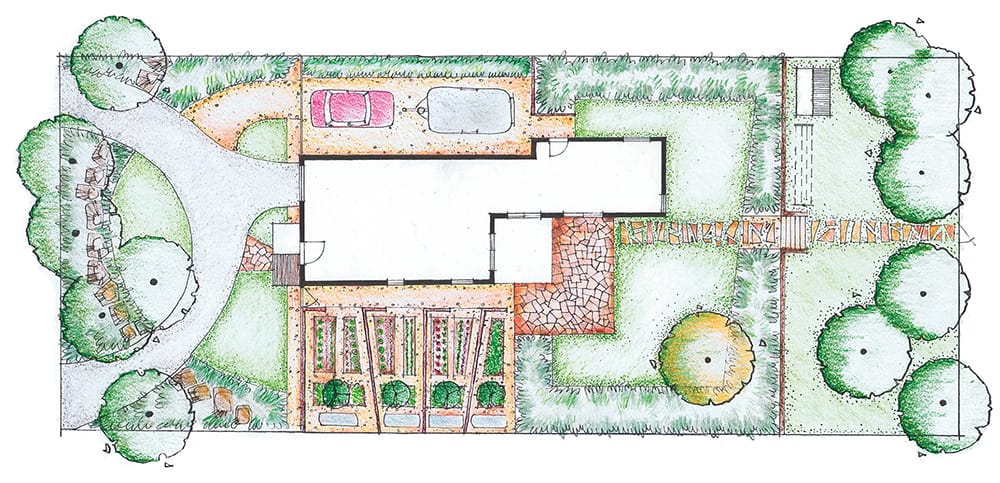
This garden is located within steeply sloping, dense Mountain Ash forest, typical of areas including the Dandenongs, and the Macedon and Kinglake Ranges.
Eucalypt trees.
Eucalypts have been removed within 10 metres of the house and branches are not overhanging the house.
Bark and leaf litter
Hanging bark and litter from trees is removed from surrounding plants and the ground during the summer months to help stop fire spreading into the trees.
Ground covers
The vegetation beneath the trees are herbaceous ground covers. They are low lying and have dense, lush summer growth which makes them slower to burn and less likely to spread fire up the trees. Carpet Bugle, Lenten Rose, Bearded Iris, Mondo Grass and Lambs Ears.
Stone retaining walls
Stone has been used in retaining walls to create terracing on the western side of the house. Stone won't catch fire like timber would and the terracing makes the slope less steep.
Vegetable garden
A vegetable garden and orchard have been planted in a series of terraces between the forest and the house. They are well-watered over summer using steel water tanks located nearby. They help create separation between the house and an oncoming fire from the nearby forest.
Lawn
The well maintained lawn helps create 'defendable space' with low vegetation around the home. It is cut short and watered during summer.
Fire direction
A fire would most likely come from this direction.
Vehicle storage
On the eastern side of the house is a gravel area used for vehicle storage when it's not bushfire season. The caravan is moved off property during summer.
Clothes line and shed.
The clothes line and wood shed are kept well away from the house as they can catch fire easily.
Feature tree
There is a small feature tree in the main lawn. It has smooth bark, an open habit and doesn't produce much leaf litter over summer. It can help catch embers before they reach the house. Prunus persica (Ironwood).
Herbaceous plants
Herbaceous plants are used in the front garden to provide ground cover. They are shade tolerant perennials and don't grow higher than 30 centimetres. Their leaves have a high mositure content, making them slower to burn. Carpet Bugle, Wood Anemone, Lenten Rose, Bearded Iris, Mondo Grass, Turf Lily and Lambs Ears.
Succulents
Low-growing succulents with a high moisture content are planted in beds on the eastern side of the house. Spider Aloe, Pigs Ears, Pussy Ears and Blue Chalk Sticks.
Hotspots on the bird's eye view of the property highlight the fire safe design features of this property. A fire would most likely come from the bottom, left corner of the picture.
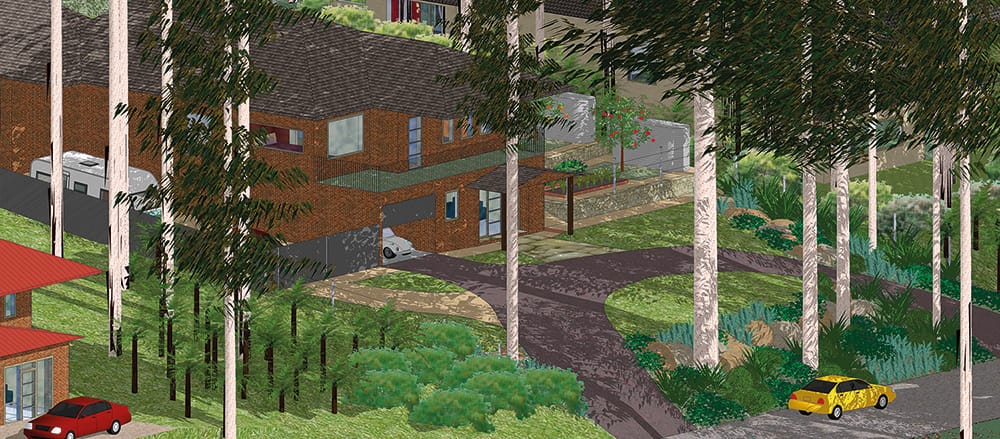
The same garden is seen below, looking from the west toward the house. A fire would most likely come from the right side of this picture.
Eucalypt trees
Eucalypts have been removed within 10 metres of the house and branches are not overhanging the house.
Bark and leaf litter
Hanging bark and litter from trees is removed from surrounding plants and the ground during the summer months to help stop fire spreading into the trees.
Herbaceous plants
Herbaceous plants are used in the front garden to provide ground cover. They are shade tolerant perennials and don't grow higher than 30 centimetres. Their leaves have a high moisture content, making them slower to burn. Carpet Bugle, Wood Anemone, Lenten Rose, Bearded Iris, Mondo Grass, Turf Lily and Lambs Ears.
Ground covers
The vegetation beneath the trees are herbaceous ground covers. They are low lying and have dense, lush summer growth which makes them slower to burn and less likely to spread fire up the trees. Carpet Bugle, Lenten Rose, Bearded Iris, Mondo Grass and Lambs Ears.
Stone retaining walls
Stone has been used in retaining walls to create terracing on the western side of the house. Stone won't catch fire like timber would and the terracing makes the slope less steep.
Vegetable garden
A vegetable garden and orchard have been planted in a series of terraces between the forest and the house. They are well-watered over summer using steel water tanks located nearby. They help create separation between the house and an oncoming fire from the nearby forest.
Trees
The indigenous Mountain Ash trees have been kept when located more than 10 metres away from the house. Others have been removed to reduce the fire risk to the home.
Hanging bark is regularly removed from the tree and garden during summer, along with leaf litter and branches. This helps stop fire spreading into the tree tops.
Shrubs
Shade tolerant, low flammability evergreen shrubs are planted in groups on the boundary of the garden's middle terrace. They are pruned regularly to maintain their height below 2 metres. Varieties include Sasanqua Camellia, Common Daphne, Persian Shield and Davis Viburnum.
Vegetation around trees
Herbaceous plants like Carpet Bugle, Lambs Ears, Lenten Rose and Mondo Grass have been planted as ground cover. They've been chosen for their high moisture content, which makes them slower to catch on fire. They also don't grow very high.
Orchard and veggie patch
Veggie patches and fruit trees (lemon, mandarin, plum and apple) are located between the forest beyond the property and the house. They have been included in the 10 m space around the house because of their low flammability. They will be kept well-watered over summer and increase the space between the house and a potential fire threat.
Steel water tanks
Steel water tanks are located on the edge of the property in front of the fruit trees and veggie garden, acting as another barrier separating the house from potential fire threat from the local forest.
Stone landscaping
Stones have been used to create retaining walls and a paved area, instead of more flammable materials like timber.
Gravel
Eastern side of the house is maintained with gravel and used as a storage area for a caravan. The caravan is moved off the property in summer.
Lawn
The lawn (Buffalo grass) will be well-maintained, kept short and irrigated over summer, to help create a low vegetation area around the house.
Feature tree
A feature tree in the main lawn has been chosen for its low flammability. The Persian Ironwood has smooth bark, open, spreading branches and leaves, and doesn't drop many leaves over summer.
Resources
Hills Garden - Landscaping for bushfire
Download a PDF version of the Model Hills Garden Design, including species names and locations.
Landscaping for Bushfire: Garden Design and Plant Selection
This downloadable booklet provides further information on garden design and plant selection which can be used for new or existing gardens in high-risk bushfire areas.
Page last updated: Thursday, 3 September 2026 5:05:23 PM