Summary
- Event organisers need to factor bushfire risk into their planning
- CFA provides guidelines about how to prepare a planning permit application to address bushfire risk.
- The best way to minimise bushfire risk is hold an event outside of the Fire Danger Period.
- CFA recommends choosing a location that does not have an identified bushfire risk.
- If the location does have bushfire risk, there are steps you must take, outlined on this page.
Planning an event in country Victoria
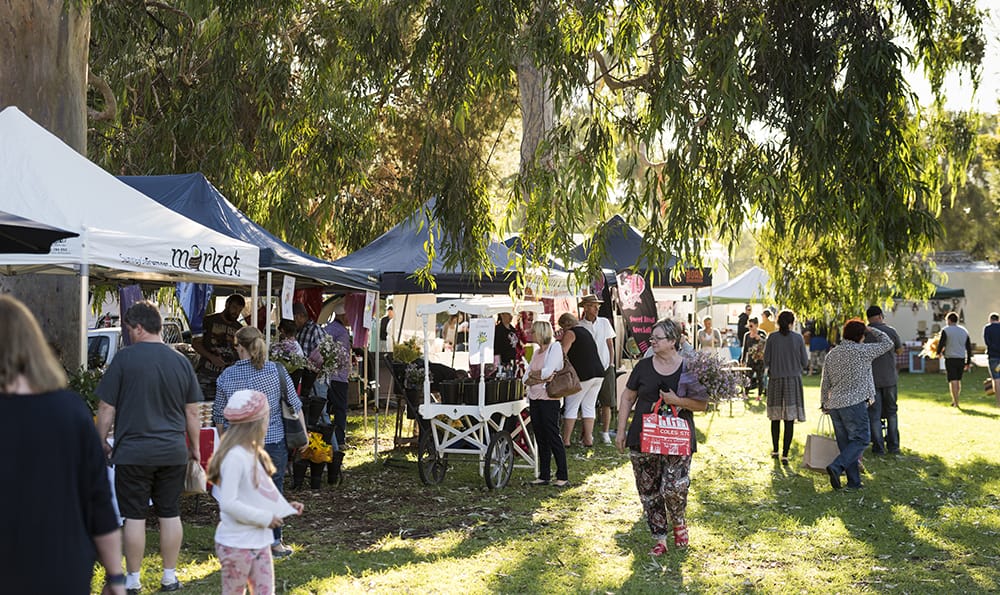 A busy farmer's market. Planning permits are normally required to hold events in areas of high bushfire risk. Credit: Tourism Victoria.
- Victoria is proud to be the home of incredible music festivals, sports and major events. But it is also one of the most likely places in the world for bushfires to occur. It's critical that events are carefully planned, especially in areas at risk of bushfire.
- Check with the relevant local council early in the planning process whether your event requires a planning permit.
- If you are planning an event in Victoria, you should refer to the Victorian Guidelines for Planning Safe and Public Events for overall safety guidelines.
CFA's role in planning permit applications
- Councils often refer planning permit applications to CFA.
- In some instances, councils are required to seek CFA’s comment on planning permit applications (a Section 55 referral pursuant to the Planning & Environment Act 1987).
- Other times councils may choose to seek CFA’s comment on those applications (a Section 52 referral pursuant to the Planning & Environment Act 1987).
- As a referral authority, CFA can object, consent to, or give conditional consent to council issuing a permit for an event.
CFA's guidelines for planning permit applications for events
- CFA has developed Planning Permit Applications for Events in Areas at Risk of Bushfire (PDF 584.2KB) guidelines for event organisers and councils seeking to manage bushfire risk and meet planning scheme.
- CFA may object to a proposal that doesn't comply with these guidelines, preventing an event going ahead. Make sure you understand CFA's guidelines and plan a safe event.
- A copy of CFA's guidelines can be found below.
1. Consider holding your event outside the Fire Danger Period
Bushfire risk can be significantly reduced by running an outdoor event when bushfires are unlikely to occur. However, we understand this is not always possible for events that take place on a particular date, like New Years Eve.
The Fire Danger Period is a time of year when fires are more likely to start and spread. It varies between different areas of Victoria, but typically runs from November to March, although it can start earlier and finish later depending on the weather and climate.
Not having an event over the warmer months during the Fire Danger Period is the most impactful way to minimise bushfire risk at an event.
Application impact
If you hold your event outside the Fire Danger Period, it's likely you won't need to consult any further with CFA about bushfire risk.
However, for events involving large numbers of people, consultation with various emergency services, including CFA might still be required.
2. Choose a location without an identified bushfire risk
If the event has to take place over the warmer months in the Fire Danger Period, try and choose a location without an identified bushfire risk.
Generate a free online Planning Property Report through Planning Victoria to find out if the property is covered by an identified bushfire risk.
If the Planning Property Report shows the property is in a Bushfire Prone Area (BPA) or in the Bushfire Management Overlay (BMO), the location has an identified bushfire risk. We don't recommend holding an event there.
If you continue applying for a planning permit, you will need to take a number of steps to manage the risk, which are outlined below.
3. Conduct a Bushfire Hazard Landscape Assessment
If your event is taking place at a location with identified bushfire risk (in a BPA or in the BMO), further assessment needs to be done to determine whether the site is too risky to host an event over the warmer months.
A Bushfire Hazard Landscape Assessment should be done to assess the potential scale and destructive power of a bushfire based on the broader surrounding landscape.
The Assessment process is outlined in the Department of Land, Water and Planning's Planning Permit Applications Bushfire Management Overlay Technical Guide (PDF 2.0).
CFA is unlikely to support events where:
- the Bushfire Hazard Landscape Assessment identifies the event site is within a
- Broader Landscape Type Three
- Broader Landscape Type Four
- it is taking place in a rural or remote area where getting in and out of the event (access) is difficult.
4. Provide suitable 'shelter-in-place' assembly areas
If your location is assessed as Broader Landscape Type One or Two, you will need to provide a place for attendees to shelter in a bushfire.
It's difficult to evacuate large numbers of people from an event, especially when they are under the influence of alcohol or other drugs, or have complex needs. This is why it's vital to provide a place to shelter.
Shelter-in-place requirements
A suitable place of shelter must be an emergency assembly area that can safely accommodate the number of attendees, allowing for 1.5m2 per person.
Neighbourhood Safer Places - Assessment Guidelines (PDF 285.4KB) provide a useful benchmark for establishing a suitable shelter-in-place.
If there isn't a shelter available onsite, the event must be next to to an urban, commercial or residential area large enough to house all attendees in the event of an emergency.
Events are unlikely to be supported by CFA if event organisers can't provide one of the above shelter-in-place options.
5. Have a trigger in place to cancel or postpone the event
If a suitable place of shelter can be provided, there needs to be a trigger point when the event is cancelled or postponed due to bushfire risk.
Events are unlikely to be supported by CFA if event organisers can't provide one of the above shelter-in-place options.
There should be clear actions linked to each rating.
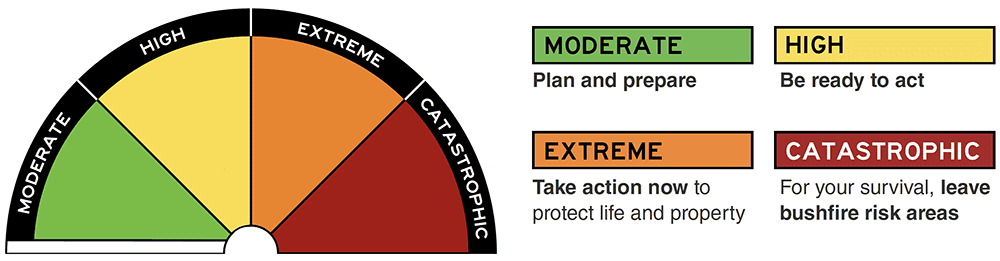 Fire danger ratings help you decide what actions to take to protect your customers and staff.
The Victorian Guidelines for Planning Safe and Public Events (PDF 3.93 MB) recommend that event organisers change, cancel or delay their events on Catastrophic Fire Danger Rating days.
Event organisers may consider using the Fire Behaviour Index (FBI) instead of the Fire Danger Rating system. Under this scale, when an FBI of greater than 75 is forecast, the event should be postponed, cancelled or delayed. Visit the Bureau of Meteorology to see the Fire Behaviour Index.
CFA is likely to object to an event planned to go ahead on a day of Catastrophic Fire Danger Rating or when the Fire Behaviour Index is expected to be greater than 75.
6. Develop an Emergency Management Plan and Fire Management Plan
A full risk assessment should be conducted by a suitably qualified professional. The risk assessment should inform the development of an Emergency Management Plan.
Use the steps in the Victorian Guidelines for Planning Safe and Public Events (PDF 3.93 MB) to develop your Emergency Management Plan.
Develop a Fire Management Plan
Prepare a separate Fire Management Plan which includes:
- A scale or dimensioned map of the event site (with grid reference system). This should show where all key structures, locations and uses within the event will be, for example, carpark areas, camping areas, stages, emergency assembly areas and more.
- Processes and procedures for monitoring the Fire Danger Ratings and or Fire Behaviour Index: who, when and how will they be monitored?
- Clear triggers for cancelation or postponement of the event based on forecast Fire Danger Ratings or Fire Behaviour Index value.
- details of any private firefighting services that may be provided during the event. The provision of such services should be escalated in line with the Fire Danger Ratings and include bump in and out times.
- Clear triggers and procedures for:
- evacuation of the site in the event of a bushfire (if safe to do so)
- sheltering in place during the event (when evacuation is not safe).
- A map and details on any proposed vegetation (fuel) management, such as the areas where grass will be mown, branches and other 'elevated fuels' reduced and when those actions will occur. Fuel management should include ‘buffer’ areas around the site, and not just management of the event site itself.
- A map showing all areas set aside for emergency vehicle access. This should allow:
- full perimeter emergency vehicle access around the event site
- entry to the event whilst allowing for attendees to exit at the same time
- A map that details any existing or proposed sources of firefighting water such as water tanks or dams.
- A map that details the location of all firefighting infrastructure, such as fire extinguisher banks and other equipment.
- Details on any other controls or treatments that were identified in the risk assessment.
7. Apply for a planning permit
If required, a planning permit application should be lodged with the relevant local council.
If CFA is asked to provide comment on that planning permit application, we will require the following:
- A copy of the risk assessment that has been conducted by a suitably qualified professional that adequately considers the likelihood and consequences of a bushfire.
- A response to clause 13.02-1S of the relevant planning scheme and a copy of the Bushfire Hazard Landscape Assessment.
- A scale or dimensioned map of the event site.
- A copy of the event's Emergency Management Plan.
- A copy of the event's Fire Management Plan (containing the information in Step 6 of this document).
CFA can respond to your application with:
- consent (no additional actions required)
- conditional consent (additional actions or amendments required)
- objection
Should CFA consent to the application, this is likely to be conditional on a number of actions occurring before the event.
Make sure you apply early enough for your event permit so that there is enough time to make changes to your plan and complete any additional work if required.
CFA recognises that planning an event is a complex a task and many details are likely to be changed between the time a planning permit application is applied lodged and closer to the event date. CFA’s standard conditions are designed to setup a subsequent consultation and approval process so that minor changes can be resolved following the decision on a planning permit application.
Having said that, the quality of the information submitted with the planning permit application must provide CFA with an adequate level of confidence that the event can be conducted safely.
Need more information?
If you have any questions regarding a proposed event, please contact the relevant CFA Manager Community Safety within the region where the event is planned to be held. Contact details found here.
We also recommend speaking to the relevant local council for more information about applying for an event permit.
Resources
Planning Permit Application Guidelines for Events in Areas at Risk of Bushfire
These guidelines are designed to help event organisers when planning an event that may be at risk of bushfire, and know what to do before submitting their planning permit application.
Page last updated: Thursday, 17 September 2026 4:37:06 PM