Summary
- Fires are more deadly when they happen in caravans than other types of accommodation.
- Fire can spread quickly in a caravan.
- Caravans must have smoke alarms and fire extinguishers.
- Cook food away from anything that can catch on fire.
- If using portable BBQs or gas stoves outside, cook on flat, stable ground.
- Don't use portable heaters or candles in caravans.
- Store LPG cylinders safely and check for leaks and loose connections.
Caravan fires can be deadly
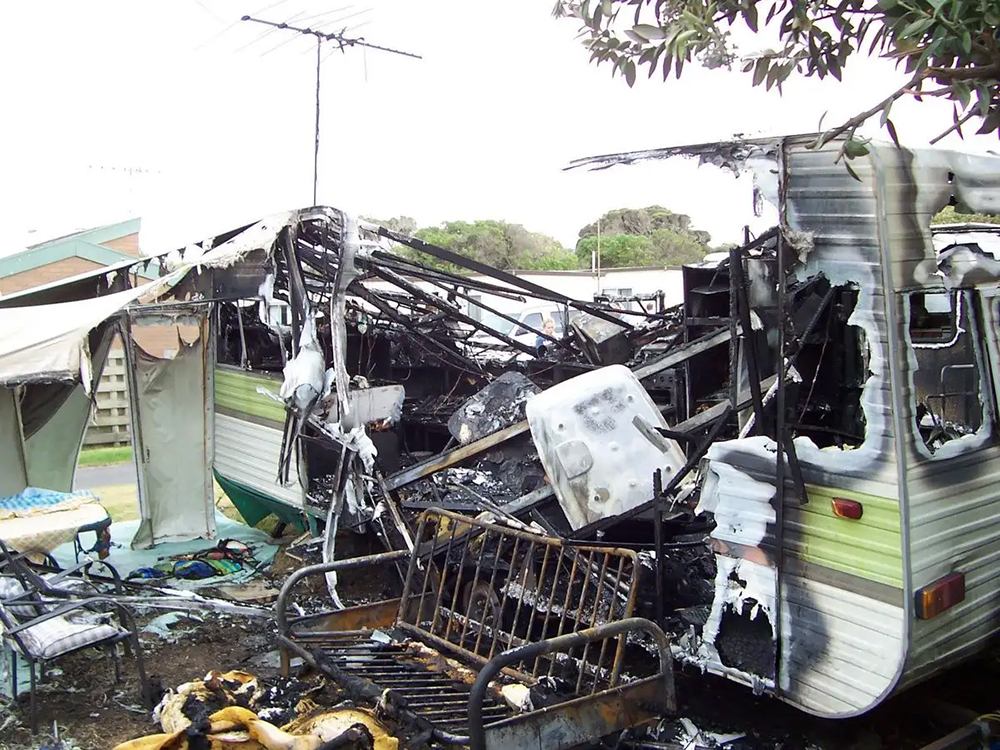
Caravans, camper vans, motor homes and camper trailers are small, enclosed spaces made from lightweight materials. This means a fire can start and spread more quickly than in a building.
The size and layout of caravans also means people can become trapped by fire.
Learn common fire hazards and how to prevent fires in your caravan or motorhome below.
Common fire hazards in caravans
Gas cylinders
LP gas is highly flammable and ignites easily when it comes in contact with flames or sparks. If gas cylinders are exposed to fire, they can explode.
Safety tips for LPG
- Secure storage - make sure LPG cylinders are secured correctly to your caravan.
- Hoses and connections
- Turn on safely - check that all appliance valves are in the off position before turning on the main gas valve.
- Turn off safely - closing the valve on the gas cylinder before you turn it off at the appliance. This stops gas becoming stuck in the hoses.
- Check for leaks
- Install gas detectors - these are placed at floor level as gas is heavier than air and gets trapped in low areas.
If you have a gas leak, close the valve on the cylinder and open caravan windows and doors until the air is clear.
Cooking safely inside your caravan
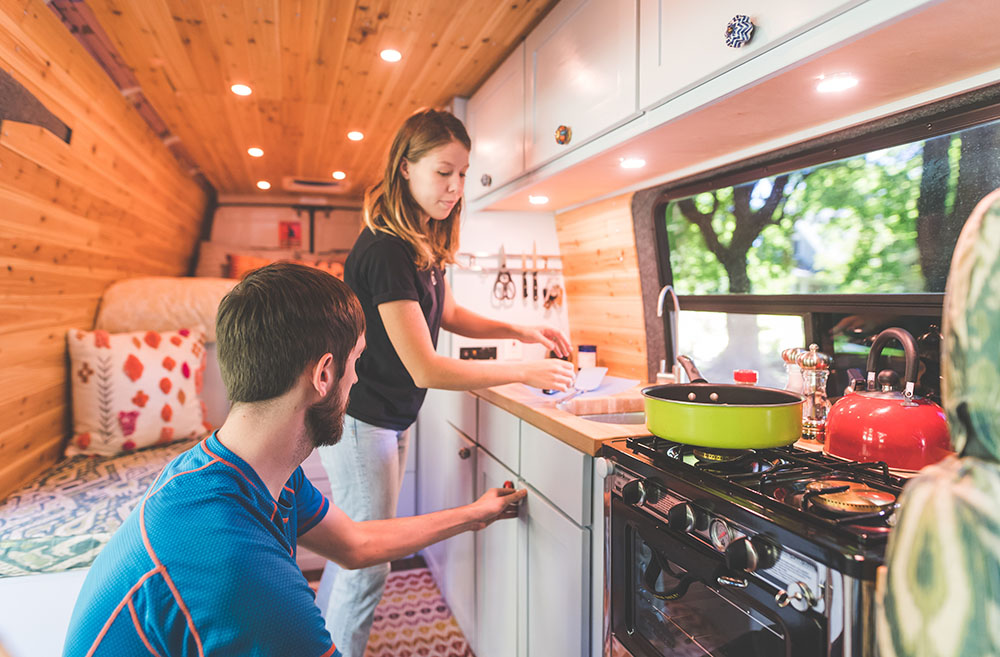
Cooking areas in caravans are small and crowded, meaning fires can spread more easily.
Prevent fires starting while cooking in your caravan by following these tips:
- Always watch what you're cooking. Don't get distracted.
- Keep curtains, tea towels, paper towel and other flammable items away from cooking areas as they can catch fire easily.
- Clean cooking surfaces and don't let grease build up.
- Be careful when handling hot food and drink. Accidents can happen more easily in small spaces and cause burns and scalds.
- Only use portable cooking equipment outdoors.
- Make sure you have a fire blanket. Mount the fire blanket on the wall or cupboard door near kitchen door.
Cooking outside
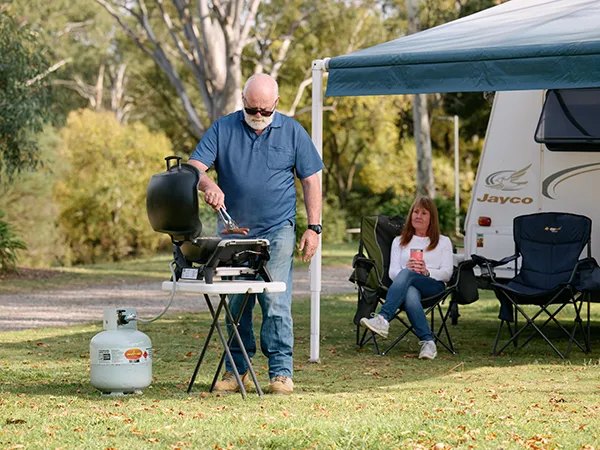 Move your BBQ and cook outside the awning or annex of your caravan.
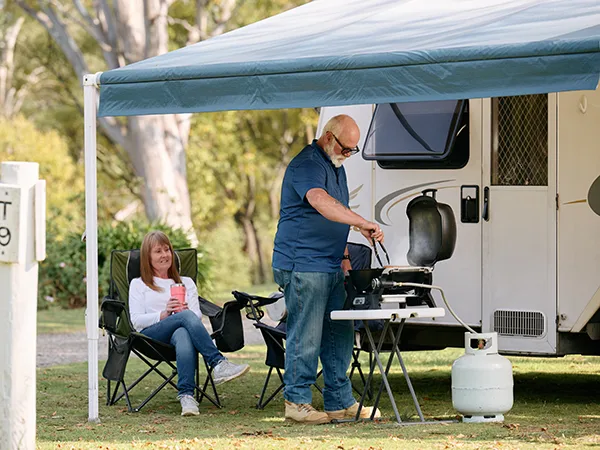 To avoid increased fire and carbon monoxide risk, don't cook under the awning or annex.
Cook safely outside by following these tips:
Portable heaters
Do not use portable heaters inside caravans due to the fire risk.
Candles
Never use candles in your caravan. Fires can easily start from an open flame and spread quickly because of the lightweight materials and small space inside a caravan.
Smoking
Never smoke inside your caravan. The fire risk is too great.
Caravans must have smoke alarms
All caravans in Victoria must be fitted with smoke alarms. This includes caravans registered in other states.
Smoke alarms which are specially designed for caravans are available at hardware and camping stores. They usually:
- are designed to cope with bumps and vibrations
- have a large hush button to turn off false alarms
- have dust and bug screens to reduce false alarms.
False alarms are more common in caravans because of a shorter distance to the smoke detector.
Caravans must have a fire extinguisher
Legally, all caravans and motor homes in Australia must be fitted with a fire extinguisher. CFA recommends an ABE dry powder extinguisher.
A fire extinguisher can quickly put out a small fire and prevent a fire spreading.
If a fire starts in your caravan
Trying to put out a fire by yourself can be very dangerous. You could end up with burns or more serious injuries.
It's important you are confident using fire equipment before you try to put out a fire in an emergency.
If you are confident using a fire extinguisher or fire blanket
- Try to put the fire out.
- If you can't put it out on your first attempt, get out, stay out and call Triple (000). Go far away from the caravan as the fire will be hot and intense.
If you are not confident using a fire extinguisher or blanket
- Don't try and put the fire out.
- Get out, stay out and call Triple Zero (000).
Get far away from the caravan if it's on fire, as the fire will be hot and intense.
Have an escape plan
Have a plan for how to get out of your caravan, including a back-up plan in case the door is blocked by fire. Keep exits clear at all times. Consider if there is another way out.
If you're in a caravan park, check in with the staff around fire safety warnings and fire evacuation plans.
Bushfire safety in Summer
Monitor the weather forecast and fire conditions during Summer.
Cooking and using fire during the Fire Danger Period and Total Fire Bans
During Fire Danger Period
Cooking inside a caravan is permitted
Using gas and electric stoves and fridges within a caravan is allowed, because by the definitions under Section 34A of the Country Fire Authority Act 1958 ("CFA Act"), they are within a "permanent structure" and not in the "open air".
The same applies for other appliances producing flames inside a caravan: they are not considered to be in the "open air," hence their use would be permitted.
Cooking in 'properly constructed fireplaces' outside is permitted
The following methods of cooking and heating are allowed during the Fire Danger Period as long as certain conditions are met:
- Gas and electric BBQs
- Gas lanterns
- Kerosene lanterns and stoves
- Gas stoves
- Gas fired heaters
- Brick or steel fireplaces using solid fuels
- Braziers
- Wood-fired ovens
- Chimeneas
- Kettle-type BBQs such as 'Webers'
You must make sure:
- The wind is less than 10km per hour (leaves in the trees are no more than gently swaying).
- The area 3 metres around and above must be clear of anything that can burn.
- A person is present at all times.
- The fire is put out (turned off) completely when finished.
If these conditions are not met during the Fire Danger Period, you could be in breach of the Act.
During Total Fire Ban
Cooking inside a caravan is permitted
Using gas and electric stoves and fridges within a caravan is allowed, because by the definitions under Section 34A of the Country Fire Authority Act 1958 (“CFA Act”), they are within a “permanent structure” and not in the “open air”.
The same applies for other appliances producing flames inside a caravan: they are not considered to be in the “open air,” so their use would be permitted.
Cooking in the open air permitted in certain circumstances
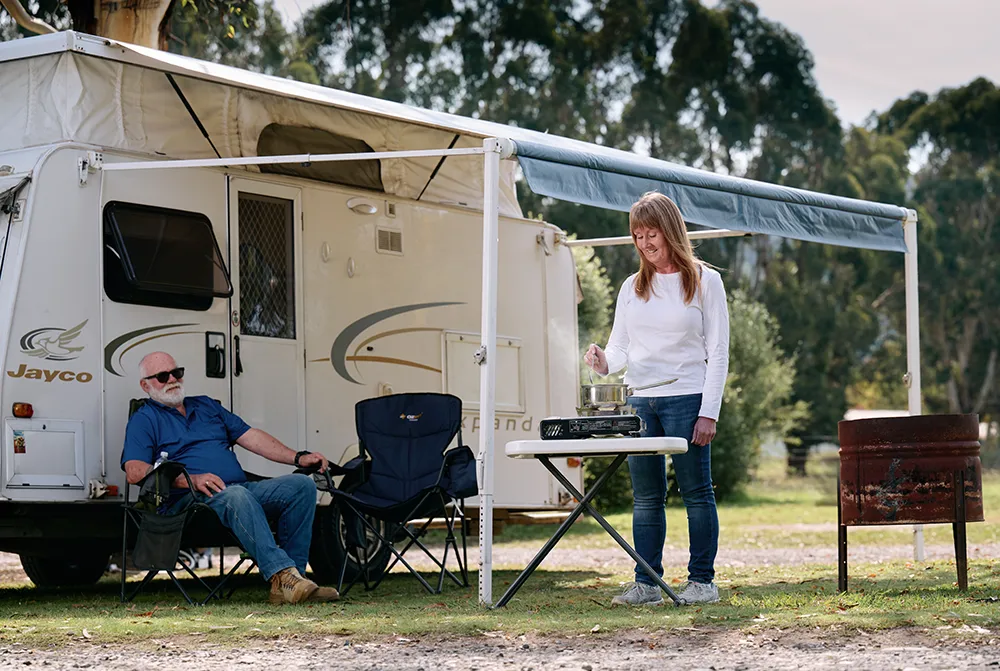 Give the wood fired cooking a miss on Total Fire Ban days. Using a portable butane cooker in a stable position is allowed.
Commercially manufactured portable appliances that use gas or electricity to prepare meals, including BBQs, stoves, grills, frypans, woks may be used in the open air under certain conditions.
All of the following conditions must be met if cooking outside:
- The portable appliance is placed in a stable position when alight.
- The area within a distance of 3 metres above and around the outer perimeter of the appliance is clear of anything that can burn, including awnings and annexes.
- There is, available for immediate use, either a hose connected to a water supply or a container with at least 10 litres of water.
- An adult is there at all times when the appliance is alight who has the capacity and means to extinguish the fire.
- The fire is completely extinguished before the adult leaves.
Fixed BBQs fired by gas or electricity, being properly constructed and permanently fixed structures built of stone, metal, concrete or another non-flammable material, designed exclusively for meal preparation are also allowed, subject to the same conditions.
All other fires and flames are banned in the open air
The following solid fuel appliances must not be used during a Total Fire Ban:
- Solid fuel BBQs (wood, heat beads or similar)
- Wood-fired pizza ovens
- Kettle type BBQs ('Webers')
- Coal or wood-fired spit roasts
All other use of fire in the open air is banned including campfires, chimeneas, fire pits and braziers.
Page last updated: Thursday, 20 August 2026 2:20:35 PM