Summary
- Fine fuels (like leaves) burn hotter and faster.
- Dry vegetation creates hotter, more intense fires.
- Hot, dry, windy days tend to cause extreme fire behaviour.
- Climate change is creating a longer fire season and more intense fires.
- Fires burn faster as they go uphill.
- Spot fires started by embers are one of the main ways fires spread.
Factors influencing bushfire behaviour
Learn how bushfires start and behave in the video below.
[Fire Behaviour]
The following may be distressing to some viewers.
Victoria is one of the most fire prone regions in the world.
Bush, grass, and scrub fires threaten homes every year. These fires are destructive and frightening and it is important for you to be aware of your environment and develop a fire plan to prepare yourself and your property.
Human activity such as campfires or using machinery near vegetation often starts fires but so can natural causes out of our control, such as lightning.
Vegetation, such as trees and other plants are fuel for fires. The more fuel there is the greater the intensity of the fire.
Fine fuels including leaves, twigs, and pieces of bark catch fire easily and burn fast, producing a lot of heat very quickly.
Larger fuels, such as logs and tree trunks take longer to catch fire but produce large amount of heat over a long time.
A continuous ladder of fine fuels from the ground to the tops of the trees can create intense and uncontrollable crown fires.
Wind plays a big role in the spread of fires. Embers can be lifted by the smoke column and carried far ahead of the fire by the wind starting new fires ahead of the main fire front.
The type of vegetation also affects how a fire behaves.
Open woodlands and scrub are more exposed to the effects of wind and fire will spread more quickly than in dense forests.
In scrub or coastal vegetation, fires can burn fiercely due to the large amounts of fine fuels.
Plants such as tea trees often contain flammable oils.
The wind can cause large showers of embers, which start new fires over short distances.
Grasslands are open to the full effects of wind and fires usually travel at about 10 to 20 kilometres per hour, but can reach speeds of up to 25 kilometres per hour in extreme conditions.
Topography, the physical features of the land, such as hills and valleys also play a role in the behaviour of fires. A fire travels much faster uphill and slower as it goes downhill. The wind can also be funnelled through a valley, changing the direction of a fire.
A wind change can be extremely dangerous. It looks like this community will be safe as the fire passes in the distance. But on a day of higher fire risk, the wind can suddenly change to a southwesterly, which pushes the fire to the northeast.
When this happens, the side of the fire can suddenly become the new fire front, much wider and more dangerous than the original one.
This can catch unprepared communities by surprise and have devastating effects.
In major fires, many people have died following a wind change.
Fires are unpredictable so leaving early is always your safest option.
Vegetation (fuel) type
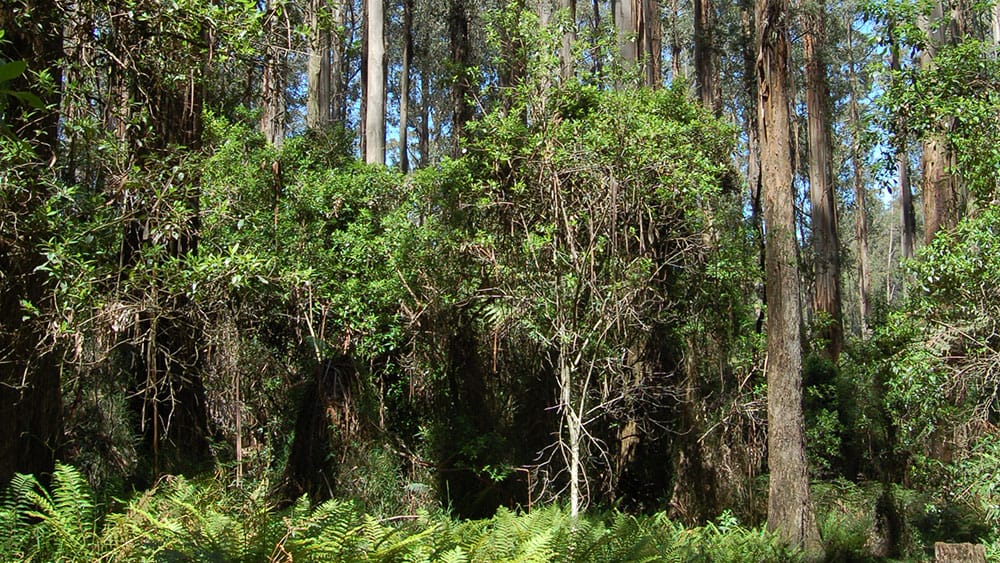 Lots of vegetation beneath tall trees like these Mountain Ash in the Sherbrooke Forest pictured creates larger, more intense bushfires.
Vegetation like trees, shrubs, leaves and branches are fuel for a fire. The kind of vegetation a fire burns through has a big effect on bushfire behaviour.
Some plant species, like tea trees, eucalypts and blue gums burn hotter and faster because of the oils they contain. Read more about choosing suitable plants for your garden.
The shape, thickness and how the leaves are arranged can also influence how quickly they burn.
The size of the fuel, and how dense the vegetation is also influences the intensity of the fire. For example, a forest with lots of fine leaf shrubs beneath tall trees creates a larger more intense bushfire than an open woodland with grass beneath trees.
Fine fuels burn easily
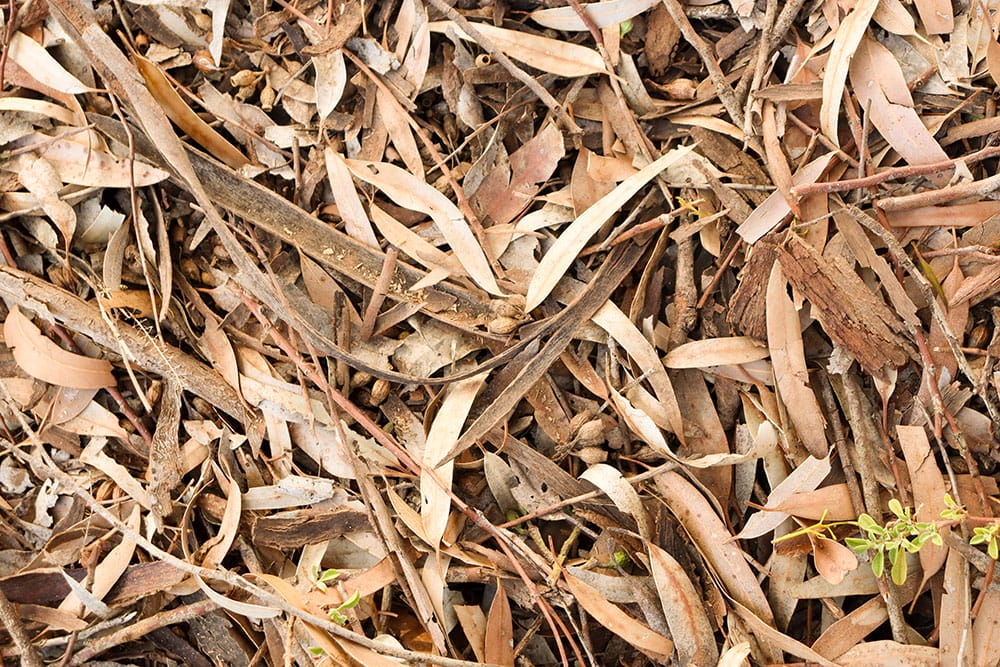 Fine fuels are often the first type of vegetation to catch on fire. They burn quickly and can be carried on the wind as embers, spreading fire.
Fine fuels are:
- branches, twigs, bark and leaves
- thinner than a pencil and catch fire very easily
- highly flammable (burn quickly)
- often the first type of vegetation to catch alight
- carried by the wind as embers, spreading fire further.
- leaves on bushes or trees, or dead leaf litter on the forest floor.
- Fine fuels burn hot and create enough heat to set fire to the thicker, bigger vegetation which keep the bushfire going for longer.
Elevated fine fuels carry fire up trees
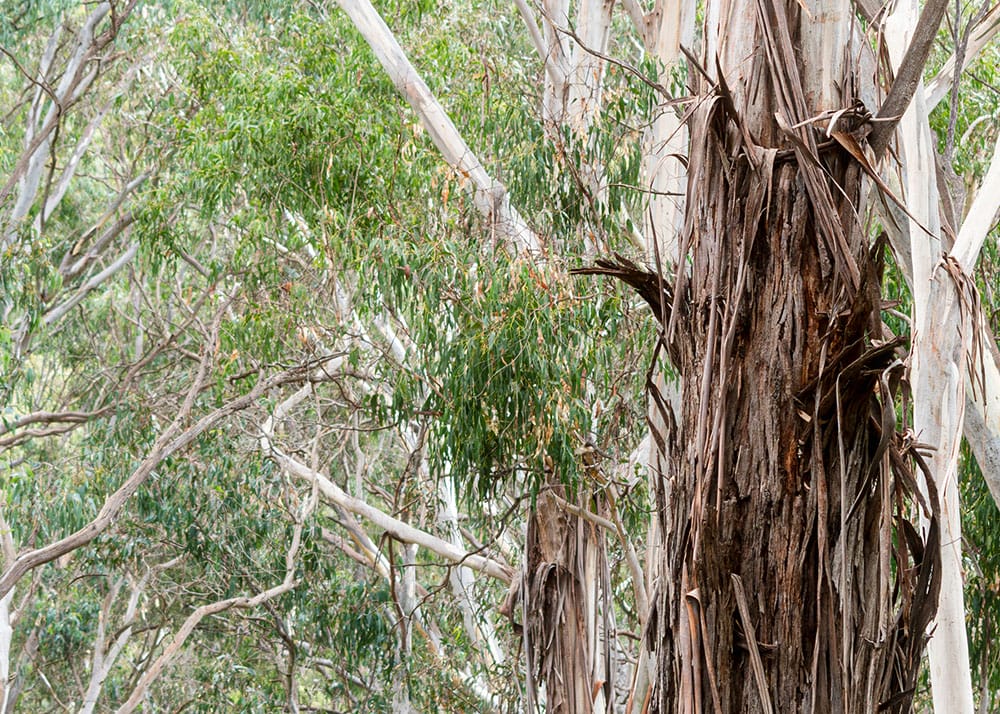 Dry bark falling off a Eucalyptus Rubida tree. Loose bark on tree trunks can carry fire from the ground up into the tops of the trees.
Fine fuels that reach higher into trees are called 'elevated' or 'ladder' fuels. They include:
- loose bark on tree trunks
- larger shrubs between trees
- bark which falls from tall trees and catches in lower branches and shrubs.
This kind of vegetation can carry fire from the ground up into the tops of the trees. In the right conditions, fine, ladder fuels can create intense and uncontrollable crown fires.
Tip: Get rid of dry branches, leaves and sticks from your property. It can help slow the spread and intensity of a bushfire.
Heavy fuels burn hot, but slowly
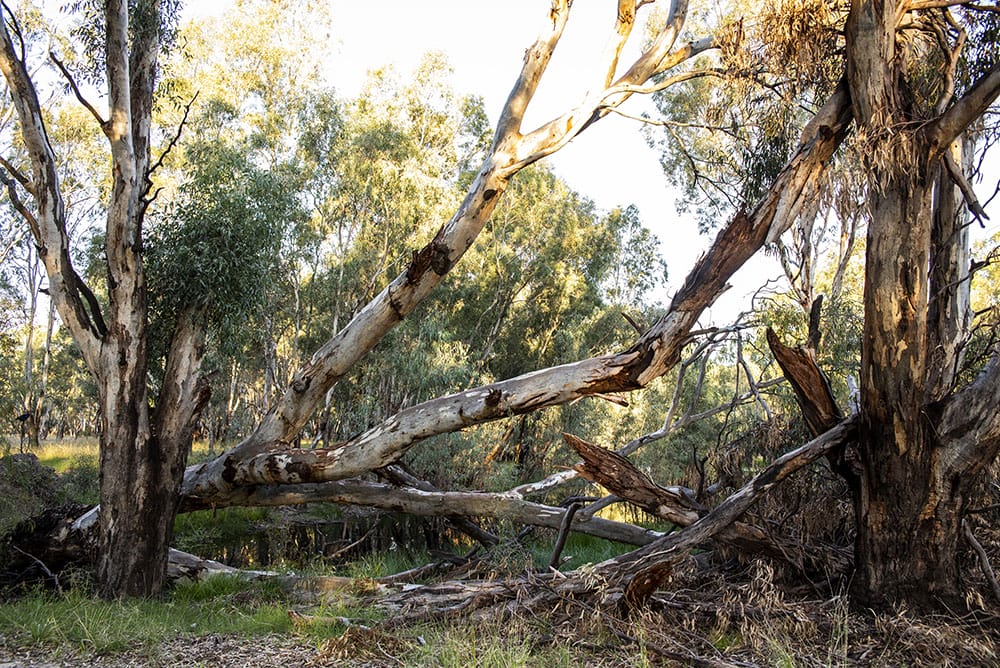 Big branches in trees, fallen branches and logs like this fallen River Gum, burn for a long time and create a lot of heat.
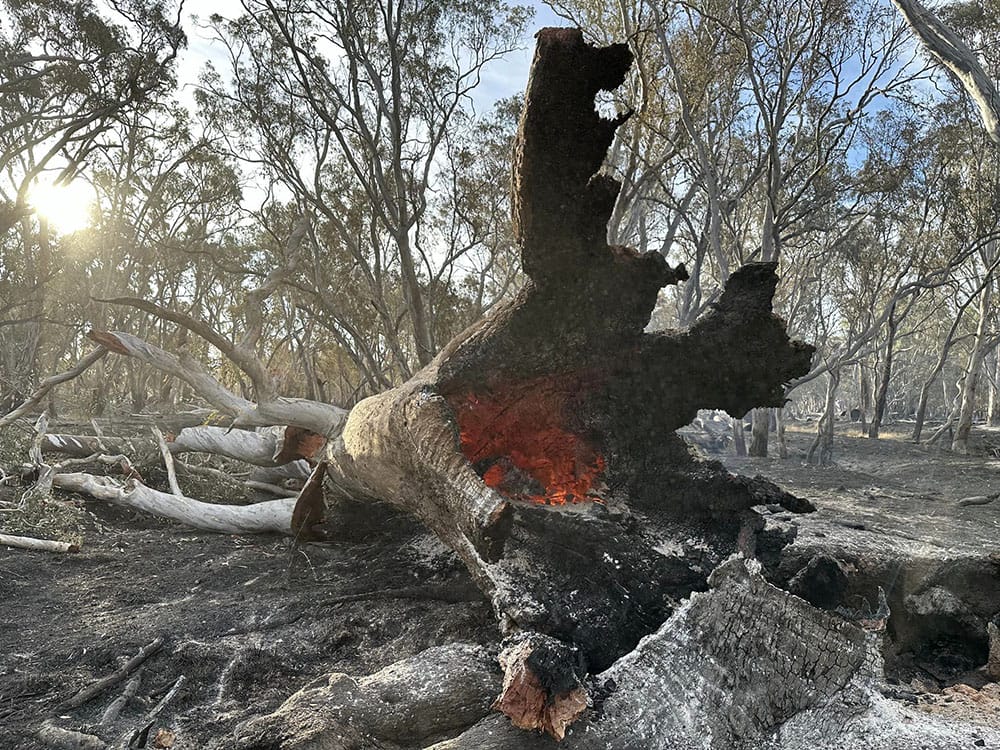 This large tree trunk slowly burns long after the fire front has passed.
Heavy fuels include big branches, tree trunks and logs.
They are thicker than a pencil and take longer to catch on fire.
Heavy fuels burn for a long time and are extremely hot.
Loosely arranged vegetation burns faster and hotter
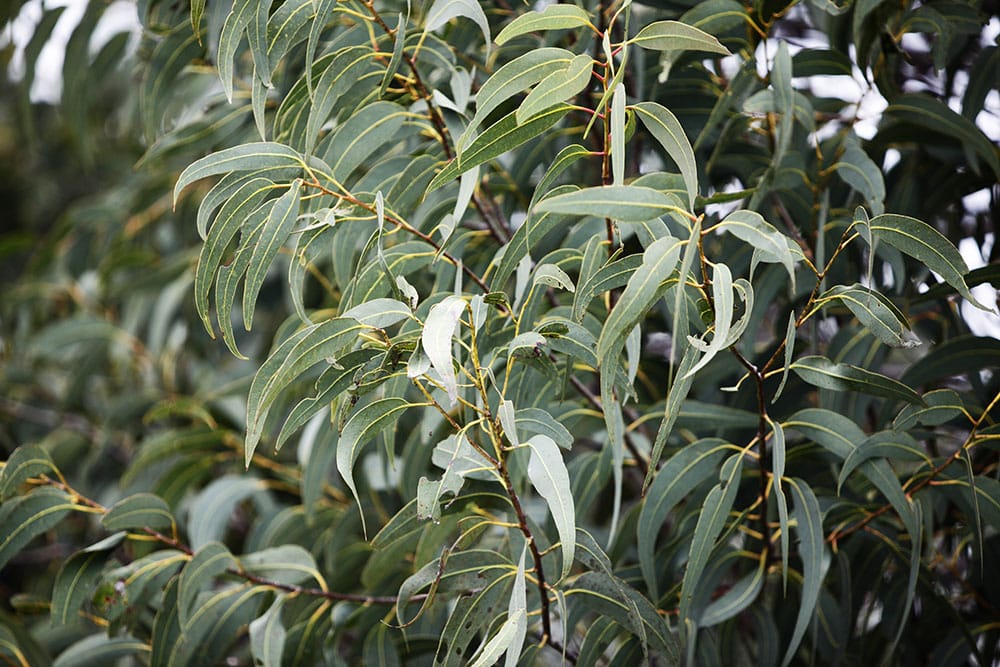
Tightly packed vegetation takes longer to catch fire, while loosely arranged vegetation burns faster and hotter.
This is because there is more air between the sticks and leaves when it is more loosely arranged, providing more oxygen to the fire.
Drier vegetation causes more intense fires
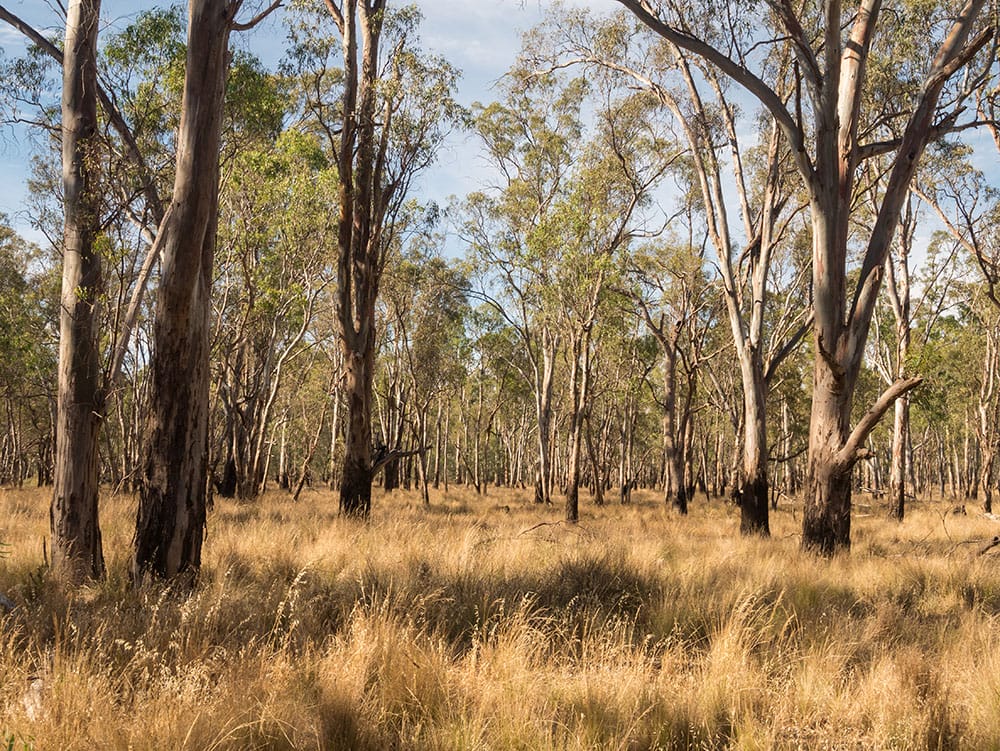
Dry vegetation catches fire more easily than moist vegetation, and also creates a hotter and more intense fire (due to the rate of combustion). Drier vegetation also spreads fire more quickly, is more likely to create spot fires and radiates more heat.
Moisture content of the fuels will vary depending on weather conditions, vegetation type or species, whether the fuel is dead or living and even the time of day. How recently it has rained has the greatest impact on how dry vegetation will be.
How to test vegetation moisture content
The ‘crackle’ test is a practical way to assess if moisture content of vegetation is low. As you walk across leaf and bark litter, the sharper the crackle sound, the drier the fuel.
In grass, a good indicator of moisture content is how easily the grass can be broken. The easier grass snaps, the drier it is. If it bends, it’s moisture content is higher.
Fire fighters and land managers use scientific instruments to accurately measure moisture content. These instruments directly measure the moisture content of a sample of vegetation material to provide an accurate reading of moisture content.
Weather and climate
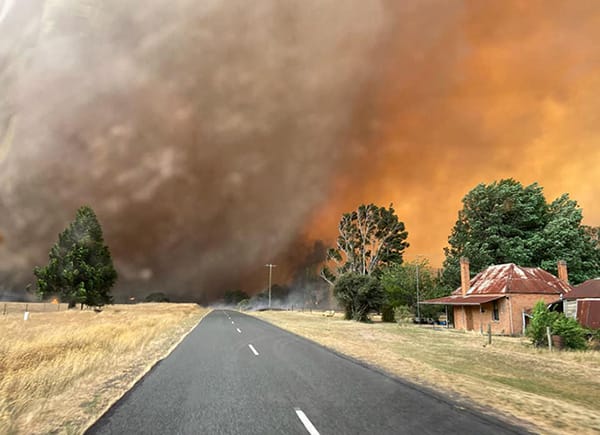 Hot, dry, windy days produce the most dangerous fires.
Hot, dry, windy days tend to cause extreme fire behaviour.
Cool, moist conditions are less likely to produce dangerous fires.
Climate change is contributing to more extreme bushfire behaviour. Long, hot summers give vegetation more time to dry out—this creates hotter and more extreme bushfires.
Higher temperatures increase fire risk
Higher air temperatures dry vegetation out faster. Dry vegetation catches fire more easily and burns more rapidly.
Higher air temperature also means that fuels are naturally warmer and catch fire more quickly.
Drier conditions make vegetation more flammable
When it is very hot and dry, the air has very little water vapour content, and vegetation is much drier and burns more easily.
Relative humidity (RH) is a measure of the water vapour content of the air. Humidity affects how vegetation burns.
- Maximum (100%) humidity (fully saturated air) - vegetation generally won't burn.
- High relative humidity (humid air) - vegetation burns slowly.
- Low relative humidity (dry air) - vegetation catches fire easily, burns faster and more fiercely.
Living trees and plants dry out more quickly in less humid conditions. However, if there is moisture in the ground they will absorb it to replace the lost moisture.
Dead fine fuels a will absorb moisture from the air when humidity is high, but moisture is drawn out of these dead fine fuels when humidity is low, meaning they will ignite more easily and burn faster and more fiercely.
Humidity makes fires less intense at night
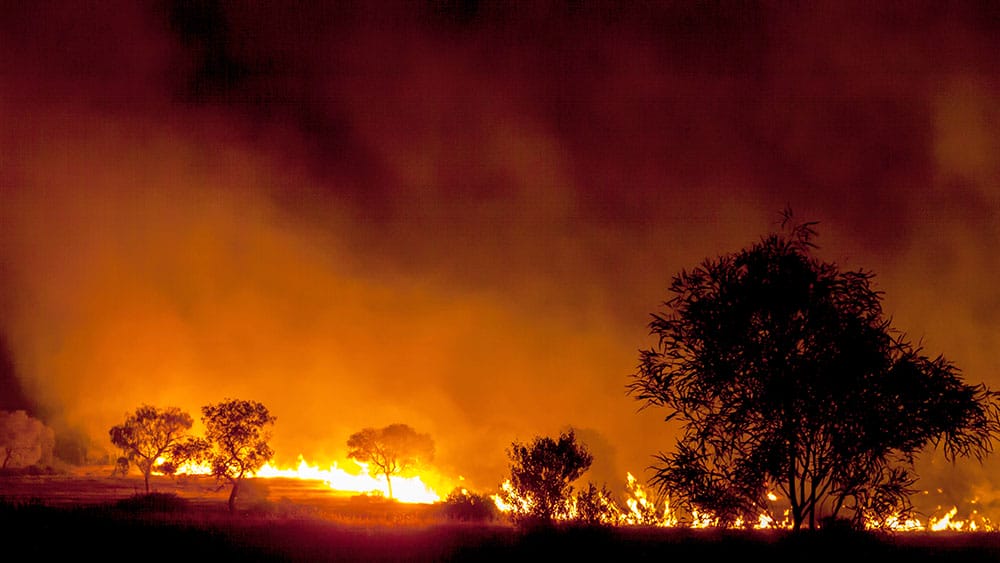 Typically bushfires become less intense at night when the temperature drops and humidity increases.
Historically, bushfires have been more intense in the daytime, and less intense at night when the temperature drops and humidity increases. This has provided firefighters with the opportunity to get on top of out of control bushfires at night.
But climate change might be contributing to a shift in this pattern. During some recent fires, low humidity and warmer temperatures at night has created more extreme fire behaviour at night time.
Strong winds create more intense fires
Wind is a major factor in the speed and direction a fire travels. This is because:
- Wind blows the fire across the landscape, pushing it into unburned areas to provide more fuel for the fire.
- Strong winds can make a fire travel faster, spread further, and become longer and narrower.
- Winds can also carry burning pieces of leaves, twigs and bark (embers) in the air ahead of the fire where they start new spot fires.
- Windy conditions can provide fresh oxygen into the fire, producing hotter fires.
Changes in wind direction are very dangerous
[Wind Change]
The following may be distressing to some viewers.
Wind drives the behaviour of bush, grass and scrub fires that threaten Victoria every year - destroying homes, devastating communities, and even taking lives.
Wind effects a fire's speed, direction, and intensity.
In Victoria, scorching winds from the north or northwest carry hot dry air from central Australia during the hotter months.
Later in the day, the wind can change and begin blowing in from the southwest. The cooler air may feel like relief, but don't be deceived. This is when you must stay alert.
If a fire is already burning nearby, this wind change can turn a dangerous situation into a deadly one.
A fire with a main front that's a few hundred metres wide can have sides that continue to burn for many kilometres behind it.
When the wind changes direction, what was once the side of the fire can suddenly become the new fire front - doubling or tripling in size and racing towards towns and homes.
Wind changes like this have taken many communities by surprise. A fire that you thought was passing by can suddenly shift direction and head straight towards you.
When this happens, you can expect a sudden drop in temperature, trees bending and breaking under strong gusty winds, and the fire erupting bigger, faster, and more ferocious than before.
The sky goes dark. Thick smoke fills the air, and what little light is left turns an eerie shade of orange and red. You might not be able to see more than a few metres in front of you.
Burning embers fall from the sky like rain, starting new fires all around you. Suddenly a more dangerous fire is racing toward your home and you are quickly surrounded.
Sadly, many lives have been lost due to wind changes.
Avoid this traumatic experience.
Leaving early is always your safest option.
A sudden and unexpected change in wind direction can cause a relatively quiet fire flank (the long side of a fire) to become a new, larger fire front.
A change in fire direction can catch people who thought they were safe, off guard. Many people who have died in bushfires have become trapped just after a wind change.
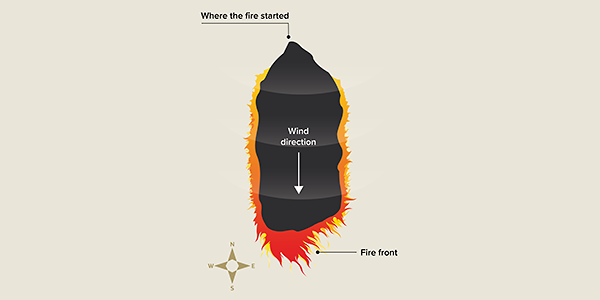 The front of the fire is relatively narrow as the fire is pushed from behind by a northerly wind trailing long edges that are not burning as strongly.
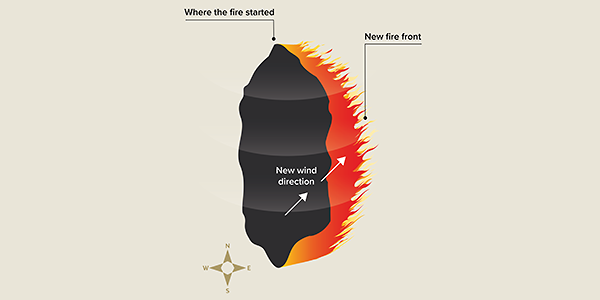 A south-westerly wind change drives the fire in a new direction, moving the fire front to the long side of the fire, creating a much bigger, more destructive fire front.
Atmospheric instability can cause extreme fire behaviour
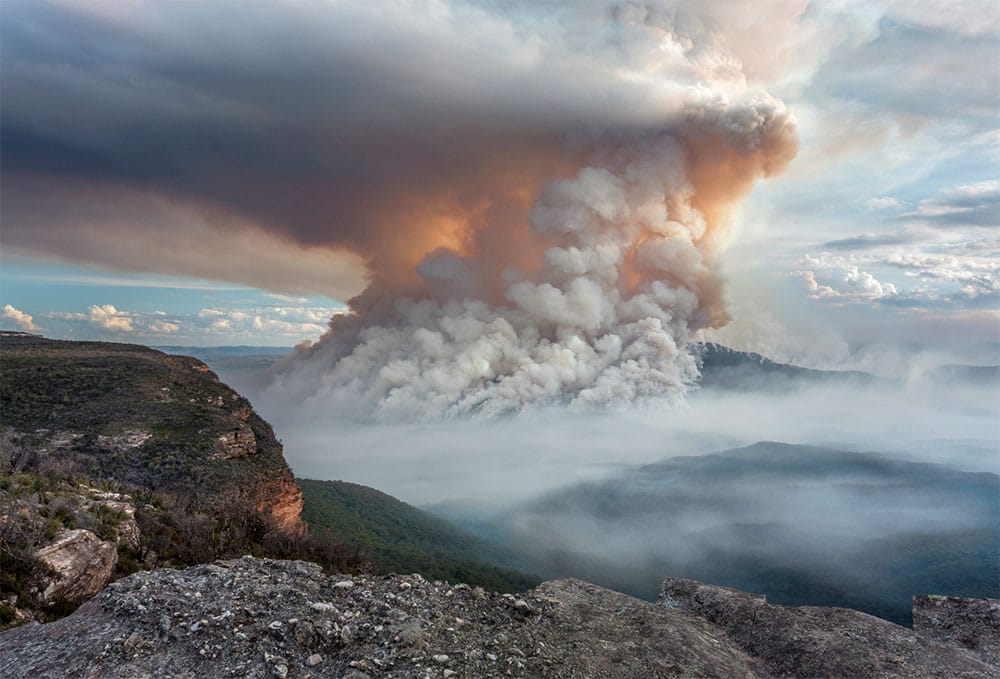 An unstable atmosphere allows the development of large convection columns which creates strong updrafts and drives extreme fire behaviour.
Atmospheric stability is a measure of whether air is able to easily mix upwards and downwards. A stable atmosphere contains layers of warm and cool air, and does not readily allow mixing upwards. You will usually see shorter clouds or a hazy sky.
When the atmosphere is unstable you will usually see tall cumulus clouds which will often develop into storm clouds and the sky will appear clear of haze.
In these conditions, smoke and heat from fire is able to rise high into the atmosphere creating a large convection column. This convection creates inward rushing winds which draw fresh oxygen into the fire and can cause extreme fire behaviour.
Droughts lead to more intense bushfires
Trees, plants and shrubs are starved of water and nutrients during a drought. Lots of vegetation dries out and dies. This provides very flammable fuel for bushfires.
Dead leaf litter on the ground and the ground itself dries out completely in a drought. Even the normally lush green vegetation in deep valleys can become drier. This creates more dry, fine fuel and can lead to more intense bushfires and damaging forest fires.
It also increases how likely fires are to start, spread, cause damage, burn overnight and cross natural barriers like creeks.
Droughts can make grassfires less intense
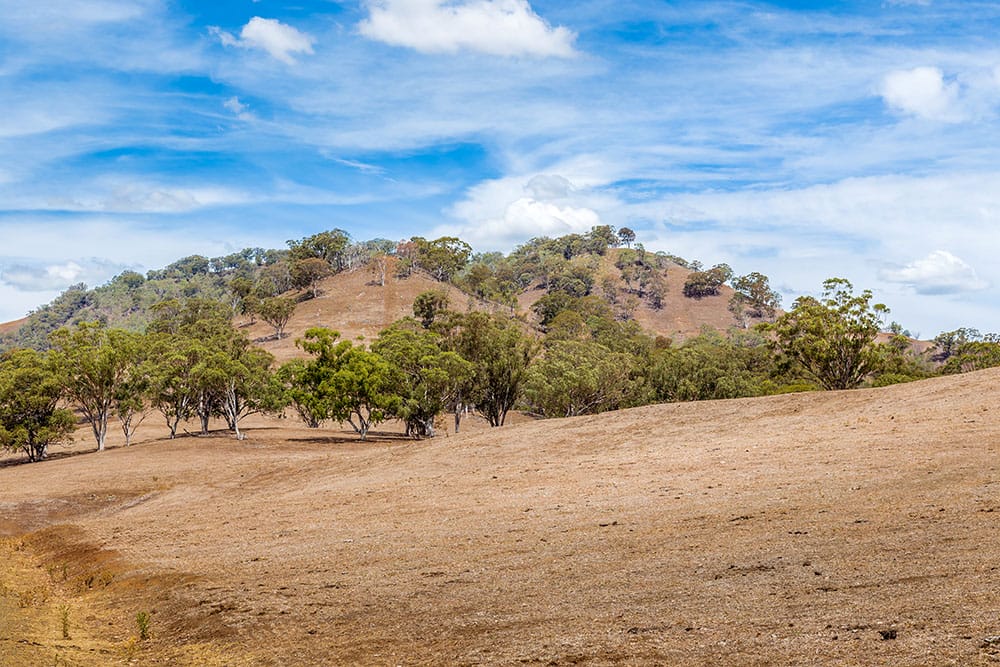 During droughts, the lack of a good spring growth of grass combined with animal grazing can mean there is little grass to burn.
While forest fires become more intense due to drought, grassfires are often less intense. This is because grass isn't able to grow as well due to a lack of rainfall, and animals eat more of the available vegetation. There is less grass to burn than in non-drought conditions.
Lots of rain in spring increases risk of grassfires
Rainfall in spring has a big effect on grassfires over summer. Lots of rainfall and good spring growth, followed by a long, hot summer can produce extreme grassfires. This is because there is more grass than usual and it is long and dry.
A drier spring with less rainfall results in less grass available as fuel in summer.
Climate change is intensifying bushfire behaviour
Australia is increasingly experiencing more frequent and intense bushfires due to the impacts of climate change. Our fire seasons are getting longer. In the past, the fire season lasted a few months, but now it can last around four or five months.
Case study
Kilmore East Fire wind change
There were very strong to gale force winds all day on Black Saturday, 7 February 2009 which, along with a sudden wind change in the afternoon, had devastating results.
In Victoria, hot, dry winds typically come from the north or north-west and are followed by a cool change from the south west, usually later in the day. This is exactly what happened on Black Saturday, but it happened unusually quickly with very strong winds.
A large, 55 kilometre-long fire that had travelled for six hours and moving in a south-easterly direction was suddenly hit by a blast of cooler air—a southwesterly wind change. This wind started pushing the fire in a new direction, creating a massive, wide fire front, moving at a terrifying speed towards the towns of Marysville, Flowerdale and Kinglake. Unfortunately, 119 people died as a result of this fire.
Topography and terrain (shape of the landscape)
The features of a particular area, such as its mountains, valleys, hills and plains, influence the speed and direction of a bushfire. Slope and aspect (the direction a hill faces) are the two main topography factors which affect fire behaviour.
Fires burn faster uphill and slower downhill. They burn more fiercely on the sides of hills that face north, than fires on southern aspects. Fires also increase in intensity when moving uphill, with flames becoming even larger and hotter.
Case study
Strong winds combined with steep slopes
The worst of the Black Saturday fires began in Kilmore East when fallen powerlines started a fire in farmland in the morning. The fire spread quickly through a pine plantation, crossed the Hume Freeway and reached Mount Disappointment in the afternoon.
When the fire burned up the side of Mount Disappointment (elevation 800 metres above sea level), strong north-westerly winds blew the fire towards Humevale and Kinglake, with embers causing spot fires 20-35 kilometres away. This was the furthest embers have ever been recorded to travel. Embers were also carried 23 kilometres from from the Strzelecki ranges down to Yarram in the Churchill fire on Black Saturday.
Embers were able to travel this far because winds are stronger at the tops of hills and mountains, than in valleys. As the fire reaches the top of the mountain, embers are carried upward by the updraft and enables the long distance travel, pushed by the prevailing winds.
Fires burn faster uphill
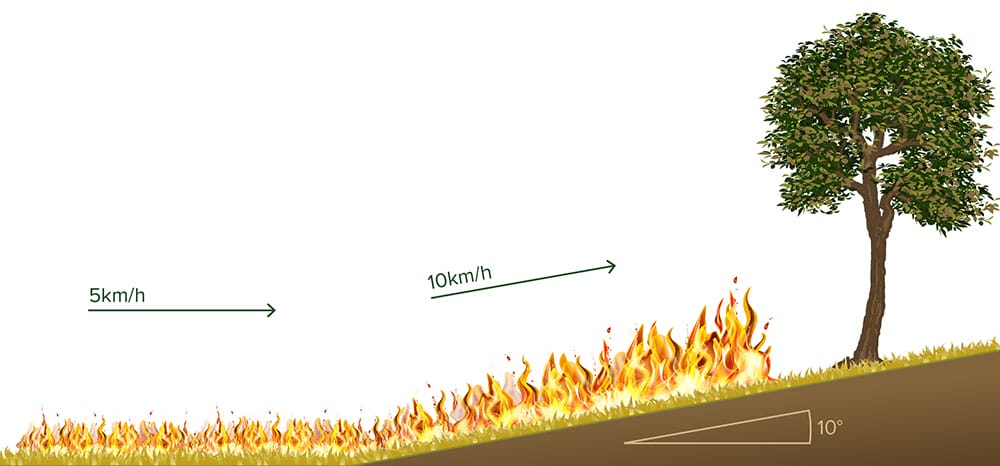 Fires burn faster uphill. For every 10˚ slope, the fire will double its speed as it travels uphill.
Fires burn faster uphill because the flames are leaning towards vegetation in front of the fire. Radiant heat pre-heats the fuel in front of the fire, drying it out and making the vegetation even more flammable.
As a general rule, for every 10˚slope, the fire will double its speed as it travels uphill, and halve its speed as it travels downhill. For example, if a fire is travelling at 5 kilometres per hour along flat ground and it hits a 10˚uphill slope, it will double in speed to 10 kilometres per hour. The fire also becomes larger and hotter.
Fires burn slower downhill
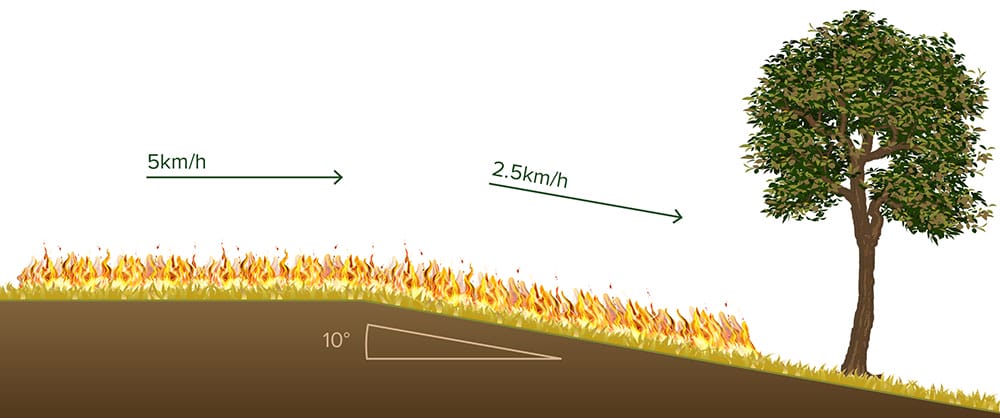 Fires travel slower downhill. The fire halves its speed as it travels down a 10˚ slope.
As fires travel downhill, they tend to move more slowly because the flames and radiant heat are leaning back towards burned ground, not unburned vegetation. A fire moving downhill will have lower flame height and produces less heat.
If a fire travelling at 5 kilometres per hour on flat ground comes to a 10˚downhill slope, it will halve in speed to 2.5 kilometres per hour. The fire will decrease in intensity and flame height.
Fires on hills with a northern and western aspect burn more fiercely
Aspect is the direction a slope faces. Fires on northern and western aspects will generally burn more fiercely than fires on southern and eastern aspects.
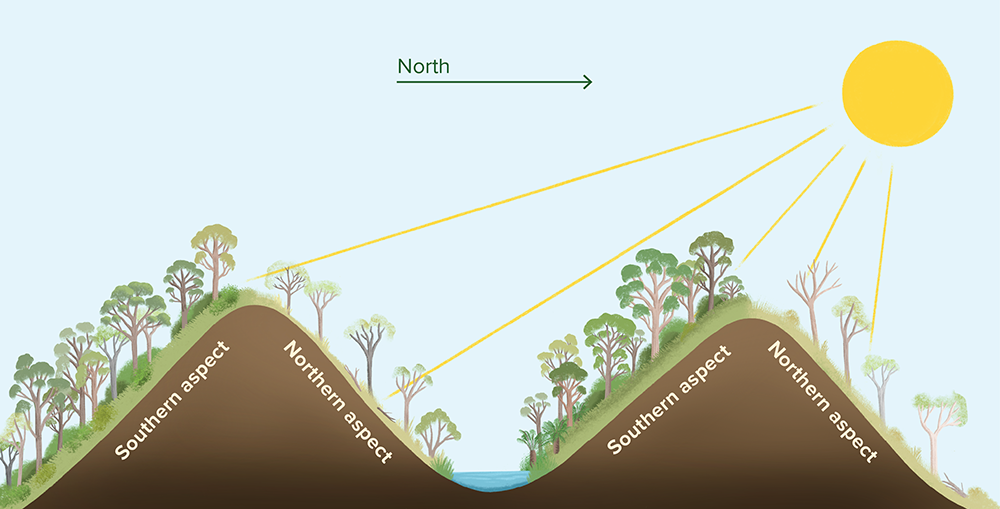
North side of hills
The side of a hill that faces north (the northern aspect) gets more sun than the side that faces south. Extra sun on the north side dries out living plants and trees, as well as dead branches, leaves and logs on the ground.
Vegetation will tend to be more sparse, with fewer or smaller shrubs between the trees, but it will be drier and burn more easily.
South or eastern side of hills
Southern and easterly aspects aren't exposed to as much direct sunlight during the hotest parts of the day and therefore have cooler local environments. This usually results in more moisture in the soil and lusher, greener vegetation.
More moisture means fires on southern and easterly aspects will generally be slower and less intense than fires on northern and western aspects.
However, during a long drought, the greener, more moist southerly and easterly aspects can be as dry as the northern side of the hill. This can result in extreme fire behaviour.
hide
Case study
2009 Black Saturday fires
Case Study: Black Saturday - Extreme Fire Behaviour
In the days leading up to Black Saturday, Victoria was in an extreme heatwave. Melbourne had temperatures over 43°C for three days in a row, and many live plants were dried out by the heat, making them easier to catch on fire. The state had also been in a long drought, with 11 years of below average rainfall, leaving large amounts of vegetation dead and dry, ready to burn.
Temperatures reached the highest on record across most of Victoria on February 7th, creating extreme fire risk conditions. In Melbourne, the temperature reached 47°C. At this temperature, vegetation is already pre-warmed, and closer to the temperature when it will catches fire.
There was also very little moisture in the air. Vegetation was very dry. The combination of hot air and low humidity dries out vegetation creating more intense and violent fire behaviour.
When the Kilmore East fire ripped through the forest in Kinglake, crown fires at the tops of the trees saw flames up to 30 metres high. Despite the north westerly wind, because of the nature of the local topography, and even though the fire had passed it by, parts of the fire started moving in a northerly direction toward Kinglake West where 16 people died.
Winds of up to 100 kilometres per hour on Black Saturday caused spot fires far ahead of the main fire front, up to 35 kilometres away in some places. At the top of Mt. Disappointment 50 metre high mountain ash trees saw flames more than 50 metres above the tree tops, sending burning Ribbon bark as embers which travelled about 35 kilometres toward Healesville.
Many people became trapped when a cool change arrived from the south west, turning the long east flank of the fire into a new 50 kilometres wide fire front. Many lives and properties were lost in towns like Kinglake West, Kinglake and Flowerdale, all to the east of the original path of the fire. In total 119 people died in this fire alone on the day, 232 people were injured and 1,242 houses were destroyed.
Atmospheric instability on the evening of Black Saturday also created a fire-induced thunderstorm. The fire created its own weather patterns, triggering storm clouds and lightning strikes which led to more fires.
Types of bushfire and how they behave
Each type of bushfire happens at a different level—under the earth, on the ground or in the trees.
Ground fires burn under the surface of the earth
Ground fires are when the layer of organic material under the surface of the earth smoulders. Roots, peat and humus (decaying matter) in the soil are fuel for these fires. They smoulder slowly with no flames and very little smoke and can go unnoticed for a long time.
They can burn for weeks or even months and are very difficult to put out. Ground fires can cause surface fires to start in vegetation on the surface of the earth.
Surface fires burn vegetation at ground level
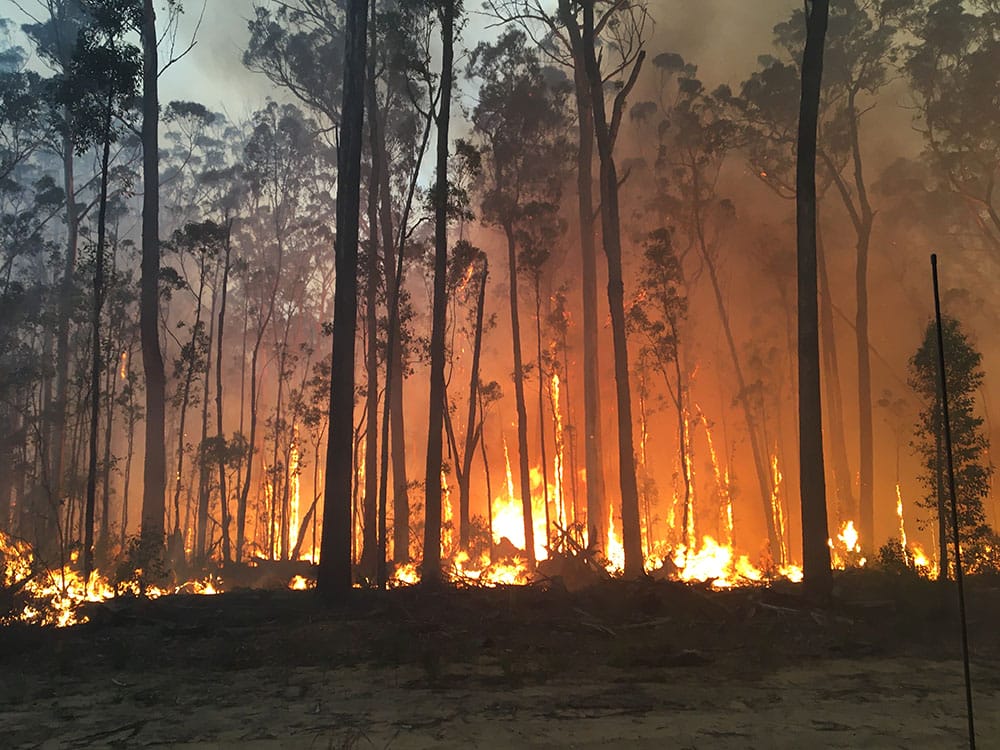 A surface fire burns along the ground, usually consuming grass, shrubs, small trees and debris on the forest floor. The bark on larger trees may burn to several metres up the trunk but the fire usually doesn't reach into the tree tops (crown).
Surface fires are the most common type of bushfire. They occur when vegetation on the ground, including leaf litter, grass, crops, stubble, dead branches, shrubs and small trees burn. They can be a low to high intensity, but generally don't reach into the tops of trees.
Crown fires burn in the tops of trees
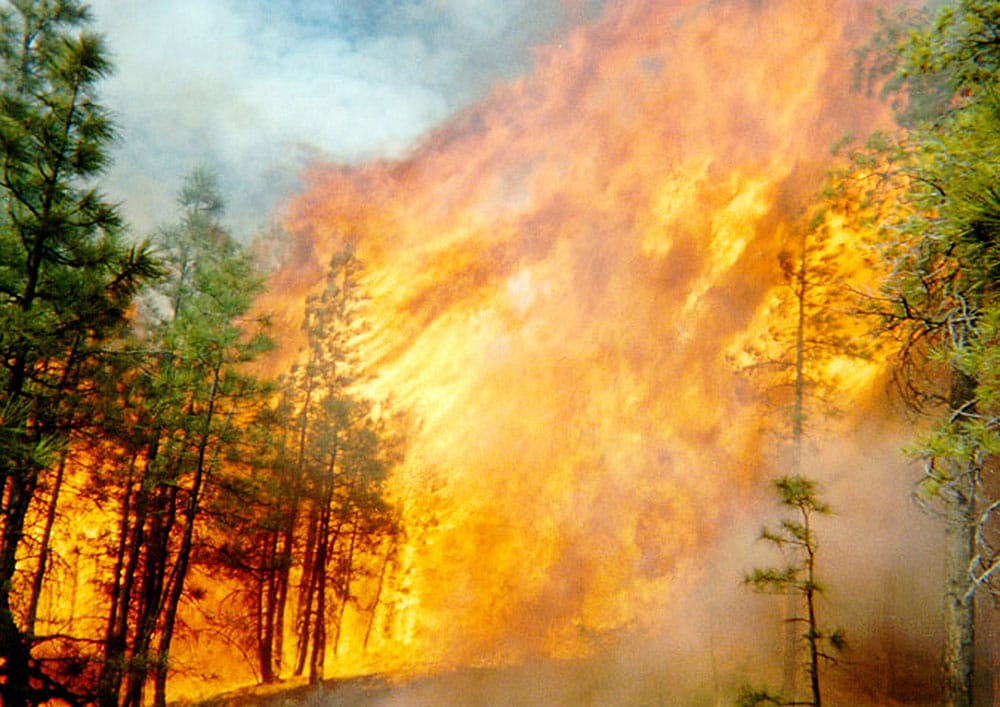
Crown fires are extremely fierce fires which burn in the crowns (tops) of trees. They happen when a surface fire becomes hot enough to spread to the crown of a tree, aided by elevated or ladder fuels.
They are extremely dangerous and produce large amounts of heat. Sometimes flames from a crown fire reach more than 30 metres higher than the tops of the trees.
Crown fires start with ladder fuels—fine fuel vegetation that runs like a ladder from the ground to the tops of trees (canopy or crown). This continuous ladder of vegetation is usually made up of:
- elevated fine fuels, such as small to medium shrubs and smaller trees
- fibrous or loose bark on the surface of tree trunks
- the peeled ribbon bark of larger trees that has become caught in branches lower down.
Trees with ribbon bark include many eucalyptus species like mountain ash.
Crown fires start when the radiant heat and flames of a surface fire ignite ladder fuels and carry flames into the canopy. High wind speeds at the tops of trees spread crown fires from canopy to canopy. They often move faster than the surface fire below.
Crown fires need a significant surface fire below providing heat energy and enough continuous tree top vegetation to sustain them.
How fires spread
Fires start small and slow, moving across the ground at a low intensity, pushed by the wind. They pick up intensity as they reach more vegetation and continue to travel in the direction the wind takes them.
Fire spreads when:
- flames directly set vegetation on fire
- radiant heat causes fine fuels to ignite
- spot fires start ahead of the main fire front due to embers.
Spot fires are caused by embers
Spotting is when small fires start and spread ahead of a main fire front. This can be caused by embers—small pieces of burning bark, twigs, leaves and debris which are carried through the air by convection and the wind. Almost all bushfires in Australia, except sub-surface fires, are able to cause some spotting.
Spot fires start when burning embers land on dry grass, leaves, mulch or wood. They usually land a few metres to 2 kilometres ahead of the fire front, but wind can sometimes carry embers a lot further. On Black Saturday in 2009, some embers were carried more than 30 kilometres away from the fire front.
Bark types can affect how far embers travel. Stringy bark eucalypts cause mass, short-distance spotting, usually up to only a few hundred metres. Candle bark (ribbon bark) eucalypts can cause spotting a number of kilometres away.
Spot fires are extremely dangerous in a bushfire. They can:
- cut people off from escape routes near the main fire
- create multiple fires for fire agencies to put out
- quickly accelerate the spread of the main fire
- surround people with fire and disorient them, as fire is coming from multiple directions
- travel many kilometres ahead of the fire
- be extremely unpredictable.
In some large forest fires, isolated spot fires may burn unnoticed because they are shielded from the prevailing wind by the convection column of the main fire. This can lead people to misjudge the distance of the approaching fire.
Spotting happens during a grassfire when strong winds blow smouldering debris ahead of the main fire. These are usually pieces of burning dry manure, seed or thistle heads and detached clumps of grass which can travel up to 100 metres away.
If a large grassfire comes into contact with scrubby patches or roadside vegetation, spotting can increase due to the sources of larger embers such as bark, leaves and twigs.
The many small leaves of coastal heath and tea tree scrub can produce an enormous mass of small embers which can shower nearby communities and set fire to homes.
Burning cone bracts (the papery part of a pine cone between the scales) or bunches of dead needles caught in the upper branches can create embers in pine forest fires. Spotting can be intense, depending on the age and structure of the forest.
Spotting from pine fires usually happens within 200 metres of the head of the fire. Embers from a pine forest fire usually don't travel as far as spotting from eucalypt forests.
Eucalypt forest fires can produce a lot of spotting. Burning bark is the main source of embers from these fires.
The type of bark burned in a eucalypt forest fire affects how far embers travel.
Rough barked eucalypts
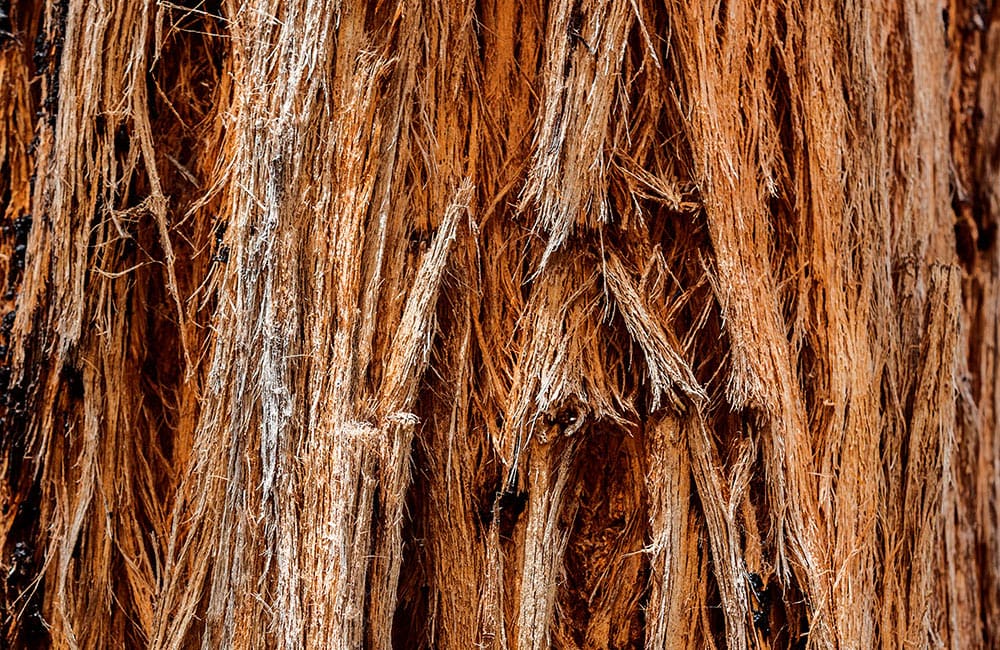
Rough barked eucalypts have fibrous bark that burns easily. Embers from this bark don't travel too far but still start fires ahead of the fire front.
Rough barked eucalypts, like stringy barks, have fibrous bark that burns easily, but isn't very aerodynamic. This means embers from this type of bark aren't carried very far by the wind.
Pieces up rough bark up to 20 centimetres long can cause mass spotting up to a few hundred metres. Under extreme fire conditions this may extend to up to 3 to 5 kilometres.
Smooth barked eucalypts
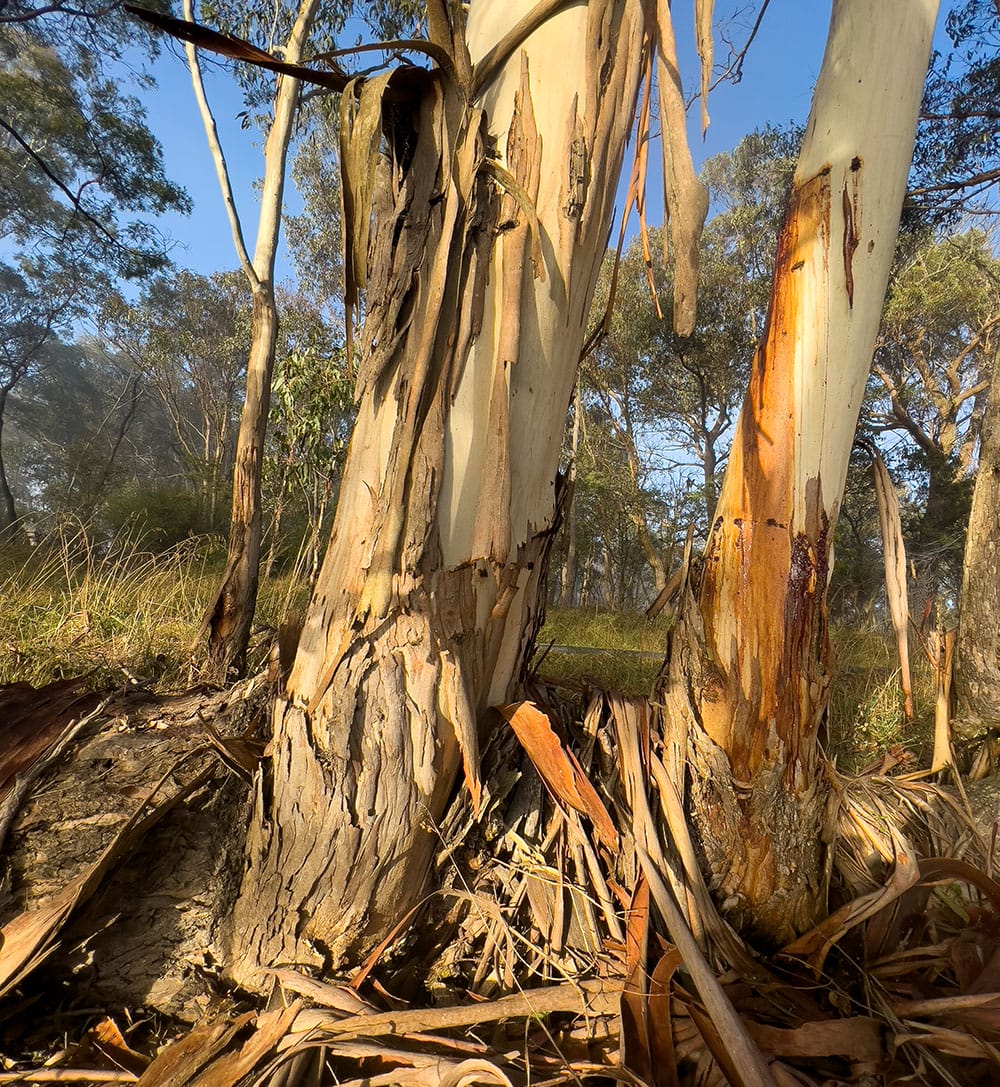
Ribbons of bark on a smooth barked eucalypt can produce embers that can travel a long distance.
Smooth barked eucalypts, such as mountain ash, can produce long streamers or tubes known as candle bark or ribbon bark.
These bark streamers burn slowly as they travel a long way down wind because of their aerodynamic properties.
Embers from these eucalypts can cause spot fires 8 kilometres or more ahead of the main fire. The maximum distance they have been known travel in Australia is about 30-35 kilometres in extreme conditions.
Resources
Your guide to survival
This easy to read guide provides essential information for anyone who lives, works or travels in Victoria so that they are prepared for the summer fire season.
Your guide to property preparation
Learn how to get your house and garden ready before the fire season in this easy to read guide.
Page last updated: Wednesday, 16 September 2026 11:30:49 AM