What you'll learn:
- Understanding CFA and fire basics.
- Home fire safety basics.
- Outdoor Fire Safety basics.
Understanding CFA and fire basics
Lesson One: Who is CFA
Lesson Objective:
For students to get to know who CFA (Country Fire Authority) is and what they do.
Video Resource: Our Community, Our CFA
This video introduces CFA and its role in the community.
[Our Community, Our CFA]
[Music featuring a remix of Vance Joy's Fire and the Flood]
[On screen text]
We are determined
Community focused
Reliable and trusted
Strength through diversity
50,000 plus committed members
1200 plus brigades
Proudly serving four million plus Victorians
Representing Victorian Spirit from every corner of the state
Bushfires
House fires
Education
Road crash rescue
Responding to 33,000 plus incidents annually
[inspiring music]
Wherever we're needed
[inspiring music]
Preparing communities
Across 224,000 km squares of Victoria
Highly trained
Research and evidence based methods
Valuable local knowledge
Experienced across all landscapes
Diverse skill sets
Flexible and inclusive roles
Strong community roots
Focused on prevention
Beyond emergency response
[Inspiring music]
Through Victoria's darkest days
[Inspiring music]
Progressive emergency service
Evolving with our community
Adapting to changing climates
[Inspiring music]
Ready for our next chapter
Trusted
Skilled
Deeply connected
Key information:
CFA (Country Fire Authority) is a fire and emergency service.
CFA and other emergency services are there to help people and give safety advice.
CFA responds to:
- Bushfires and grassfires
- Building fires and house fires
- Car accidents
- Chemical spills
- Search and rescue (hikers lost, people trapped)
- Floods
- Other emergencies
Many CFA firefighters are volunteers. There are more than 50,000 volunteers
You can join CFA as a volunteer firefighter or to perform other roles.
Levels 0-1 teaching tools and activities
Levels 2-4 teaching tools and activities
NOTE: You do not need to have a CFA presenter for this lesson.
Lesson Two: Fire science and the fire triangle
Lesson Objective
For students to understand the fire triangle—the three things a fire needs to burn.
Please note, this lesson may not be suitable for level 0-1 students.
Video Resource: CFA Fire Triangle
This animation introduces the three things a fire needs to burn, otherwise known as the fire triangle.
[CFA Fire Triangle]
[Voice over]
Fire needs three things to burn. It needs heat, it needs fuel, and it also needs oxygen, which is in the air.
Fires burn when these three things come together. Removing any one of these three things will make the fire go out.
If you add water this takes away the heat. If you smother the fire with a fire blanket or pot lid, you take the oxygen away. If you rake the leaves and grass away, you remove the fuel and the fire will go out.
This is the fire triangle.
[On screen text]
Fired Up English program for English as an Additional Language (EAL) students. In collaboration with Chisholm Tafe
Key information:
Fire is a chemical reaction that occurs when the following three things are present and the conditions are right:
1. Heat
This could be from lightning, the sun, or radiant heat from a heater.
2. Fuel
This can include wood, paper, leaves, gas or petrol.
3. Oxygen
Air in the environment.
Fire needs these three things to burn. Removing any one of these three things can cause the fire to go out.
Remove Heat
If you add water, this takes away the heat and can cause the fire to go out.
Remove fuel
If you rake the leaves and grass away until there is only dirt, you remove the fuel and can cause the fire to go out.
Remove oxygen
If you smother the fire with a fire blanket, you take the oxygen away and can cause the fire to
go out.
Levels 2-4 teaching tools and activities
hide
Home Fire Safety
Lesson Three: Home Fire Dangers
Lesson objectives:
- For students to understand the dangers of house fires.
- For students to know how they can prevent home fires.
Video resource: Kitchen fire safety
This video introduces kitchen fire safety.
[Fired Up English – Kitchen Safety]
[Voice over]
Each year, there are more than 3000 house fires in Victoria. Over one third occur in the kitchen.
So when you are cooking stay in the kitchen. Never leave your cooking unattended.
Kitchen fires can happen quickly. Always pay attention.
There are easy things you can do to prevent fires in the kitchen.
Keep tea towels and paper towels away from the stove as they can catch fire.
Keep your stove and cooking area clean from grease and oil.
If a fire does occur on the stove, you should take action to put it out.
One, turn off the stove. Two, use a fire blanket or fire extinguisher to put out the flames.
Remember to stay and watch your cooking. You can prevent fires from starting.
[On screen text]
Fired Up English program for English as an Additional Language (EAL) students. In collaboration with Chisholm Tafe
Key Information
- Each year there are more than 3,000 house fires in Victoria. That's more than eight per day.
- On average 20 people die every year in house fires.
- Over one third of all house fires in Victoria occur in the kitchen. Most can or could have been prevented by doing simple things.
How to prevent house fires
- Never leave the kitchen when you're cooking. Always stay and watch.
- Keep tea towels and curtains away from cooking, because they can catch fire.
- Make sure that you do not leave candles or incense burning if you are not in the room.
- Keep clothes you are drying away from your heater. Everything should be at least one metre away from heaters.
- Do not plug too many electrical appliances to a power board because they can overheat and start a fire.
- Never leave electrical appliances, like computers or phones charging on your bed or cushions.
Levels 0-1 teaching tools and activities
Levels 2-4 teaching tools and activities
hide
Lesson Four: Smoke Alarms
Lesson objectives:
- For students to know the importance of having working smoke alarms in their home.
- For students to know how to keep their smoke alarm in working order.
Video resource: Smoke alarms
This video introduces why smoke alarms are important, where you should put them and how to maintain them.
[Fired Up English – Smoke Alarms]
[Voice over]
We can't smell smoke when we're asleep.
Smoke alarms alert you if there is smoke in your house. If you hear a smoke alarm, you should check your house for fire.
The law says our house must have a working smoke alarm on each level. CFA recommends you should have one in every bedroom where you sleep.
You need to test your smoke alarm is working once a month by pushing the test button.
If your smoke alarm goes off when you are cooking, it may be too close to the stove.
Are all the smoke alarms in your house working?
[On screen text]
Fired Up English program for English as an Additional Language (EAL) students. In collaboration with Chisholm Tafe
Key information
- Only working smoke alarms save lives.
- It is law in Victoria to have at least one smoke alarm on each level of every home.
- It is recommended to have a smoke alarm in every room where someone sleeps.
- Without a working smoke alarm in your home you are four times more likely to die in a fire.
- When you are asleep you can't smell smoke. A smoke alarm is your electronic nose. It will alert you if there is smoke from a fire and beep loudly.
- A small fire can burn an entire room in just two to three minutes.
- A smoke alarm provides early warning and time to escape.
- If your smoke alarm is beeping when you are cooking, move it back from the kitchen away from the stove.
Tips to keep your smoke alarm in working order:
- Test your smoke alarms once a month. The alarm should produce a loud "beep, beep, beep" sound when you press the test button.
- Clean your smoke alarms at least once a year. Gently clean dust around the outside cover.
- Replace all smoke alarms every 10 years.
- Replace the battery every year.
- Waiting until the smoke alarm beeps before you change the battery is too late - this indicates the battery is already flat and your family is not protected.
Renter and rental provider responsibilities
It is the rental provider's responsibility to install and maintain smoke alarms within their properties.
It is the renter's responsibility to:
- test the smoke alarm every month to make sure it is working.
- contact their rental provider if the smoke alarm is not working.
- contact their rental provider if the smoke alarm emits an occasional chirping noise as this means the battery is dead or the smoke alarm is faulty.
Levels 0-1 teaching tools and activities
Levels 2-4 teaching tools and activities
Break students into small groups and ask them to read the articles below. Discuss as a group what happened and how it could have been avoided.
CFA News and Media article series (PDF 629.7KB)
hide
Resources
Smoke Alarms ideographic
A highly visual brochure about smoke alarms designed with multicultural communities in mind.
Lesson Five: Escape Plans
Lesson Objectives:
- For students to understand the importance of escaping a building if there is a fire or other emergency.
- For students to prepare an escape plan for their home.
Video resource: Escape plan
A video about the importance of a home fire escape plan, and what to do if a fire happens in your home.
[Fired Up English – Escape plan]
[Voice over]
If a fire starts in your home, you need to know how to get out.
Every household needs a home fire escape plan. Together, practise the plan.
[Smoke alarm sounds]
Get down low and stay out of the smoke. Close doors behind you. This can slow down the spread of fire and smoke. Alert other people on your way out. Once outside go to the letterbox. Call Triple Zero, ask for fire.
Never re-enter a burning building.
[Fire truck siren wailing]
A house fire is very dangerous. You need to get out quickly and stay out.
Have you got a home fire escape plan?
[On screen text]
Fired Up English program for English as an Additional Language (EAL) students. In collaboration with Chisholm Tafe.
Key information
- If there is a fire in the house you need to know how to get out.
- All households should have a home escape plan that is well known and practiced by all members of the household.
- Everyone in the house needs to know how to get out, stay out and call Triple Zero (000).
If there is a fire in your home or building
Follow these steps in an emergency:
- Get down low and stay out of smoke.
- If it is safe to do so, close doors on your way out/behind you to slow down the spread of fire and smoke.
- Alert other people on your way out.
- Get out and stay out.
- Meet at a safe place, such as the letterbox outside your home.
- Call Triple Zero (000) from a mobile phone or a neighbour's phone. Ask for 'fire' when the call is connected.
Levels 0-1 teaching tools and activities:
Levels 2-4 teaching tools and activities:
- Activity 5.4 - Draw and create your own home fire escape plan (PDF 75KB).
Students need to go home and practice their escape plan with their household members.
- Activity 5.5 Role play in groups - the six key points when evacuating a building (listed above).
- Activity 5.6 Practice the evacuation drill at your site.
hide
Resources
Home fire escape plan - template
Draw and create your home fire escape plan.
Lesson Six: Calling Triple Zero (000)
Lesson Objectives:
- For students to know how to call Triple Zero (000) in an emergency.
Video resource: Dialing Triple Zero (000)
A video about getting help from the fire brigade in an emergency by calling Triple Zero (000).
[Fired Up English – Calling Triple Zero]
[Voice over]
In a fire emergency, you need to get help from the fire brigade.
Phone Triple Zero, you will need to say fire.
You can ask for an interpreter over the phone. The interpreter will ask, "Where is your emergency?" and you will need to say your address.
They will ask "What kind of emergency?" and you will need to tell them.
Stay on the phone. Do not hang up.
[Fire truck siren wailing]
Wait at the front of the building for the fire truck. It is free. You do not need to pay for a fire truck.
Remember, triple zero in an emergency. It is the same number to call if you need the police, the fire brigade, or an ambulance.
[On screen text]
Fired Up English program for English as an Additional Language (EAL) students. In collaboration with Chisholm Tafe.
Key information
- Triple Zero (000) has interpreters available at all times. We encourage people to ask for an interpreter.
- Calling Triple Zero (000) is free. The fire brigade will not make you pay to attend a fire.
When to call Triple Zero (000)
- An emergency is serious and dangerous and requires immediate action. This includes danger to life, health or property.
- Even when you think you've extinguished a fire in a home, it is best to call Triple Zero (000) to ask the fire brigade to check that the fire is fully extinguished and the home is safe.
What happens when I call Triple Zero (000)?
First, you will be asked which service you require: Police, Fire or Ambulance.
The emergency fire service call-taker will then ask:
- Where is your emergency?
- What is your emergency?
The closest firefighters, ambulance or police will be sent to your emergency.
The call-taker will continue to ask you questions. This will help determine if additional help is required.
The information you provide will be passed on to the emergency services.
Ask for an interpreter
Triple Zero (000) has interpreters available at all times. We encourage people to ask for an interpreter to speak to you in your language about your emergency.
Don't hang up until the call-taker tells you to.
If you are calling from a mobile phone, you may also be asked which state you are calling from. This is because a mobile phone only shows a billing address, not a GPS location. The operator needs to know which state to transfer the call.
hide
Lesson Seven: Cooking fires and fire blankets
Lesson Objectives
- For students to understand what can cause a fire in the kitchen
- For students to learn how to use a fire blanket and fire extinguishers
Key information
- Over one third of house fires start in the kitchen.
- You cannot leave any cooking on the stove or oven unattended.
- Keep your stove clean and place your tea towels away from the stove.
- Pots of oil left on the stove to heat up can create a fire.
- Never throw water on hot boiling oil.
- If a cooking pot is on fire:
- Fire blankets are a large cloth made of special material that will not burn very easily. They come in different sizes.
- They need to be hung in your kitchen away from the stove.
- There are different types of fire extinguishers. Some are for oil fires, some are for electrical fires and some are for paper or wood fires.
Video resource: Cooking fires and fire blankets
This video discusses the fire risks when cooking and what to do if a fire starts, including how to use a fire blanket.
[Fired Up English – Kitchen Safety]
[Voice over]
Each year, there are more than 3000 house fires in Victoria. Over one third occur in the kitchen.
So when you are cooking stay in the kitchen. Never leave your cooking unattended.
Kitchen fires can happen quickly. Always pay attention.
There are easy things you can do to prevent fires in the kitchen.
Keep tea towels and paper towels away from the stove as they can catch fire.
Keep your stove and cooking area clean from grease and oil.
If a fire does occur on the stove, you should take action to put it out.
One, turn off the stove. Two, use a fire blanket or fire extinguisher to put out the flames.
Remember to stay and watch your cooking. You can prevent fires from starting.
[On screen text]
Fired Up English program for English as an Additional Language (EAL) students. In collaboration with Chisholm Tafe
Optional: In-person fire blanket demonstration by CFA Firefighter or Presenter
Levels 0-1 teaching tools and activities:
Levels 2-4 teaching tools and activities:
hide
Outdoor fire safety
Lesson Eight: BBQ and Outdoor safety
Lesson objectives:
- For students to know how to use a gas BBQ safely.
- For students to understand the dangers of flammable liquids and gas.
Gas BBQ Safety
[Gas BBQ Safety]
[On screen text]
Gas BBQ Safety
Our Community - Our CFA
cfa.vic.gov.au
[Upbeat music]
[Presenter]
BBQs are a great way to enjoy good food and good company, but safety should always be a priority. Whether you're grilling in the backyard or on a deck, knowing how to properly handle your gas BBQ is essential to keep everyone safe.
In this video, we’ll guide you through, key safety tips for cooking on a gas BBQ outdoors. A lot of this information can also be applied to other backyard gas appliances such as patio heaters and pizza ovens.
[On screen text]
Fire restrictions and Total Fire Ban days
[Presenter]
When planning to have a BBQ outside, always check for any fire restrictions and Total Fire Bans in your area. Is the Fire Danger Period in place? Is it a Total Fire Ban day? You can do this by downloading the VicEmergency app or check the CFA website.
If where you are, is in a declared Fire Danger Period, Fire Danger Period restrictions you are only allowed to use a BBQ for cooking if, the wind is less than 10 kilometres per hour. Look up at surrounding trees, if leaves and small twigs are in constant motion, the wind is stronger than 10 kilometres per hour.
Three metres around and above the BBQ area must be clear of anything that can burn, the BBQ needs to be supervised and watched at all times, and the BBQ should be completely turned off when finished.
On a Total Fire Ban day, you can only use a commercially manufactured gas or electric BBQ if you follow these rules. Plus have at least 10 litres of water on hand to put out any fire that may start. On Total Fire Ban days, the use of all solid fuel BBQs that use fuels like wood, or heat beads is banned.
[On screen text]
Check your gas BBQ is safe to use
[Presenter]
Before lighting your gas BBQ, first, check the age and condition of your gas cylinder. If it's been more than 10 years since the last test, or if it's damaged, don't use it. Using a reputable cylinder exchange service like you'd find at a hardware store or your local outlet is a great way to be sure your cylinder is safe to use.
Check the hose, connectors and O-rings on your gas cylinder and BBQ for signs of wear, perishing or cracks. If left unchecked, these damaged parts could lead to dangerous gas leaks which could cause a fire or explosion. Don't use the gas BBQ until repairs have been made. If all parts look to be in order, make sure the connections are tight.
[On screen text]
Check for leaks with soapy water.
[Presenter]
You can easily check for leaks using soapy water. Mix water and dishwashing liquid into a spray bottle or onto a sponge. Turn on the gas cylinder, but leave the BBQ off. This will pressurise the system. Then spray or wipe the soapy mixture on the entire valve, regulator and hose assembly. If you see bubbles or smell gas, there's a leak.
If so, turn off the gas immediately. Refit, replace or tighten all connections. Then repeat the soapy water test to check if it's still leaking. No bubbles, no troubles.
The connections on any new BBQs currently being sold are designed to prevent gas leaks, but it's still a good idea to check for leaks anyway.
[On screen text]
Setting up for cooking safely
[Presenter]
Make sure your BBQ is clean. A build-up of grease and fat can mean that a flare-up can spread easily and become a dangerous fire. Make sure the space around your BBQ and where you are cooking is clear, by removing rubbish, clutter and flammable items.
Always cook in a well-ventilated area. Never BBQ indoors or in an enclosed space like a garage or shed. Carbon monoxide fumes, which cannot be smelled, can build up to deadly levels indoors.
[On screen text]
Cooking and supervision
[Presenter]
Be careful when cooking fatty meats like sausages or chops, which can cause flare-ups and grease fires. Aways wear an apron and use proper BBQ tools to protect yourself and your clothing.
Never leave a BBQ unattended. Make sure someone responsible is always watching. Finally, never leave children unsupervised around a BBQ while it's cooking.
[On screen text]
What to do if your BBQ catches fire
[Presenter]
If a fire does start, and if safe to do so, turn off the gas at the cylinder. Turning off the gas will, in most cases, allow the fire to burn itself out. If a fire starts and the situation is unsafe, call Triple 000 immediately.
[On screen text]
Turning off and storing gas BBQs
[Presenter]
When you're finished cooking and before you leave the BBQ unattended, make sure you turn off both the BBQ and the gas cylinder. Make sure the BBQ is completely cooled before cleaning up off any grease and fat build-up. If you're storing the BBQ, always store the gas bottles upright, away from heat sources and direct sunlight.
A BBQ is a great way to enjoy good food and great company in your backyard. But remember to check your equipment first, and BBQ safely!
Cheers!
[On screen text]
Enjoy a safe BBQ
[Presenter - softly]
Who's up for some food?
[Music fades]
Key information:
- Before you use a gas BBQ
- check to see if the cylinder is damaged
- check the hose to make sure it is not damaged or leaking
- spray the hose and regulator connections with soapy water - if soap bubbles appear, you'll know that gas is escaping. This means you'll need to either tighten the connections or replace your hose.
- Check that your barbecue is clean. Too much fat or residue can catch fire.
- Using a barbecue indoors is illegal. BBQs are for outside.
- Store petrol and other flammable liquids out of the sun in a cool area. If something is flammable, it can catch alight and start a fire.
Levels 0-1 teaching tools and activities:
Levels 2-4 teaching tools and activities:
- Activity 8.2 - How to have a safe BBQ - create your own safety poster and show a safe BBQ
hide
Lesson Nine: Bushfires and Grassfires
Lesson objective:
- For students to know what a bushfire and grassfire is and that they are common in Victoria and dangerous.
Key information:
- There are bushfires and grassfires every year.
- Bushfires and grassfires are very dangerous.
- When the grass dries out in summer it can easily catch fire.
- Some fires are in paddocks on farms. Some fires are in the forest and in National Parks or Reserves.
- When there are lots of trees and bushes it can be dangerous if they catch fire.
- Fire can move really fast in dry grass and bush.
- Some fires can burn down houses and kill people.
- Black Saturday was on 7 February 2009. It was a day that had Catastrophic conditions. 173 people died that day across Victoria in large uncontrollable bushfires.
Levels 0-1 teaching tools and activities
Levels 2-4 teaching tools and activities
- Activity 9.2 - Discussion cards 1-4 Bushfires and Grassfires (PDF 1004.8KB)
- Activity 9.3 - Watch the video clips below. Leave the sound turned off and then discuss what students saw such as fire, smoke, firefighters, house on fire, worried people, hot, dry and windy weather.
- Activity 9.4 - Create a presentation about the bushfire history of Victoria. Students can develop their own presentation about the bushfire history of Victoria and share with the class.
hide
Lesson Ten: Fire Danger Ratings
Lesson objectives
- For students to know what Fire Danger Ratings are and where to find them during the Fire Danger Period.
- For students to know that 'leaving early' is the safest option for people who live in bushfire-prone areas.
Fire Danger Ratings
This video explains the Fire Danger Ratings System.
[Fire Danger Ratings (FDR)]
[Gentle music]
[Voice over]
Fire Danger Ratings tell you how dangerous a fire could be if one started.
This is important to you because the higher the rating, the more dangerous the conditions. The Rating should be your prompt to take action.
There are nine Fire Weather districts in Victoria and the Fire Danger Rating is forecast daily for each district, up to four days in advance.
Fire Danger Ratings start at Moderate. In these conditions, most fires can be controlled.
The next level is high. Fires can be dangerous in these conditions. Be ready to act. The safest option is to avoid bushfire risk areas.
An Extreme rating means fires will spread quickly and be extremely dangerous. Take action to protect your life and property. Reconsider travel through bushfire risk areas.
A Catastrophic rating means that if a fire starts and takes hold, lives are likely to be lost. You should leave bushfire risk areas on these days. Homes cannot withstand fires in these conditions. Stay safe by going to a safer location early in the morning or the night before.
Know your fire weather district, if you live, work or travel through a bushfire risk area, make it a habit to check the Fire Danger Rating every day.
Leaving early, well before any fire has started is always your safest option.
Remember, monitor warnings and stay informed.
[On screen text]
Vic Emergency App
Local news
emergency.vic.gov.au
1800 226 226 Vic Emergency Hotline
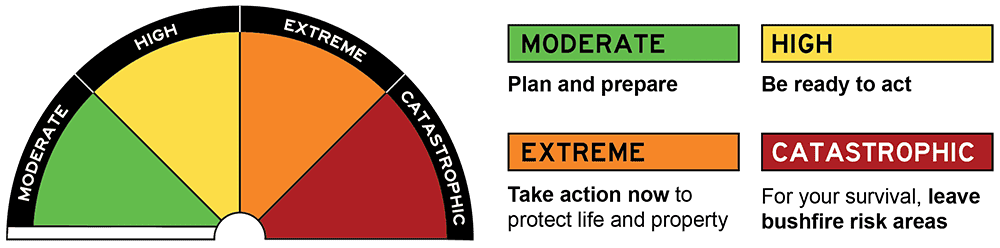 The Australian Fire Danger Ratings System indicates how dangerous a fire would be if one started on that day. Each rating has an action associated with it.
Key information
- Fire Danger Ratings are used during the Fire Danger Period (usually October to May).
- The Fire Danger Rating tells you how dangerous a fire would be if one started.
- Every day the arrow points to the rating for the day.
- The higher the rating, the more dangerous a fire will be if one starts.
- Ratings are forecast up to four days in advance.
There are four levels of fire danger:
- Moderate - Plan and prepare.
- High - Be ready to act.
- Extreme - Take action now to protect your life and property. Do not travel into the bush.
- Catastrophic - For your survival, leave bushfire risk areas the night before or in the morning. Do not travel into the bush.
Where you can find the Fire Danger Rating each day:
Levels 0-1 teaching tools and activities:
Levels 2-4 teaching tools and activities:
hide
Lesson Eleven - Total Fire Bans (TFBs)
Lesson objectives:
- For students to know what a Total Fire Ban is.
- For students to know how to find out if there is a Total Fire Ban in place.
- For students to learn what they cannot do on days of Total Fire Ban.
Total Fire Bans
This video explains what a Total Fire Ban means.
[Fired Up English – Total Fire Ban]
[Voice over]
In Victoria there are laws about lighting fires outside.
When the grass dries out in summer it can easily catch fire. You need to be careful not to start fires outside.
That is why we have Total Fire Ban days in Victoria.
No fires are allowed outside on a Total Fire Ban, and, we also need to be careful not to accidentally start a fire.
You cannot use machinery that can make sparks.
You can only use gas barbecues if you follow certain rules.
Can I or Can't I? is on the CFA website. It has all the rules of what you can, and can't do.
[On screen text]
Fired Up English program for English as an Additional Language (EAL) students. In collaboration with Chisholm Tafe.
Key information:
- In Victoria we have to be careful not to start fires outside because they can spread very quickly.
- In Victoria there are laws about lighting fires outside and using machinery during the Fire Danger Period (usually Oct - May).
- On a day of Total Fire Ban no fires are allowed outside. It is against the law.
- You can not use machinery that might make sparks like grinders or mowers.
- CFA has a Facebook page and over summer this will let you know if there are any Total Fire Bans. You may also see signs or hear about a Total Fire Ban during the news on TV.
- Visit the CFA or Vic Emergency website or call the VicEmergency Hotline on 1800 226 226.
- It is your responsibility to find out if it is a Total Fire Ban.
Teaching tools and activities Levels 0-1:
Teaching tools and activities Level 2-4:
hide
Lesson Twelve - Preparing your Property
Lesson objectives:
For students to know what they can do to reduce the risk of a house catching fire during a bush or grassfire.
Preparing Your Property
This video explains how to prepare your property for fire season.
[Prepare your property for fire season]
[Music]
[Voice over]
This fire season it's important that everyone is aware of their fire risk.
Preparing your property may reduce the impact the fire has on your home.
Ways in which you can prepare your home include:
Keep your grass cut to less than ten centimetres.
Keep gutters clear of leaf litter.
Remove any flammable items from decks and verandahs, including boxes furniture and doormats.
Cut back overhanging branches.
Remove dried grasses, leaves twigs and loose bark.
Prune shrubs well away from tree branches.
Move wood piles away from your home.
These are just some of the main ways in which you could prepare your home.
To learn more about preparing your property, visit cfa.vic.gov.au/prepare
[Music fades]
Key Information
- Everyone in Victoria who lives near forest, bush, grassland or coastal scrub needs to prepare their property for bushfire.
- Keep grass cut to less than 10cm. Fire can ignite and travel quickly through long grass.
- Keep woodpiles away from the house.
- Remove flammable items from around your house.
- Cut back overhanging tree branches and prune shrubs so they do not touch other trees or the house.
- Keep gutters and roof areas clear of leaf litter.
Levels 0-1 teaching tools and activities:
- Activity 12.1 - Key Words and Images - Preparing Your Property
Levels 2-4 teaching tools and activities:
- Activity 12.2 - Well-Prepared Property Poster (PDF 2.9MB). Use the Well-Prepared Property poster and talk students through each item.
- How would they prepare their property?
- What would they do at home?
- Activity 12.3 - Draw a poster of a well prepared house close to the bush
hide
Resources
Preparing your property
CFA's 'Preparing Your Property' booklet contains comprehensive information about property preparation in the lead up to bushfire season.
Page last updated: Thursday, 8 October 2026 12:18:45 PM