Summary
- Community Fire Refuges are not Emergency Relief Centres. There will be no staff or services available.
- Victoria has five Community Fire Refuges in high risk bushfire areas.
- They are designed to protect people from direct flames, radiant heat, and embers when trapped by a bushfire.
- They are a last resort for when plans, like leaving early or defending a well-prepared home, have failed.
- You shouldn't plan to be there. You don't want to end up there.
- Community Fire Refuges are not a leave early destination.
- Leaving early, before a fire has started, is the safest option.
What is a Community Fire Refuge?
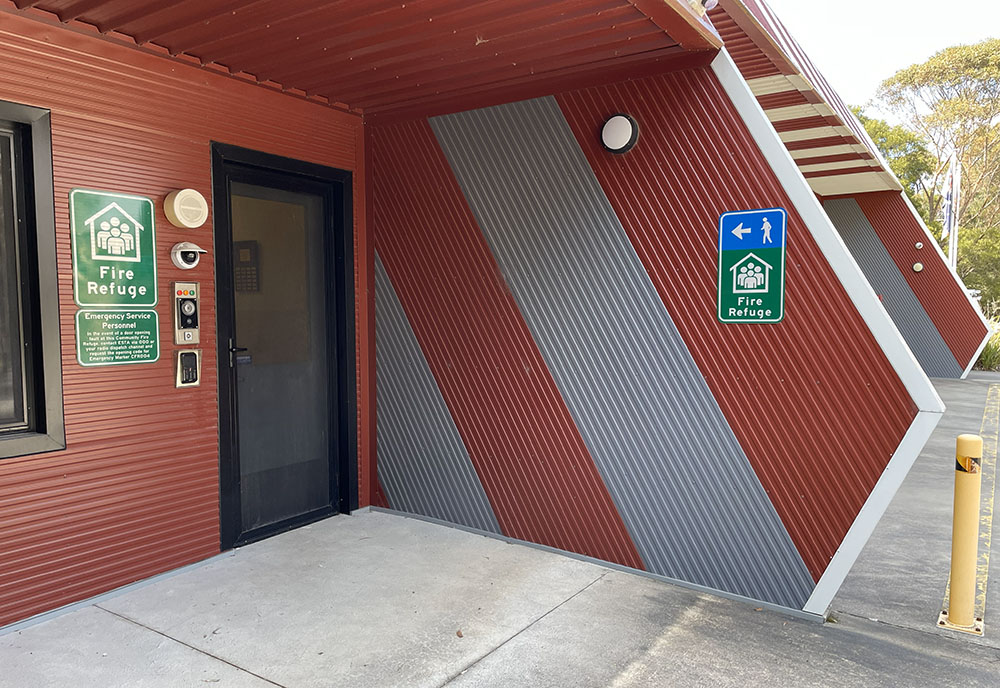 Community Fire Refuge at Millgrove. Not all Community Fire Refuges have this distinctive painting.
Community Fire Refuges are purpose built or modified buildings designed to:
- provide short-term shelter from a bushfire
- protect from radiant heat and embers
- be used when other plans have failed.
Community Fire Refuges can only be opened if there is a significant fire in the area.
They are not recovery centres. Community Fire Refuges are designed to be used as a short-term shelter until the immediate fire threat has passed.
Community Fire Refuges are not an emergency relief or recovery centre. There will be no staff or services available. If you're looking for help after a fire contact your local council.
Community Fire Refuge locations
There are currently five official Community Fire Refuges in Victoria.
These Community Fire Refuges have been formally prescribed in the CFA Regulations 2025.
Millwarra Primary School East Warburton Campus
Library and Learning Centre
397 Woods Point Road, East Warburton
Ferny Creek Primary School
Library and Learning Centre
School Road, Ferny Creek
Country Fire Authority (CFA) Fire Station
3060 Warburton Highway, Millgrove
Country Fire Authority (CFA) Fire Station
2 Terrill Street, Blackwood
Country Fire Authority (CFA) Fire Station
8-14 Lavers Hill-Cobden Road, Lavers Hill
Community Fire Refuges are clearly identified by road signs and signs at the fire refuge itself.
Not all townships have a Community Fire Refuge. They are designed as a last resort option in some very high risk areas.
When to go to a Community Fire Refuge
Community Fire Refuges are a last resort option. Your safety is not guaranteed.
Only go if:
- your bushfire plan has failed
- you are trapped by a significant fire and unable to escape
- you can get there safely
- you can access the location before the fire arrives.
Do not go to a Community Fire Refuge if you can leave the area safely before there are signs of a fire.
What to expect
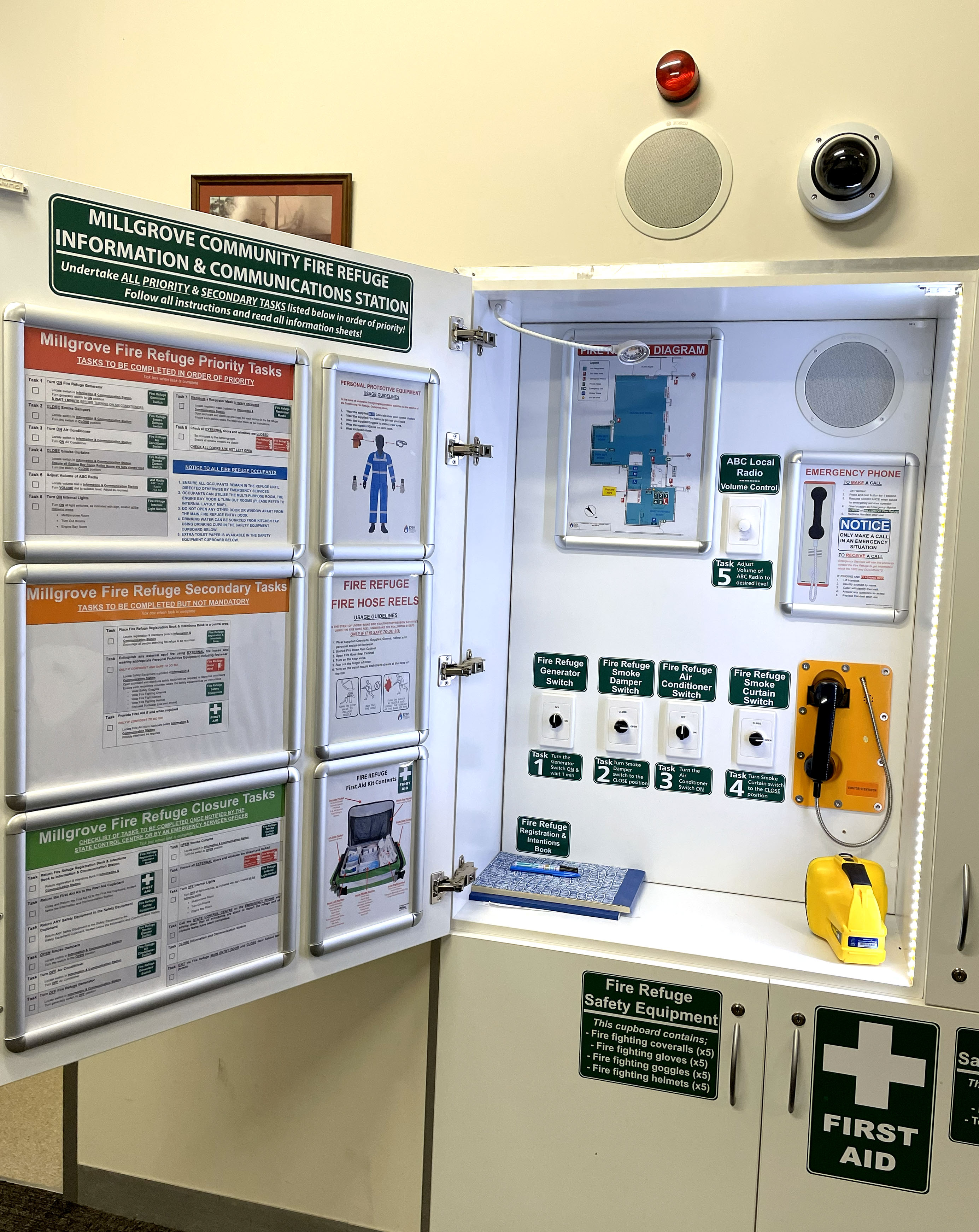 Inside a Community Fire Refuge you will find a communications cabinet box on the wall with complete instructions on what you should do.
Community Fire Refuges are designed to be used and self-operated by the community.
There will be an entry button to get in. Once you're inside, you will find, first aid and safety equipment, and instructions for what to do next.
What you can expect:
- It may be hot and uncomfortable.
- There will be limited capacity.
- Parking nearby will be limited.
- You may experience distress.
Emergency services are unlikely to be present at a Community Fire Refuge.
All last resort options carry a risk of injury or death.
What to take
Only take the essentials with you:
- Mobile phone and charger
- Medication
- Food
- Drinking water
It is a short-term shelter, while the fire passes.
Pets and livestock cannot be taken into a fire refuge.
What to wear
You should wear protective clothing. Cover all exposed skin to protect you from radiant heat.
Driving to a Community Fire Refuge is risky
Driving to a Community Fire Refuge during a bushfire can be dangerous, because:
- roads might become blocked by fallen trees
- smoke can make it hard to see
- embers can cause spot fires
- there could be a lot of traffic
- you could become trapped by fire on the way.
Only go to a Community Fire Refuge if you are confident you can get there safely.
Difference between a Community Fire Refuge and Neighbourhood Safer Place - Bushfire Place of Last Resort
Both Community Fire Refuges and Neighbourhood Safer Places are places of absolute last resort. Some differences are listed below:
Community Fire Refuge
- Purpose-built or modified buildings.
- Designed to protect against direct flames, radiant heat, and embers.
- Only five across the State.
Neighbourhood Safer Place - Bushfire Place of Last Resort
- Generally an open-air space like a sports oval.
- Not a purpose-built or fire-proof structure.
- May provide some protection from direct flames and radiant heat in a bushfire.
- Unlikely to provide any protection from wind, fire noise, embers, smoke and ash.
More information
Background and policy information at Emergency Management Victoria.
Page last updated: Monday, 21 September 2026 3:06:36 PM