Summary
- By law, smoke alarms must be installed between each sleeping area and the rest of the house, and on each floor.
- Bedroom fires when people are sleeping are the most deadly.
- CFA recommends you put smoke alarms in every bedroom and living area to give you more time to escape a fire.
- Install smoke alarms away from walls and corners.
Where to install smoke alarms
By law, smoke alarms must be installed between each sleeping area and the rest of the house. Due to recent research, CFA recommends you go further and put smoke alarms in every living area and every bedroom as well.
[Smoke Alarms - where to put them]
[tense music]
The number and location of smoke alarms is more important than the type of smoke alarms you have.
You are required by law to have smoke alarms between each sleeping area and the rest of the house. This is why you will often find them in a hallway or a main room of a house. Smoke alarms are also required on every level of the house and in escape paths, such as stairways. Early warning could save your life.
Victorian Fire Services recommend that you also have smoke alarms in lounge or living areas and areas where people sleep, such as bedrooms. You might even consider putting one in the garage.
For the best protection, having interconnected smoke alarms
means that when one activates, they all will.
Smoke alarms are not needed in kitchens, laundries or bathrooms. In these areas, they are likely to cause false alarms.
Only working smoke alarms in the right locations save lives.
Legally required smoke alarms
Victorian law has minimum requirements for the number and location of smoke alarms in homes.
Single storey homes, including apartments, units and caravans
According to Victorian law, there must be a smoke alarm between each sleeping area and the rest of the house.
Multi-storey homes
By law, in multi-storey homes:
- there must be a smoke alarm between each sleeping area and the rest of the house.
- there must be a smoke alarm on every floor of a multi-storey home, including floors with no bedrooms.
- If there are no bedrooms upstairs, a smoke alarm must be located near the top of the stairs.
- If there are bedrooms upstairs, then a smoke alarm must be positioned near the inter-connecting stairs on the ground floor.
- smoke alarms should be installed on the path people would take when leaving during an emergency.
CFA recommends smoke alarms in every bedroom and living room
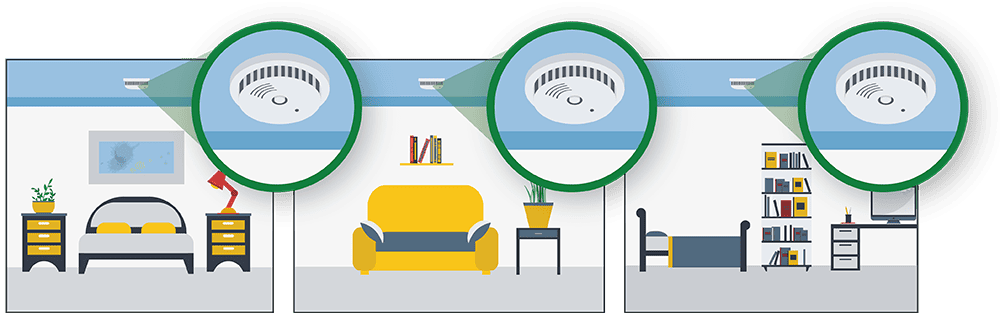 CFA recommends a working smoke alarm in every bedroom and living area.
CFA recommends going beyond what's required by law. The more smoke alarms you have, the sooner you know there's a fire, and the sooner you can escape.
CFA recommends installing a working smoke alarm in every bedroom and every living area.
This is because we know that fires in bedrooms are the most deadly—more people die in house fires which start in the bedroom than anywhere else in the home.
We also recommend putting smoke alarms in rooms where you charge devices and equipment, such as the garage.
Example floor plans
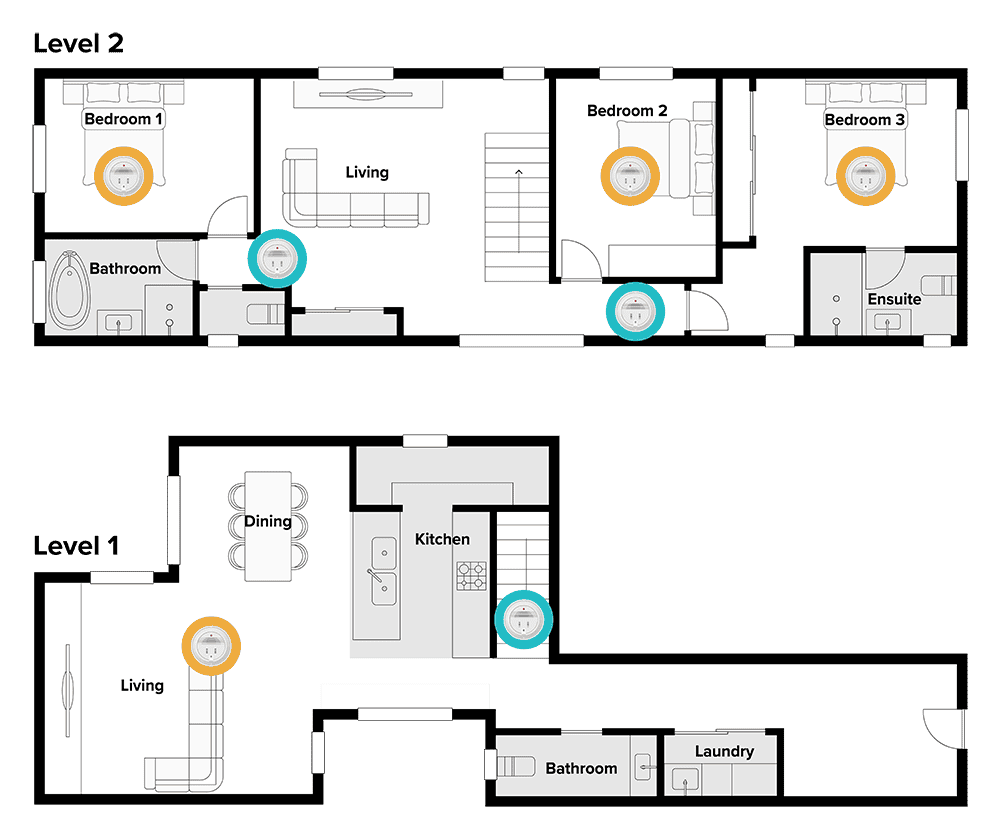 In this floor plan of a 3-bedroom double storey unit, blue circles indicate the minimum legally required smoke alarms, outside sleeping areas and at the bottom of stairs. The yellow circles in every living room and bedroom indicate where CFA recommends installing extra smoke alarms.
CFA has a range of floor plans marked with smoke alarm locations to help you develop a plan for your home.
Each floor plan shows where smoke alarms are legally required (blue), and where CFA recommends putting extra smoke alarms (yellow). Find a selection of floor plans below.
Your exact floor plan might not be here. In that case, apply the principles on this page to your own floor plan.
2 Bedroom Home
2 Bedroom, Single Storey
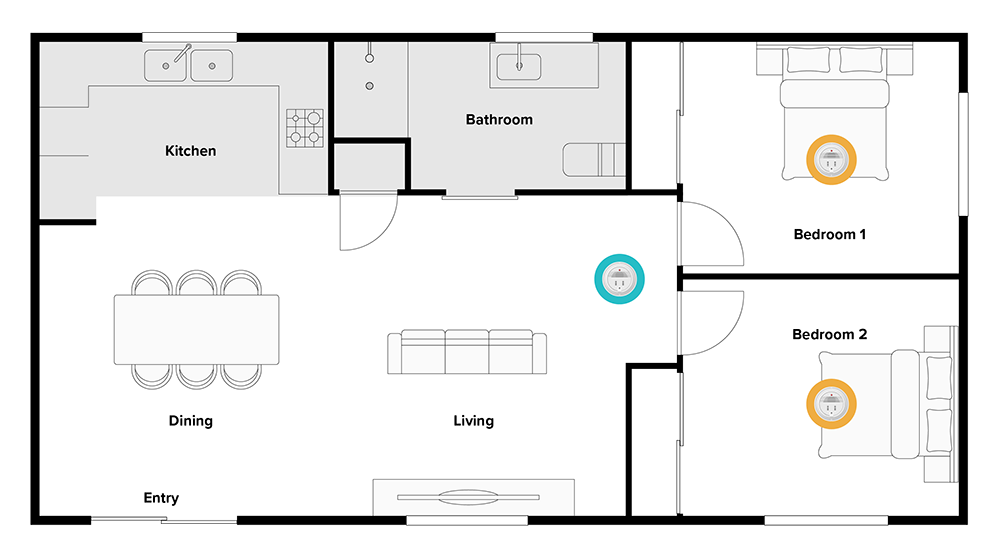
In this two bedroom, single storey home one smoke alarm (blue) is required by law directly outside the two bedrooms that are clustered together. Because the two bedrooms are close together, one smoke alarm can legally cover both rooms.
CFA recommends installing an additional smoke alarm (yellow) inside each of the bedrooms because, if a fire starts inside the bedroom, the extra smoke alarm is more likely to detect the smoke than the one outside the bedrooms.
2 Bedroom, 2 Storey
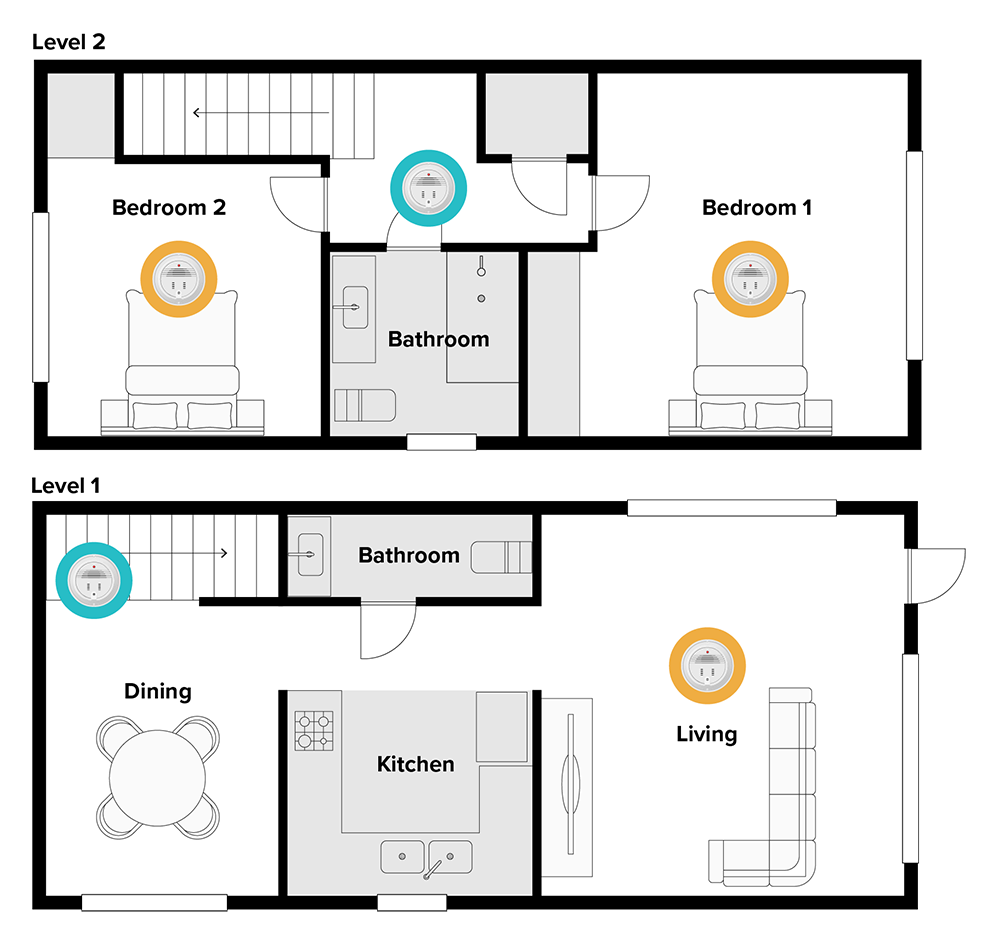
This two bedroom, double storey home requires (blue) one smoke alarm outside the two bedrooms on the top floor. As the two bedrooms are close together, one smoke alarm can legally cover both bedrooms. Because the home has two storeys, an additional smoke alarm is required by law in the stairwell on the ground floor.
CFA recommends installing an additional smoke alarm (yellow) inside each of the bedrooms because, if a fire starts inside the bedroom, the extra smoke alarm is more likely to detect the smoke than the one outside the bedrooms. We also recommend installing an additional smoke alarm in the living room because most fatal fires start in either a bedroom or living area.
3 Bedroom Home
3 Bedroom, Single Storey
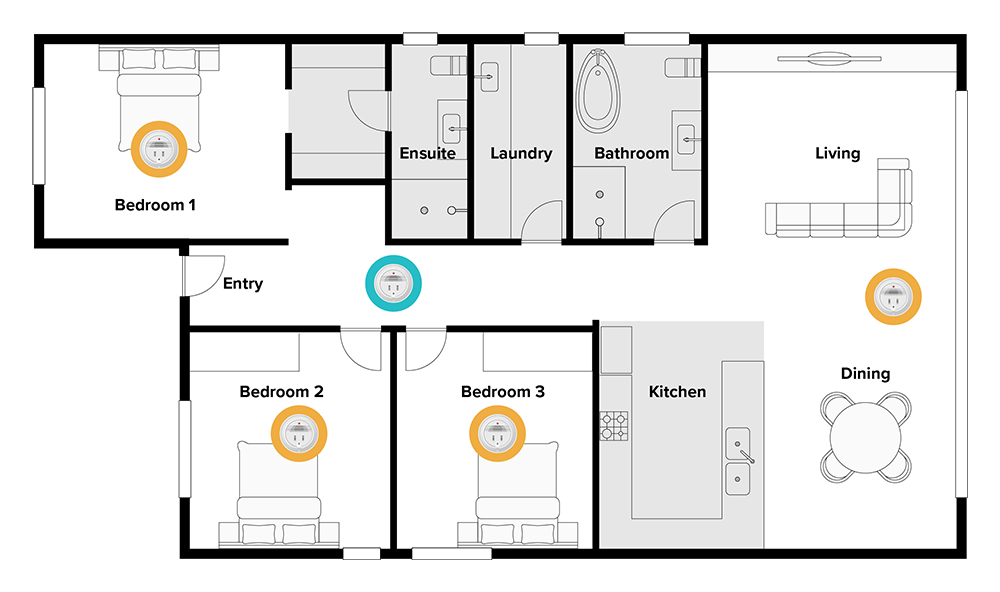
This three bedroom, single storey home requires (blue) a single smoke alarm outside the 3 bedrooms that are clustered together around a hallway. As the bedrooms are close together, one smoke alarm can legally cover all three bedrooms.
CFA recommends installing an additional smoke alarm (yellow) inside each of the bedrooms because, if a fire starts inside the bedroom, the extra smoke alarm is more likely to detect the smoke than the one outside the bedrooms. We also recommend installing an additional smoke alarm in the living area because most fatal fires start in either a bedroom or living area.
3 Bedroom, 2 Storey
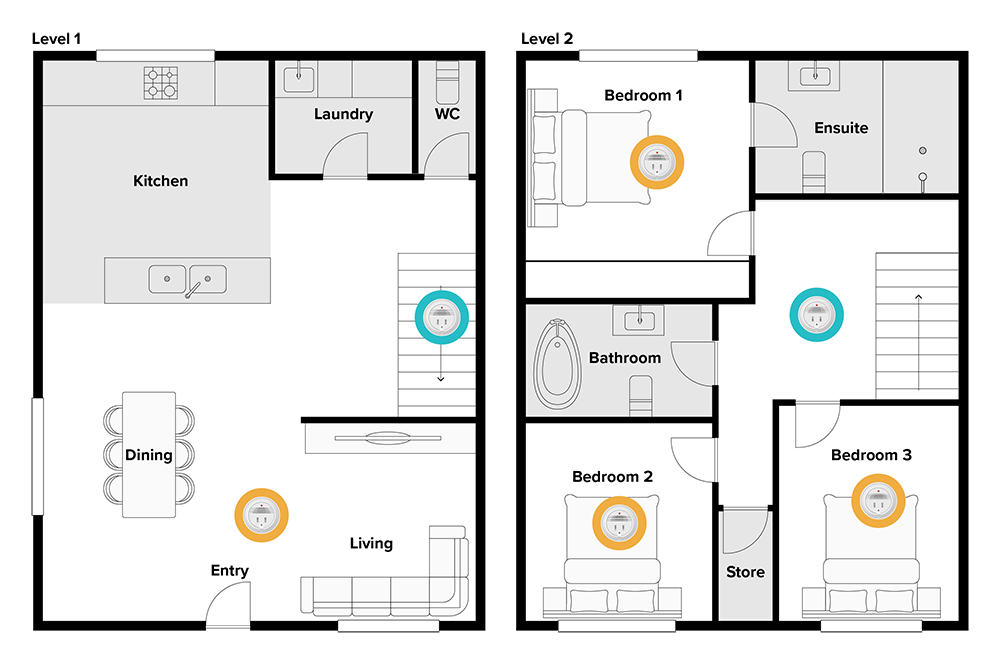
This three bedroom, double storey home requires (blue) one smoke alarm outside the three bedrooms on the top floor. As the three bedrooms are close together, one smoke alarm can legally cover both bedrooms. Because the home has two storeys, an additional smoke alarm is required by law in the stairwell on the ground floor.
CFA recommends installing an additional smoke alarm (yellow) inside each of the bedrooms because, if a fire starts inside the bedroom, the extra smoke alarm is more likely to detect the smoke than the one outside the bedrooms. We also recommend installing an additional smoke alarm in the living room because most fatal fires start in either a bedroom or living area.
3 Bedroom, 3 Storey
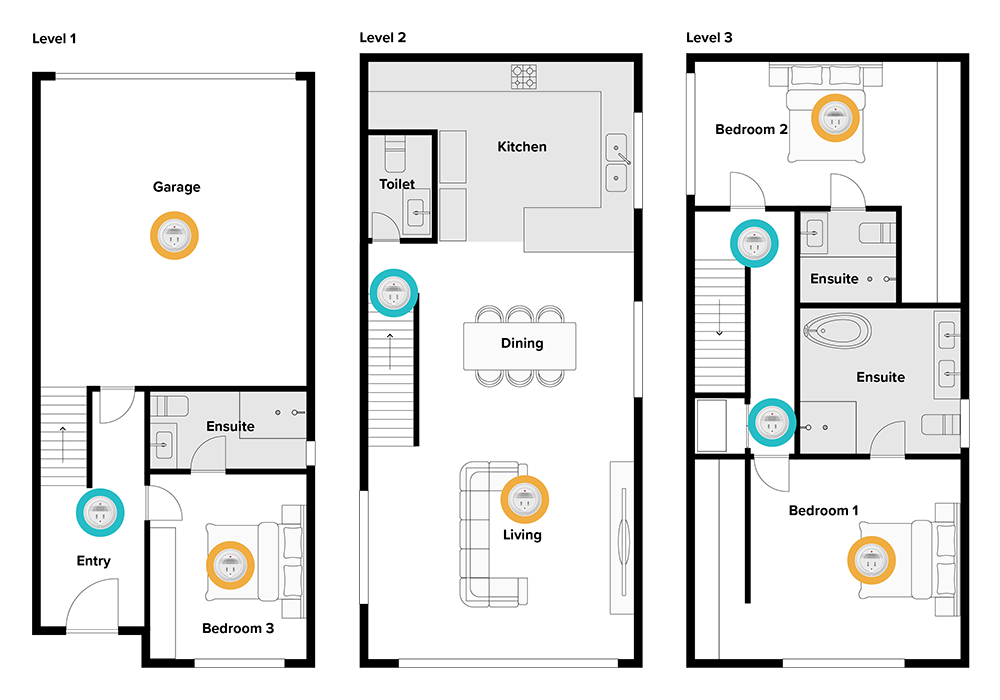
This three bedroom, three storey home requires (blue) one smoke alarm outside bedroom three, on the ground floor. It also requires a smoke alarm outside each of the two bedrooms on the top floor. As the two bedrooms on the top floor are some distance apart, they each require their own smoke alarm outside the bedroom door. Because the home has three storeys, an additional smoke alarm is required by law in the stairwell on the middle floor. The same rule would normally require another smoke alarm at the bottom of the stairs on the ground floor, however the smoke alarm outside bedroom three already serves that purpose.
CFA recommends installing an additional smoke alarm (yellow) inside each of the bedrooms because, if a fire starts inside the bedroom, the extra smoke alarm is more likely to detect the smoke than the one outside the bedroom. We also recommend installing an additional smoke alarm in the garage, and one in the living room because most fatal fires start in either a bedroom or living area.
4 Bedroom Home
4 Bedroom, Single Storey
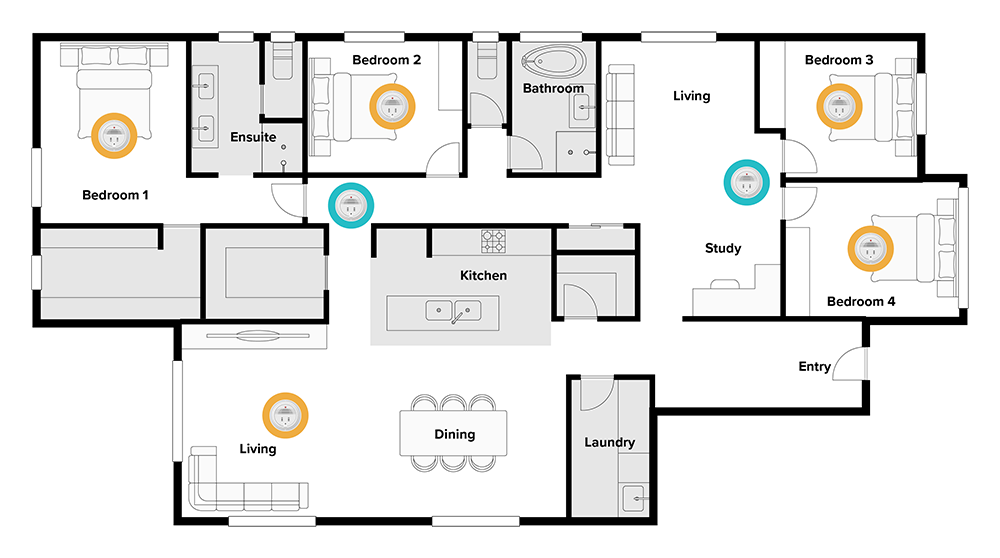
This four bedroom, single storey home requires (blue) a single smoke alarm outside the 3 bedrooms that are clustered together adjoining the living room. As the bedrooms are close together, one smoke alarm can legally cover both bedrooms. It also requires a single smoke alarm outside the two bedrooms clustered at the other end of the house.
CFA recommends installing an additional smoke alarm (yellow) inside each of the bedrooms because, if a fire starts inside the bedroom, the extra smoke alarm is more likely to detect the smoke than the one outside the bedrooms. We also recommend installing an additional smoke alarm in the living area because most fatal fires start in either a bedroom or living area.
4 Bedroom, 2 Storey
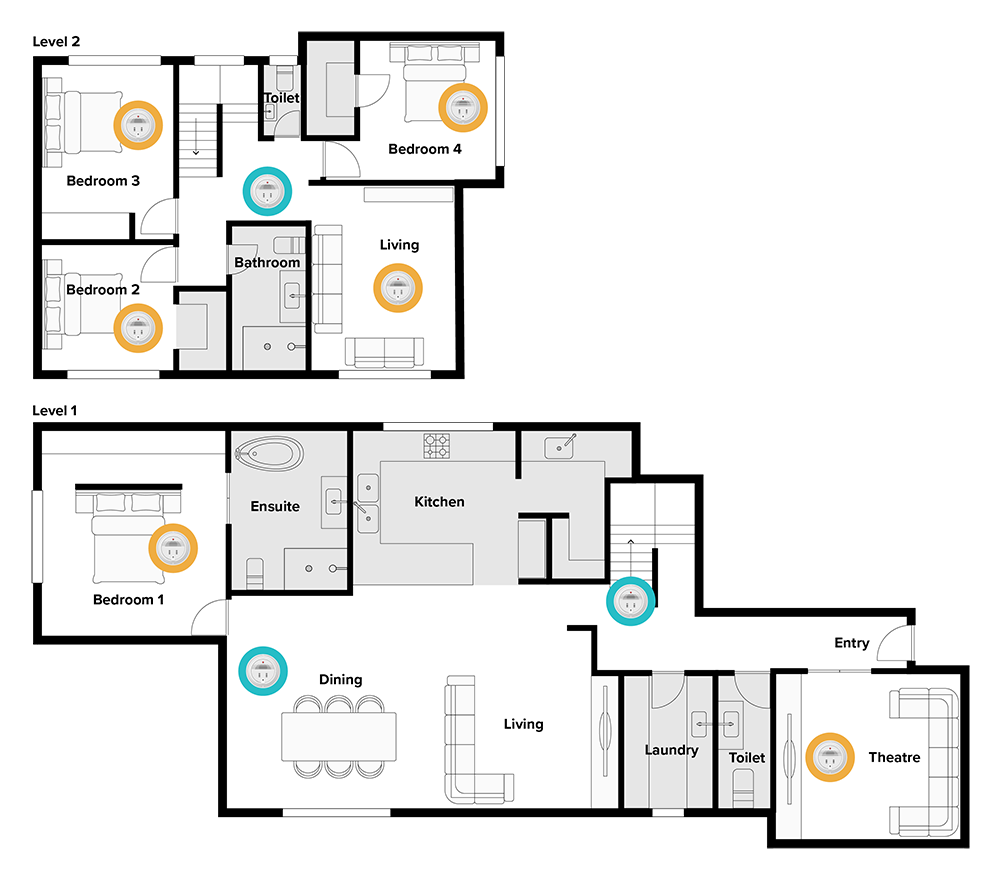
This four bedroom, double storey home requires (blue) one smoke alarm outside the three bedrooms on the top floor. As the three bedrooms are close together, one smoke alarm can legally cover all three bedrooms. Another smoke alarm is required outside the master bedroom at the far end of the ground floor. Because the home has two storeys, an additional smoke alarm is required by law in the stairwell on the ground floor.
CFA recommends installing an additional smoke alarm (yellow) inside each of the bedrooms because, if a fire starts inside the bedroom, the extra smoke alarm is more likely to detect the smoke than the one outside the bedrooms. We normally also recommend installing an additional smoke alarm in the living room because most fatal fires start in either a bedroom or living area. However, the smoke alarm outside the master bedroom will serve this purpose. We do, however recommend installing an additional smoke alarm inside the home theatre and in the upstairs, separate living area.
4 Bedroom, 3 Storey
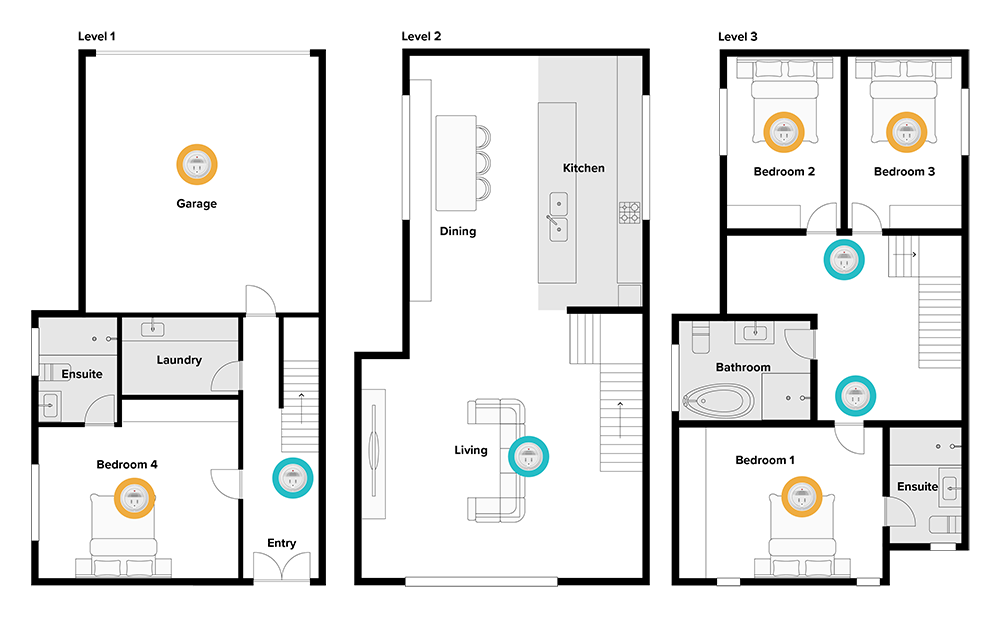
This four bedroom, three storey home requires (blue) one smoke alarm outside bedroom four, on the ground floor. It also requires a smoke alarm outside the master bedroom on the top floor. Another smoke alarm is required outside the other two bedrooms on the top floor. As the two sleeping areas on the top floor are some distance apart, they each require their own smoke alarm. Because the home has three storeys, an additional smoke alarm is required by law in the stairwell on the middle floor. The same rule would normally require another smoke alarm at the bottom of the stairs on the ground floor, however the smoke alarm outside bedroom four already serves that purpose.
CFA recommends installing an additional smoke alarm (yellow) inside each of the bedrooms because, if a fire starts inside the bedroom, the extra smoke alarm is more likely to detect the smoke than the one outside the bedroom. We also normally recommend installing an additional smoke alarm in the living room because most fatal fires start in either a bedroom or living area. However, the smoke alarm that serves the stairwell on the middle floor will do. We do recommend installing another smoke alarm in the garage.
Guidelines for installing smoke alarms
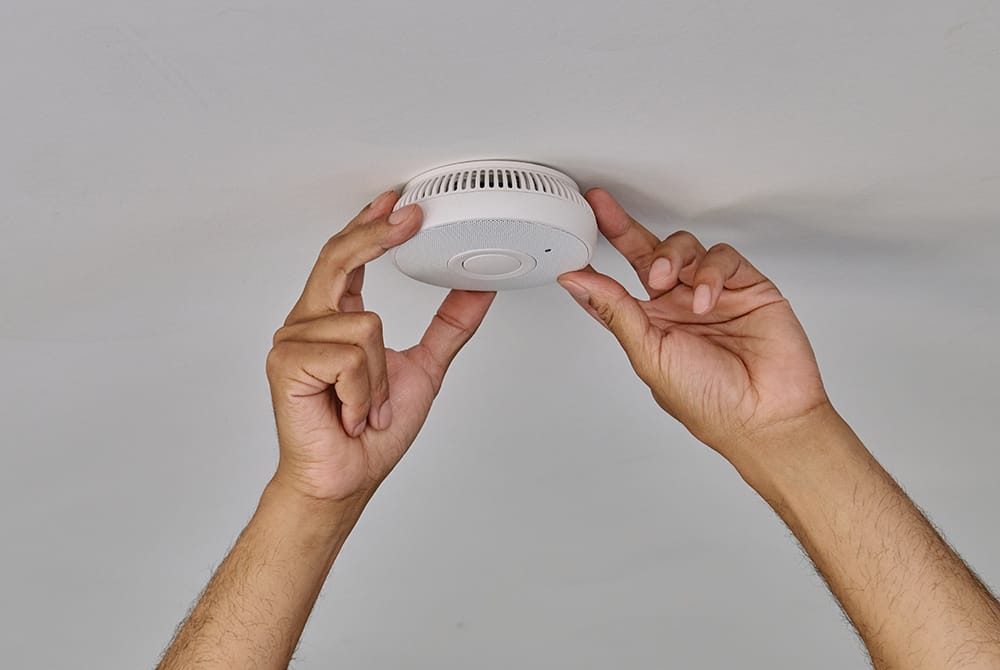
The ideal location for a smoke alarm is the centre of a ceiling, away from walls and corners.
Do not install smoke alarms near the highest point of cathedral or sloping ceilings, the corner junction of walls and ceilings or between exposed floor joists. Smoke can trap a pocket of clean air in corners like these, meaning that a smoke alarm in the corners may not detect smoke. These locations are called 'dead air spaces'.
Do not install smoke alarms near windows, doors or air ducts where drafts could affect alarm sensitivity.
Ceiling installation
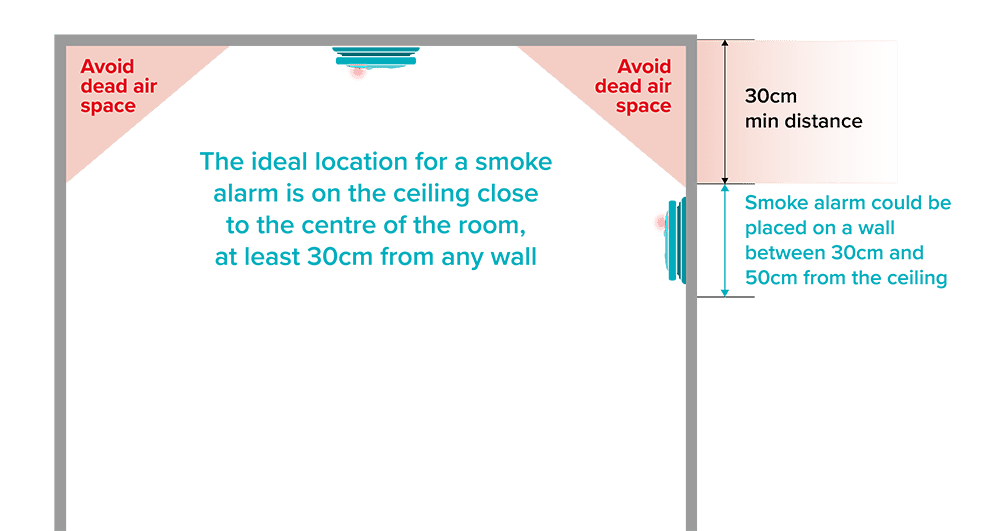
Smoke alarms should be located in the centre of the ceiling. If it can't be located in the centre, it should be 30cm from any corner or wall.
Wall installation
If it's not possible to install a smoke alarm on the ceiling, you can install one high up on a wall. Smoke alarms on walls should be located 30cm - 50cm from the ceiling.
Cathedral ceiling or sloping ceiling installation
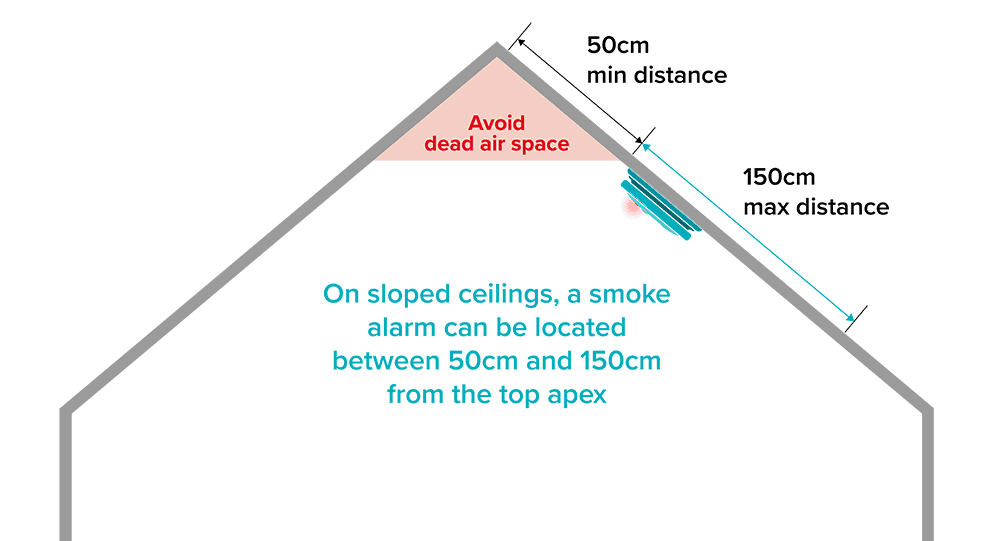
Smoke alarms on cathedral or sloped ceilings should be located 0.5m - 1.5m from the highest point.
hide
How to install a smoke alarm
In this video, you will learn how to install a battery powered smoke alarm in your home.
[How to install a smoke alarm]
[Presenter]
Want to know how to install a smoke alarm in your home? Today, I'll show you step-by-step how to install a battery-powered smoke alarm.
Before you begin, you'll need a drill, phillips head screwdriver, tape measure, pencil, hammer, cable and stud finder, a sturdy ladder, and what's included in the pack. Inside you'll find the smoke alarm with mounting bracket, mounting plugs, screws, and installation instructions.
First, test the smoke alarm is working. If it's powered by a nine volt battery, insert the battery. If the smoke alarm is powered by a ten-year long life battery, turn it on by following the instructions. This one is tested by pressing and holding the test button for around two seconds, then release.
[ALARM SOUNDS]
[ALARM SOUNDS]
[ALARM SOUNDS]
You'll hear three beeps and see the LED light flash to confirm the alarm is active.
Check the instructions for your smoke alarm.
Write the installation date in the space provided on the back of the smoke alarm, and set a reminder to replace it in ten years.
Smoke alarms should be installed as close to the centre of the ceiling as possible, and always more than thirty centimetres from any wall.
Use the cable and stud finder to check there are no electrical cables or joists where you want to drill. To prevent electrocution, go to your switchboard and turn off the mains power before drilling.
Place the mounting bracket against the ceiling and, using a pencil, mark where to drill through the fixing holes. Using the pencil marks as a guide, drill two holes and push the supplied mounting plugs into the holes. Sometimes a gentle tap is required to get them all the way in.
Line up the mounting bracket with the holes. Insert the screws through the mounting bracket into the plugs and don't over tighten the screws. Fit the smoke alarm onto the bracket and turn clockwise until securely locked into position.
Once installed, test the smoke alarm by pressing and holding the test button for around two seconds. The alarm will sound three beeps, and the LED light will flash to confirm it's working correctly.
[ALARM SOUNDS]
[ALARM SOUNDS]
[ALARM SOUNDS]
Your smoke alarm is now installed and ready to provide early warning and time to escape in the event of a fire. Don't forget to test it every month.
[On screen text]
Only working smoke alarms save lives.
cfa.vic.gov.au/smokealarms
frv.vic.gov.au/smoke-alarms
Safety disclaimer: Before following these DIY instructions take steps to ensure your own safety, including protecting yourself from electrocution and earing safety glasses. 240v hardwired smoke alarms can only be installed by a licensed electrician.
Don't open or break smoke alarms
Some smoke alarms contain a very small amount of radioactive
material. It is safe within the smoke alarm and won't hurt you. But do
not open, dismantle or break smoke alarms when disposing of them as the
radioactive material may be exposed.
Household quantities of smoke alarms can be placed into your general household waste for normal kerbside pickup.
Resources
Smoke alarms (illustrated)
A quick and easy to read factsheet with illustrations.
Smoke alarms
A quick guide on smoke alarms maintenance and where to install.
Page last updated: Wednesday, 23 September 2026 5:28:09 PM