What you'll learn
Residents will have working smoke alarms installed in their home, but they will also:
- learn how and when to maintain and replace smoke alarms.
- develop a better understanding of general home fire safety.
Who is it for?
This service is aimed at people who could be at high risk in a house fire. It's specifically for people who can't obtain, install or maintain smoke alarms. This can include people who:
- are older and/or less mobile
- have a disability
- are from multicultural communities, particularly if they have low literacy levels
- are experiencing social or financial disadvantage.
At risk residents are identified by CFA using local risk information, or by direct referral.
Why the Smoke Alarm Installation Service exists
Smoke alarms save lives
In Victoria, an average of 20 people die in house fires every year. Most of these deaths could be prevented. Smoke alarms give people the chance to escape when a fire breaks out.
[Smoke Alarms]
[Tense music]
[Voice over]
In Victoria, on average, 20 people die in house fires each year, so smoke alarms are important devices to have in your home. In a house fire, a smoke alarm detects smoke and beeps loudly to alert you.
[Smoke alarm beeping rapidly, fire crackling]
This warning allows you time to act and get out of the house, before it becomes too dangerous. Smoke alarms in your home will not call the fire brigade for you, so, you need to escape to be safe, then call Triple Zero so your local fire brigade can come to help.
[Siren wailing loudly]
[Music fades out]
[Gentle music]
[Voice over]
You and your loved ones may be seriously burned, injured or die in a fire if you don't have smoke alarms in your home, if they're not installed in the right locations, or if the batteries have been removed.
[Ominous music]
Smoke alarms are made to alert you before the air becomes -- Fire! -- too toxic for you to escape. Toxins in the smoke irritate the eyes, nose, and throat. These toxins also stop oxygen from being absorbed in your lungs. You will find it hard to breathe and see. You will not be able to think clearly. So, you will make bad decisions and may not be able to escape in time.
Fires can spread to other rooms within two to three minutes, but a fire may burn for some time before a smoke alarm beeps. So you will have even less time to escape. Working smoke alarms in the right locations allow you more time to escape.
You are at highest risk from fire when you are sleeping. Many people think they will wake up when there is a fire, but they are wrong. Most people who die in fires are found on or next to their bed. During sleep, you lose your sense of smell so smoke won't wake you up.
Carbon monoxide in the smoke, also known as the silent killer, will put you into a deeper sleep.
Smoke will kill you before the flames do.
Some people think the smoke alarm outside their bedroom is enough to alert them to fire. Research has shown that if a fire starts in a bedroom and the door is closed, the smoke alarm outside the bedroom will not activate, until the fire burns through the door. By then, the bedroom will be full of smoke, and it will be, too late.
Smoke may not wake you, but a working smoke alarm in your bedroom will.
[Smoke alarm beeping]
[Baby crying]
[Dramatic music fades]
[Gentle music]
The number and location of smoke alarms is more important than the type of smoke alarms you have.
You are required by law, to have smoke alarms between each sleeping area and the rest of the house. This is why you will often find them in a hallway or a main room of a house. Smoke alarms are also required on every level of the house and in escape paths, such as stairways. Early warning could save your life.
Victorian Fire Services recommend that you also have smoke alarms in lounge or living areas and areas where people sleep, such as bedrooms. You might even consider putting one in the garage.
For the best protection, having interconnected smoke alarms means that when one activates, they all will.
Smoke alarms are not needed in kitchens, laundries or bathrooms. In these areas, they are likely to cause false alarms.
Only working smoke alarms in the right locations save lives.
[Tense music]
Some people need extra help to obtain, install or maintain smoke alarms
Some residents are at higher risk of injury or death in a house fire. This can include people who:
- are older and/or less mobile
- have a disability
- are from multicultural communities, particularly if they have low literacy levels
- are experiencing social or financial disadvantage.
This program is designed to reduce their risk in a home fire by ensuring they have working smoke alarms.
What happens during a visit
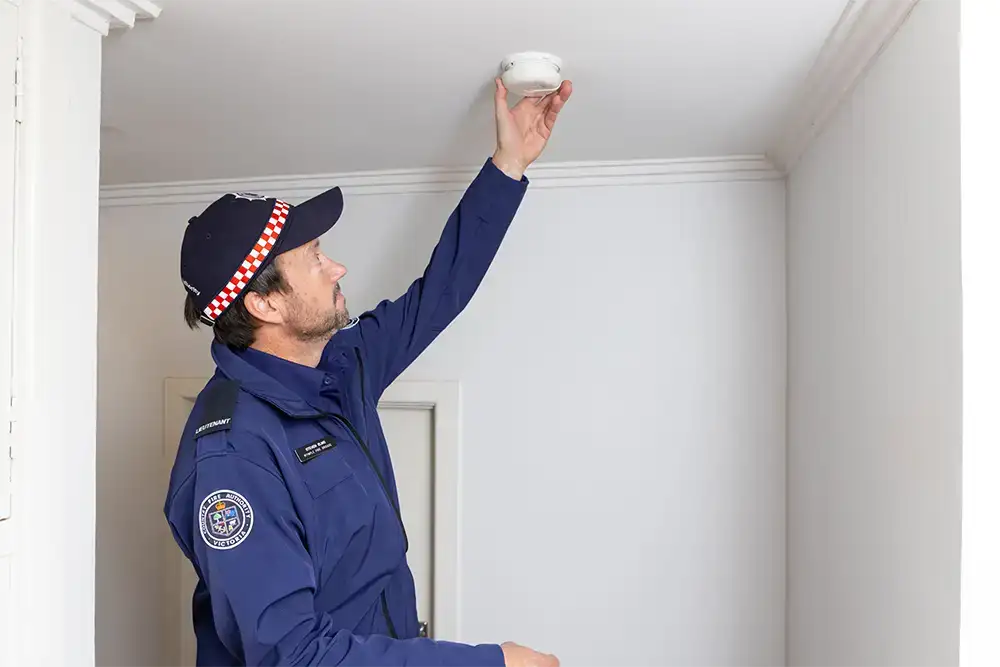
Trained CFA members visit high-risk homes to install smoke alarms and offer advice.
During the free visit, a trained CFA member will help residents understand why they need working smoke alarms. They will also install the recommended number of smoke alarms in the home.
The CFA member will also educate residents about how to maintain and replace smoke alarms when needed, and offer general home fire safety information.
Program/service cost
The Smoke Alarm Installation Service is free.
Who can access the service
The Smoke Alarm Installation Service is a targeted program. This means CFA contacts residents identified as being at high risk. Find out if it is delivered in your area by speaking to your regional or district office.
If you live outside CFA's service area
If you live outside CFA's service area, Fire Rescue Victoria's At Risk Groups Unit may be able to help. Contact FRV on 1300 367 617 or online.

CFA thanks RACV for their generous support to the Smoke Alarm Installation Service. Together we are improving home fire safety for thousands of residents across Victorian communities.
Page last updated: Wednesday, 26 August 2026 4:58:10 PM