Summary
Smoke alarms vary in terms of:
- how they are powered
- the kind of technology they use to detect smoke
- whether they are interconnected or not
- whether they have extra features like smartphone compatibility
- how much they cost.
Power source options: battery or hard-wired
Battery-powered smoke alarms
Battery-powered smoke alarms are generally cheaper than hard-wired smoke alarms. Hard-wired smoke alarms are required by law in some homes.
The two types of batteries found in smoke alarms are:
9-volt (9V) batteries
- Batteries need to be replaced every year.
- Cheaper up front cost for the alarm. But an ongoing yearly cost to replace battery.
Long-life batteries
- Powered by long-life batteries , sealed inside the smoke alarm.
- These batteries last 10 years and don't need to be replaced.
- The whole smoke alarm unit is replaced after 10 years.
- Slightly more expensive up front cost, but no ongoing costs.
Hard-wired (240V) smoke alarms
These are connected directly to your home's mains power, and must have back-up battery power supply.
For homes constructed after 1 August 1997, legally-required smoke alarms must be hard-wired. They must also have a back-up battery in case there is a power failure.
240 volt, hard-wired smoke alarms must be installed by an electrician.
All smoke alarms—whether long-life battery, 9V battery or hard-wired— should be replaced after 10 years.
Interconnected Smoke Alarms
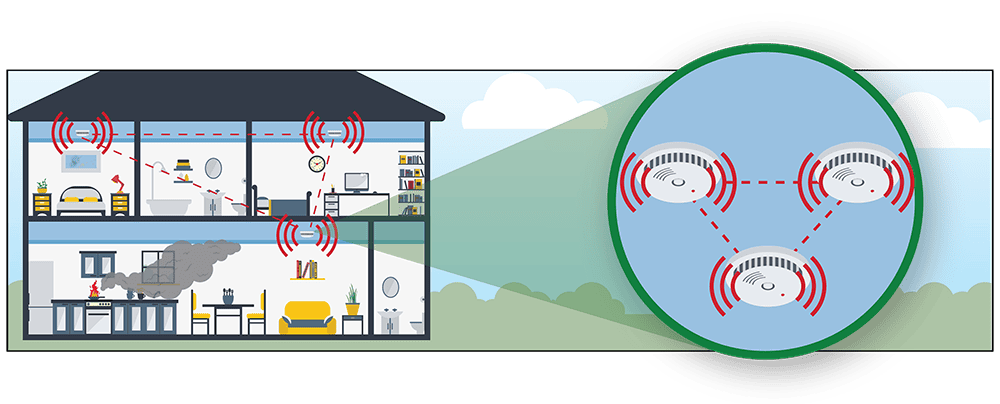
Interconnected smoke alarms are linked to each other. If one goes off, all the smoke alarms in the house will also go off. This is useful in larger homes where sleeping and living areas are far apart from each other. It's also useful if you have smoke alarms inside bedrooms or in a garage.
Studies have shown that 85% of children don't wake to the sound of a smoke alarm.
If a house has interconnected smoke alarms, the smoke alarm in the caregiver's room will be alerted if a smoke alarm goes off in the child's room. This could save the child's life.
All homes constructed, or significantly renovated after 1 May 2014 must have 240 volt hard-wired smoke alarms that are interconnected.
Connection technology
There are a range of inter-connected smoke alarms available on the market, which connect using different technologies.
All the smoke alarms in your home must use the same technology to connect to one another and work properly.
Below are the different types of interconnected smoke alarms:
- Connection is via a physical cable running through your roof space.
- Interconnection is done by an electrician at the time of installation.
- Back up batteries means even if you lose power the smoke alarms will still work and still be connected to one another.
- Connection is via radio frequency.
- This technology is similar to that used in cordless home phones.
- They are the most common type of interconnected smoke alarms.
- They have to be paired to each other.
- Maintains interconnection if your wi-fi isn't working.
- Connection is via the wi-fi network through the touch of a button.
- These 'smart' smoke alarms are often controlled through an app.
- The app allows you to do things like silence the alarms or tell you where in your house the fire is located.
- If the wifi stops working, the smoke alarms risk becoming disconnected from one another. But they will still work as smoke alarms.
Types of detection technology
Smoke alarms detect smoke in different ways.
Ionisation smoke alarms
- Better than photoelectric alarms at detecting smoke given off by fast-flaming fires (for example paper or petrol fires).
- False alarms from cooking and steam are more likely.
- Cheap and reasonably common.
How they work
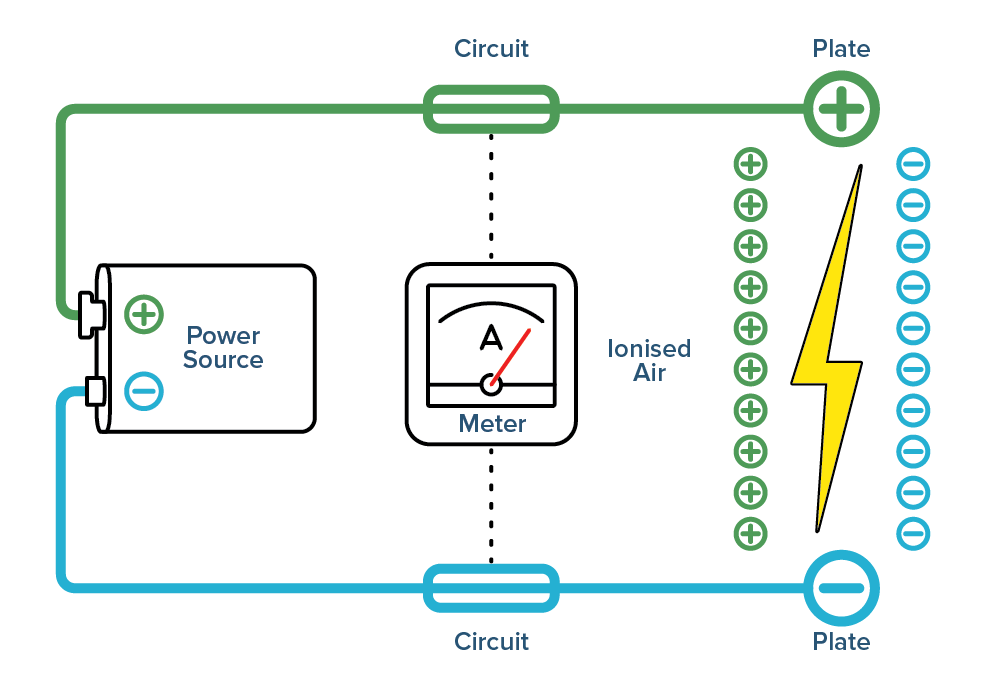 Ionisation smoke alarms use a very small piece of radioactive material which ionises (charges) the air between two electrically-charged plates inside a detection chamber. This causes a small electric current to flow through the air between the two plates.
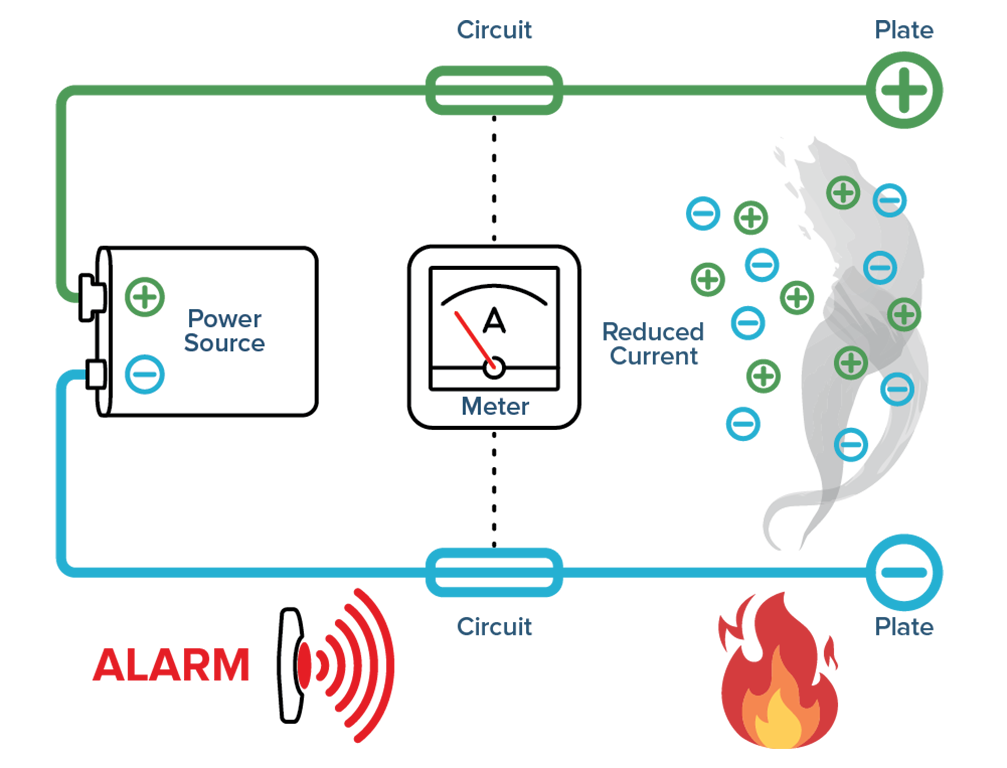 When smoke particles enter the chamber some of them attach themselves to the ions and reduce the current flow. The electronics inside the smoke alarm detect the drop in current and sound the alarm.
Photoelectric smoke alarms
- Photoelectric smoke alarms are better than ionisation alarms at detecting smoke from smouldering fires, for example fires involving cigarettes, synthetic furnishings and electrical overloading.
- Most widely available type of smoke alarm and reasonably cheap.
- Less likely than ionisation smoke alarms to cause false alarms.
How they work
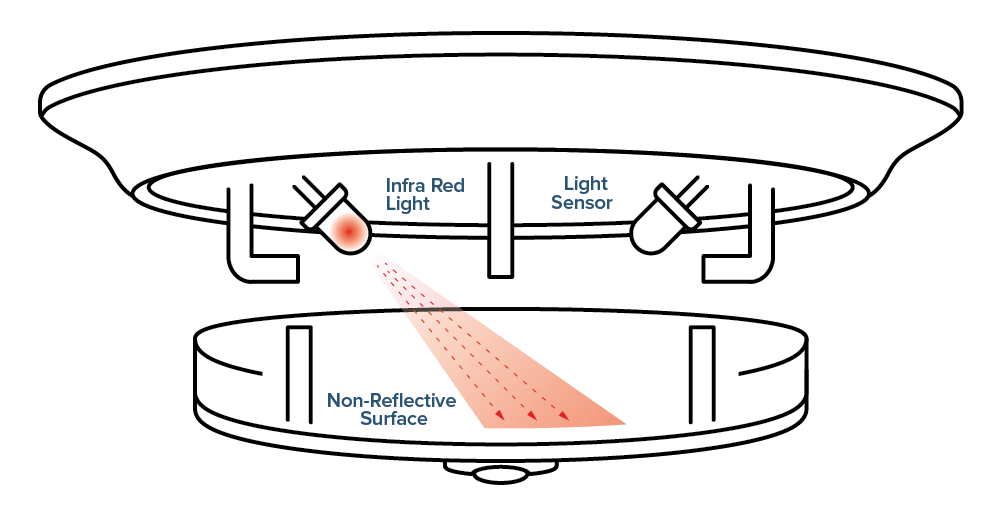 Photoelectric smoke alarms have a small detection chamber. This chamber is matte black inside and contains an LED and a light sensor. The LED produces an a beam of light which is aimed away from the sensor. While there is no smoke the sensor 'sees' nothing so the smoke alarm remains silent.
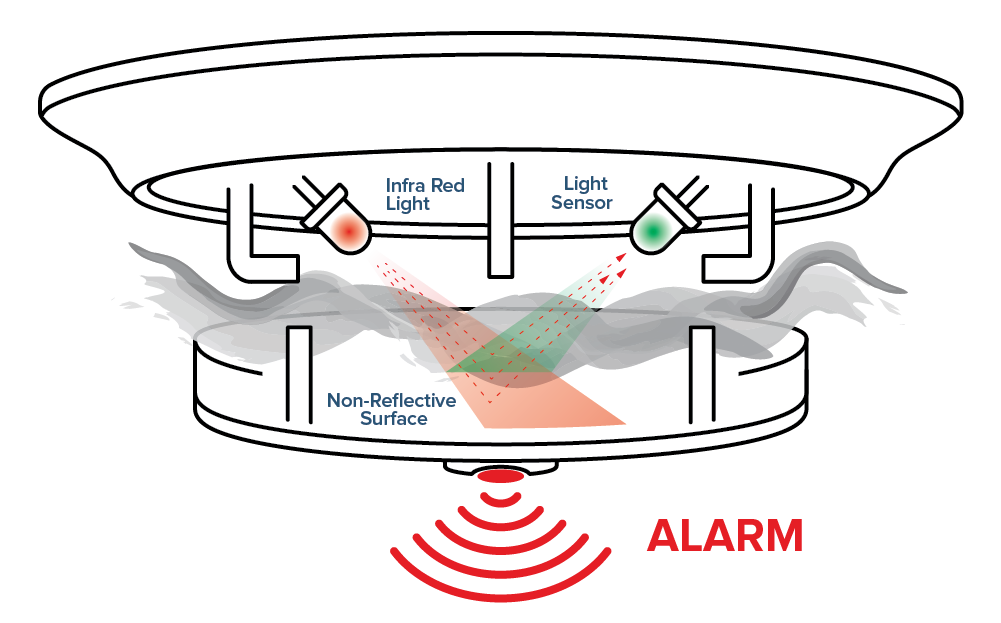 Any smoke entering the chamber will start to scatter the light in the beam so that some of it reflects onto the sensor which activates the alarm.
Dual sensor smoke alarms
Dual sensor smoke alarms contain both photoelectric and ionisation detection technology in separate chambers.
- More expensive and less commonly available than other types.
- Research has shown that dual sensor alarms are quicker to activate than ionisation or photoelectric smoke alarms.
Multi-criteria smoke alarms
Multi-criteria smoke alarms combine a smoke detector with some other form of fire detection.
- They have two methods of detecting that a fire has started.
- More expensive and less widely available.
Some examples of multi-criteria smoke alarm combinations:
- A smoke detector combined with a heat detector.
- A photoelectric smoke detector combined with a carbon monoxide detector.
Advanced smoke alarm technology
'Smart' smoke alarms
Some smart smoke alarms work via an app. The app interface allows you to do things like see where the fire has started or turn the alarm off if there is a false alarm.
Talking alarms
These alarms allow you to record your voice to be used as the alert. This can be very effective for waking up sleeping children. Research has shown that children may not wake up to a smoke alarm, but they will wake to their mother's voice.
Smoke alarms for people who are deaf or hard of hearing
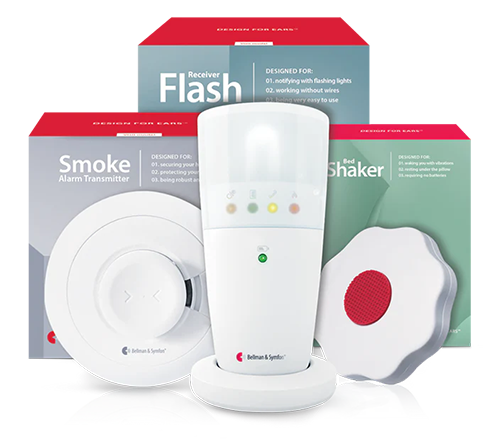
Specialised smoke alarms are available for people who are deaf or hard of hearing. They are are designed to alert people in multiple ways.
They have:
- a normal smoke alarm attached to the ceiling
- a separate strobe light
- a vibrating bed pad.
When triggered, alarms will sound, the lights will flash, and the vibrating pad will activate.
Specialised alarms can be interconnected with conventional audible alarms in different locations within the home and others can be linked with some personal alarms.
A Smoke Alarm Subsidy is available from the Government. Find out if you are eligible for a Smoke Alarm Subsidy via Expression Australia.
Resources
Smoke alarm subsidy
Download the smoke alarm subsidy flyer.
Smoke alarms (illustrated)
A quick and easy to read factsheet with illustrations.
Smoke alarms
A quick guide on smoke alarms maintenance and where to install.
Page last updated: Tuesday, 22 September 2026 3:52:35 PM