Summary
- Grassfires can burn in parklands, reserves and paddocks.
- On windy days grassfires move very quickly.
- They can create huge amounts of radiant heat and threaten lives and homes.
- Don't wait for a warning before taking action.
- If you live in a suburb right next to grasslands and a fire starts, walk a few streets back.
- Don't drive away—there is a high risk of accidents, and traffic can prevent fire trucks getting to houses.
- Keep your property maintained and your grass short.
Grassfires can happen anywhere
Fires don’t only happen in the bush. If you live near grassland, a reserve, park or paddocks, you are at risk of grassfires. Learn more about how they start and spread in the video below.
[Grassfires]
The following may be distressing to some viewers.
Grass is a major part of the Australian landscape.
It is considered a fine fuel, which means it is easier to ignite.
Under hot and dry conditions, grass dries out very quickly so grassfires can start earlier in the day than bushfires.
Grassfires occur in open spaces like paddocks, farmland and parkland. This means grassfires are open to the full effect of the wind.
Under gusty conditions they are unpredictable, can change direction quickly, and go from a small fire to a dangerous fire in a matter of minutes.
The taller and drier the grass the more intensely a grassfire will burn.
Grassfires can also involve other vegetation such as bush and scrub, which influences the fire's behaviour.
When threatened by a grassfire you may become isolated.
Grassfires should not be underestimated. They are fast, hot and can produce large amounts of radiant heat, threatening lives, properties and livelihoods.
And although grassfires are usually short-lived compared to bushfires, they can still spread many kilometres in a relatively short time, reaching speeds of up to 25 kilometres per hour, faster than you can run.
A grassfire can damage properties at the edge of an urban area but are unlikely to travel beyond the first street.
During a grassfire it is important to remember that there are things you can do to protect yourself.
The safest place to be during a grassfire is well away from the threat.
Grassfires are dangerous
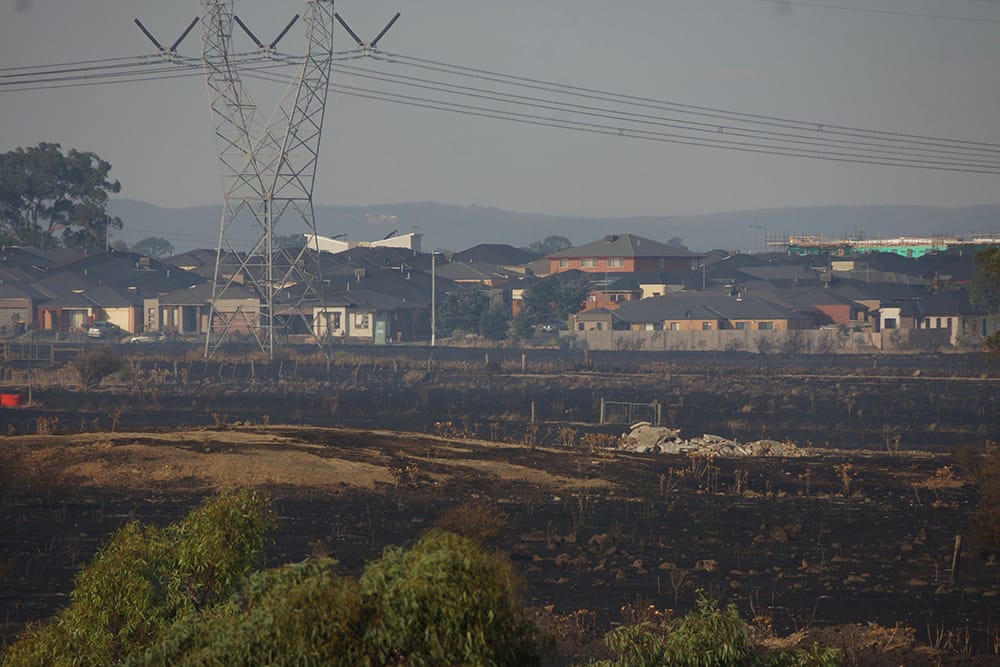
People die in grassfires. They travel very quickly and can take you by surprise.
Grassfires:
- create large amounts of radiant heat
- move extremely fast when blown by strong winds—faster than you can run
- create a lot of smoke, which makes it hard to see, breathe and move around safely.
Don't drive near a grassfire
Smoke from a grassfire can make it hard to see and cause people to have accidents.
Keep roads clear for the fire brigade and other emergency services. Traffic on the roads can prevent fire trucks getting to houses.
What to do when there's a grassfire
Don’t wait for a warning before taking action. Learn what to do when there's a grassfire in an urban area in the following video.
[Urban Grassfire]
On hot, dry, windy days, grassfires can start anywhere and spread quickly.
If a fire starts, you'll be much safer a few streets away.
Walk at least two streets back from burning grassland.
If you are two or three streets away, stay where you are and monitor conditions.
Never drive, to keep roads clear for emergency services.
Visit cfa.vic.gov.au to learn more.
If you live right next to grassland and a fire starts
Walk back two streets back from the fire. Don’t drive.
If you live two or three streets away when a fire starts
Stay where you are and monitor conditions. It is unlikely the grassfire will spread beyond the first row of houses.
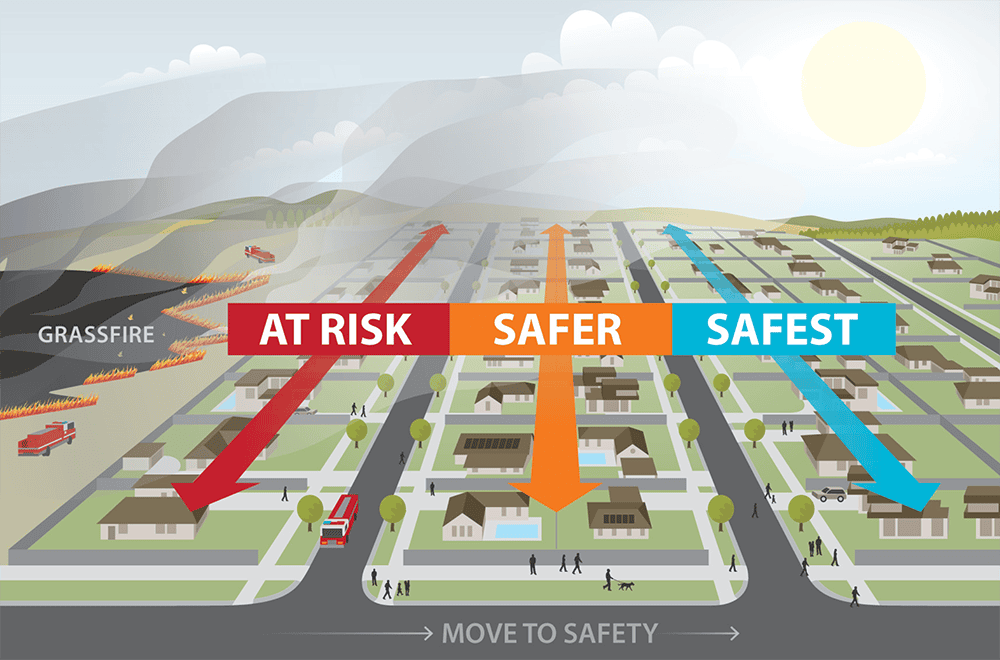 The further you are away from the grassfire, the safer you are. Walk, don't drive, away from the fire to keep streets clear for emergency services.
Once you are safe inside
Stay inside and keep all windows and doors closed.
Place towels and blankets around the bottom of doors and window sills to block the smoke from coming in.
Don’t use your air conditioner as it will circulate smoke through your home. Some air conditioners can also catch burning embers and result in your home catching fire.
Don't drive in dry grass. You could start a fire.
This video shows why you should never park on or drive through long dry grass.
[Never park or drive through long grass.]
[No voice over]
The camera is looking from underneath a car, looking back past the exhaust pipe and muffler. The car reverses out of a driveway into a suburban street with the morning sun low on the horizon.
It's later in the day as we cut to the same point of view with the car driving down a freeway in light traffic, then suddenly on a dirt road in the remote countryside.
Next the car is stopping in some dry grass which we can see coming into contact with the exhaust pipe. As the car comes to a complete stop we can hear the engine continue to idle. Before more than a few seconds have passed the grass catches fire from the heat of the exhaust pipe that it's touching.
Flames quickly spread down the blades of grass, catching other bits of grass on fire. Smoke starts to rise from the burning grass. Just before the camera changes angles we see the grass suddenly flare as the heat increases and all the grass starts to burn quickly.
The camera angle changes to directly overhead as we see a blue car drive from the grass on the side of the road back onto the dirt road to continue its journey. As it leaves we can see that the grass on the side of the road is on fire and the fire is getting bigger. It appears that the driver wouldn't have known the fire had started.
The camera slowly zooms in toward the fire as a message appears on the screen.
[On screen text]
Out of sight, out of control. Driving through dry grass can lead to grass fires.
For more information visit cfa.vic.gov.au/vehicles
Hot exhaust systems in cars and motorbikes can start fires in dry grass. Don't drive through grass in Summer.
Even pulling over onto the side of the road where there is dry grass
could start a serious grassfire without you even being aware.
Resources
Urban grassfires
Learn what to do when there's a grassfire in a suburban area.
Page last updated: Monday, 14 September 2026 7:17:14 PM