Summary
Learn what Fire Danger Ratings mean and how they help you understand fire risk and stay safe during bushfires and grassfires.
- The different Fire Danger Rating levels
- What each rating means
- Actions you should take at each level
- How ratings help you prepare and stay safe
Fire Danger Ratings
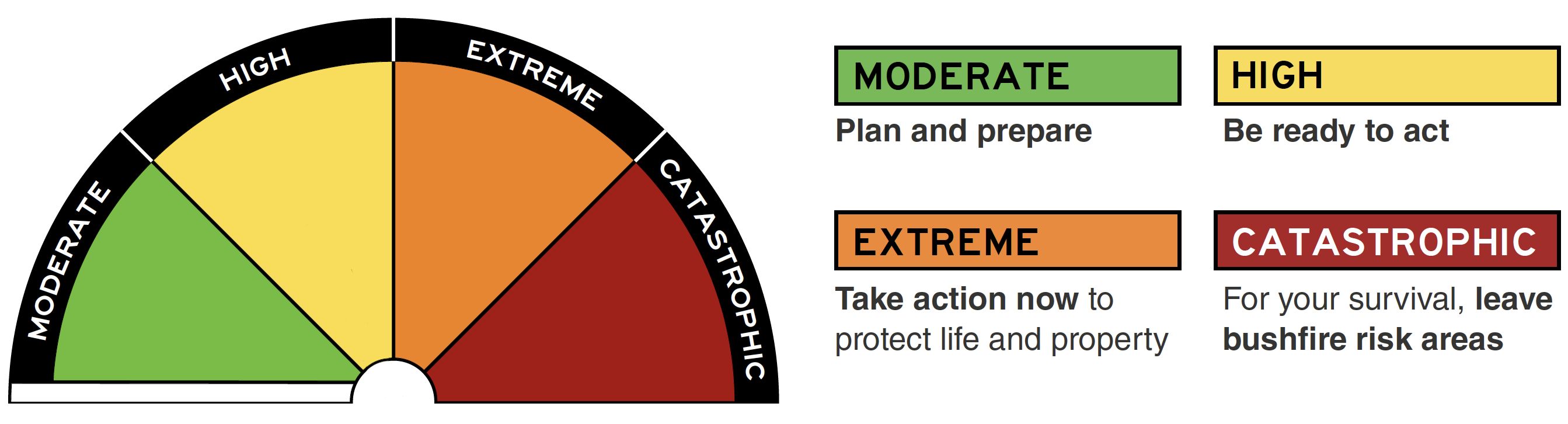
There are four levels of fire danger:
- Moderate - Plan and prepare
- High - Be ready to act
- Extreme - Take action now to protect your life and property
- Catastrophic - For your survival, leave bushfire risk areas
Fire Danger Ratings will be issued on days when there is a fire risk.
Each fire danger rating will have a clear set of messages including the actions the community can take to reduce their risk.
Ratings are forecast using Bureau of Meteorology data for up to four days in advance, based on weather and other environmental conditions such as vegetation.
The rating is your trigger to take action to stay safe.
What does it mean?
If a fire starts and takes hold, lives are likely to be lost.
- These are the most dangerous conditions for a fire.
What should I do?
For your survival, leave bushfire risk areas.
- Your life may depend on the decisions you make, even before there is a fire.
- For your survival, do not be in bushfire risk areas.
- Stay safe by going to a safer location early in the morning or the night before.
- Homes cannot withstand fires in these conditions. You may not be able to leave and help may not be available.
What does it mean?
Fires will spread quickly and be extremely dangerous.
- These are dangerous fire conditions.
- Expect hot, dry and windy conditions.
What should I do?
Take action now to protect your life and property
- Check your bushfire plan and that your property is fire ready
- If a fire starts, take immediate action. If you and your property are not prepared to the highest level, go to a safer location well before the fire impacts.
- Reconsider travel through bushfire risk areas.
- Leaving bushfire risk areas early in the day is your safest option.
What does it mean?
Fires can be dangerous.
What should I do?
Be ready to act.
- There’s a heightened risk. Be alert for fires in your area.
- Decide what you will do if a fire starts.
- If a fire starts, your life and property may be at risk. The safest option is to avoid bushfire risk areas.
What does it mean?
Most fires can be controlled.
What should I do?
Plan and prepare.
- Stay up to date and be ready to act if there is a fire.
The system also introduces an 'off' level for days where no proactive action is required by the community. This does not mean that fires cannot happen, but that they are not likely to move or act in a way that threatens the safety of the community. This rating is the thin white wedge on the colour wheel sitting under 'Moderate'.
Current Fire Danger Ratings
View current and forecast Fire Danger Ratings across Victoria, including Total Fire Ban information and fire risk conditions for different parts of the state.
Use CFA Local to check the Fire Danger Rating forecast for your local area, along with local warnings, restrictions, permits, brigade information and other community safety information.
Page last updated: Tuesday, 6 October 2026 1:51:28 PM