Summary
- If all other plans have failed, sheltering in your car could help save your life.
- You are more likely to survive in a car than out in the open.
- Buildings are more likely to provide better protection from fire than a car.
- Do not drive through smoke as you could crash.
- Park your car off the road away from vegetation in a clear open space or behind a barrier like a wall.
- Shelter under a dry pure wool blanket below window level until the fire has passed.
Never 'wait and see'
Never wait and see what will happen if there is a fire near your area. Leave if it is still safe to do so. The longer you wait to leave, the greater the risk to your life.
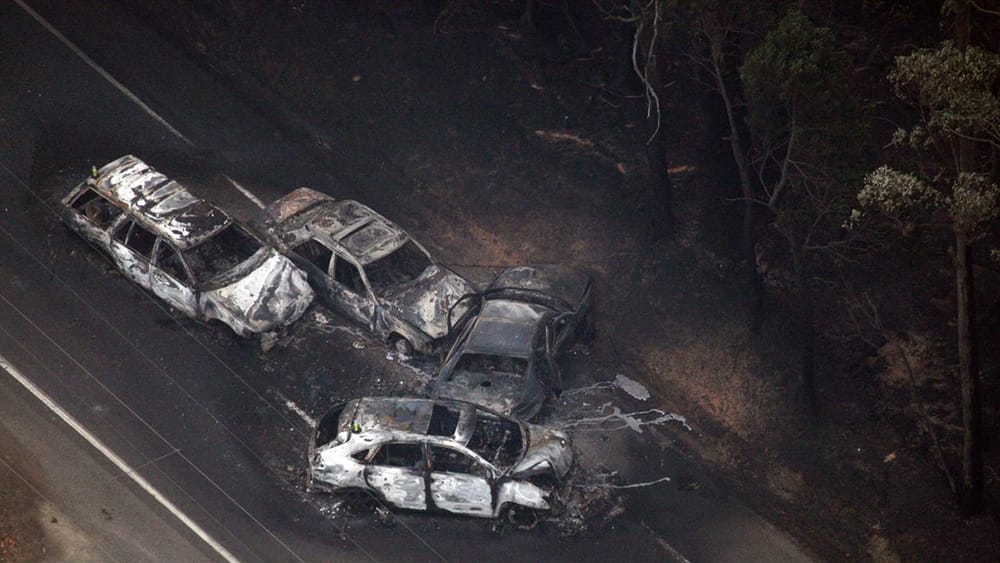 Driving on the road during a bushfire could be fatal.
If you try to leave too late you could:
- become blocked by road closures, traffic jams or fallen trees
- lose visibility and have a car crash
- find yourself in the path of the fire.
Many people died during the Black Saturday fires on the roads trying to leave too late. Don't delay leaving.
Modern cars are highly flammable
Modern cars contain more plastic than older cars, especially in the bumpers, grill, wing mirrors and parts of the under-floor.
Plastic catches on fire more easily than metal and also creates toxic fumes which can damage airways and potentially result in death.
Newer cars also often have bigger windows. This lets more heat radiate through into the car during a bushfire, which can make it less likely you'll survive.
What to do if you are caught in the path of a fire
- Turn back and drive away from the fire if it is safe to do so.
- If you can't drive away, shelter inside a building if there is one very close by.
- If you have nowhere else to shelter, stay in your car. You are better off in a car than out in the open when the fire front arrives.
Follow the instructions below to protect yourself from radiant heat.
How to shelter in a car during a fire
- Park the car:
- away from bushes, trees and other cars as they can catch alight easily
- behind a barrier like a brick wall or a rocky outcrop
- in a cleared area such as on gravel, an oval, or a burnt out paddock.
- facing the oncoming fire front.
- Turn headlights and hazard lights on so you are visible to other drivers and emergency services.
- Close windows and air vents.
- Turn engine off when fire is close by.
- Passengers get down below the window line, as close to the floor as possible, to protect from radiant heat and toxic gases.
- Shelter under a dry blanket made of pure wool. Wool can protect you from radiant heat. Do not wet blankets as the extreme heat will give you steam burns.
- Cover your mouth with a cloth or P2 mask so you're not breathing in as much smoke or fumes.
- Drink water so you don't get dehydrated. Even if you are not thirsty.
What to expect as the fire front passes
The vehicle will be extremely uncomfortable as the fire front gets closer. Things you might experience:
- Intense heat, smoke and embers as the fire approaches.
- Strong winds rocking the vehicle.
- Smoke and toxic fumes.
- Tyres and plastic parts catching on fire and popping.
- Windows breaking.
- Interior catching on fire.
Fuel tanks are very unlikely to explode. They might vent, especially LPG tanks.
What to do once the fire has passed
1. Stay covered until the temperature of the car drops
Once the fire has passed, check if it's safe to get out of the car by holding up your hand and feeling the air. If it is hotter than when skin is badly sunburned, it's still too hot to get out from under the blanket.
2. Get out of the car when it's safe to do so
Once you're out of the car, stay covered up in dry woollen blankets and move to a safer place, like burnt ground. The dry woollen blankets will continue to protect you from radiant heat.
3. Call Triple Zero (000).
Sheltering in a car is a last resort option
Being in a car during a fire is very dangerous and can result in serious injury or death. This is because of the extreme heat your body has to endure. It is a last resort option only.
Days of high fire risk are hot and windy, and inside a car without any airflow or air conditioning is very hot and uncomfortable. Add the heat of a bushfire or grassfire, and conditions are extremely distressing and uncomfortable.
Despite this, it is safer inside a car than out in the open during a fire.
Case study
Lara grassfire
On 8 January 1969, a fire at Anakie near the Geelong-Ballan Road flared up and travelled towards Lara.
17 people died when it became a fast-moving grassfire at the
Melbourne-Geelong Freeway in Lara. They died getting out of their cars
trying to outrun the fire through dense smoke. The six people who
sheltered in their cars survived.
As a result, guidelines changed to recommend sheltering in a car when the fire is upon you.
The
fire ended up burning to the edge of suburban Melbourne affecting
Altona, Diamond Valley and Kangaroo Ground. In total 23 people died, 100
were injured, and 230 homes and 21 buildings were destroyed.
Prepare a bushfire kit for your car
Keep a kit with essential supplies in your car during Summer. We recommend including:
- Woollen blankets - for covering passengers sheltering in the bottom of the car to protect from radiant heat. Do not wet blankets.
- Water - to stay hydrated.
- P2 masks - to filter out toxic fumes. A cloth you can wet and cover your mouth with would also be suitable while under a dry blanket.
Don't drive through smoke
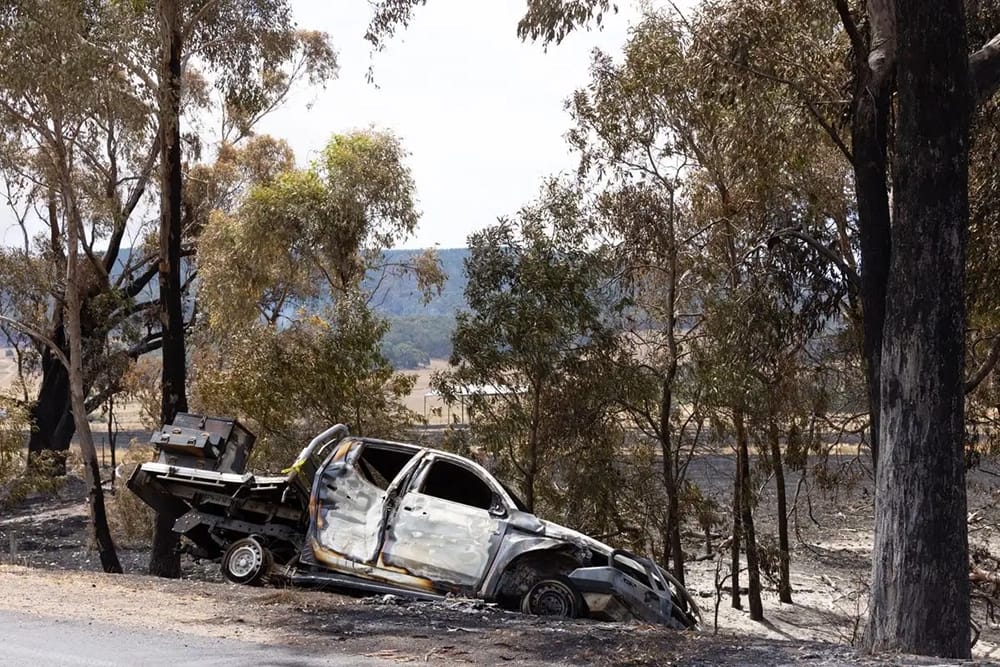
Driving through smoke is dangerous as you can't see at all and your chances of having an accident are very high. Many people have died in car accidents during bushfires. Leaving early is always your safest option.
Case study
Dangers of driving with low visibility
During a bushfire in Yarra Glen, a 48 year old man drove onto the
wrong side of the road, crashed and died. He died because of a car crash
caused by not being able to see, not the bushfire itself.
Page last updated: Tuesday, 22 September 2026 11:47:17 AM