As an owner or manager of accommodation in an alpine region, you have a legal responsibility to protect your property, staff and guests from the risks of fire.
Summary
The remote and difficult terrain in alpine regions makes it more challenging for CFA to respond to fires and other emergencies.
CFA can support you to keep everyone safe, including ensuring your fire equipment is compliant and your staff are properly trained and aware of their roles in an emergency.
- Take your fire safety responsibilities seriously and keep your guests safe.
- Make sure staff know what to do in an emergency.
- Run regular evacuation drills.
- Keep internal passageways clear of gear and bedding.
- Keep fire exits free from snow.
- Do regular checks of fire equipment to make sure it's compliant.
- Clean and test detectors and fire indicator panels regularly.
- Service chimneys, flues and wood heaters before every season.
Guest and staff fire safety
Everyone staying on site needs to be aware what they can do to prevent fires starting. The following advice applies to both staff and guests using accommodation. Make sure you communicate this advice to everyone:
Do:
- Dry your snow gear and clothes on a hanger in the drying room.
- Keep paths to exit doors clear.
- Use official kitchen areas and equipment for cooking.
- Keep smoke alarms uncovered so they work effectively.
- Charge your devices safely on hard surfaces like a table.
Don't:
- Don't hang clothes and snow gear on emergency equipment or on heaters in your room.
- Don't use portable stoves, or other cooking appliances in bedrooms.
- Don't overload power points.
- Don't charge devices on beds or blankets.
- Don't tune skis and snowboards in bedrooms. Hot wax can drip onto the carpet and make toxic fumes. Hot irons can start a fire if left on. Snow gear can also block emergency exit routes.
Consider setting up a charging station in your accommodation to prevent battery fires in bedrooms.
Remember, a callout fee may be charged if a fire alarm is set off and it is a false alarm.
Create a tip sheet with fire safety reminders to put up around your accommodation.
Keep exits clear
Alpine doors open inwards because snow can build up outside.
Emergency exits need to be kept clear and unlocked from the inside. Make sure your guests don't leave their gear or bedding blocking doorways and exit routes. This is so people can escape if there is a fire.
In an emergency, fire wardens should let people know doors open inwards.
Be careful when evacuating snow-covered buildings
Watch out when evacuating a building if there has been heavy snowfall. Snow on the roof can start to melt due to the heat of a fire, curl and come off the roof as a big mass of ice. This is called 'snow shedding'.
Pre-season fire safety checklist
The following checklists are designed to make sure you don't forget important steps in the lead up to snow season. Use these lists to help you develop a routine for fire safety on site.
Fire planning and training checklist
- Appoint Fire Warden or wardens if not already done
- Train staff in fire safety
- Train staff in how to use fire extinguishers and fire blankets
- Prepare Alpine Fire Warden's kit
- Make sure staff know the evacuation plan
- Run evacuation drills to practise evacuation plan
- Display emergency management plan, fire orders and evacuation plans correctly (see below)
Documents to be displayed
Review and update these documents as required:
- Emergency Management Plan
- Check contact and building details are up to date each year before snow season.
- Fire Orders
- Clear instructions listing out what to do in a fire.
- Emergency phone number should be clearly visible in numerals and letters.
- Location and address of accommodation clearly listed.
- Print out and attach to wall at or near each entry/exit and on back of doors in rooms where people sleep.
Download Fire Orders in your language:
- Evacuation plans
- Illustrated floor plan which identifies all exit routes, emergency exits, fire fighting equipment and emergency assembly points.
- Whole building evacuation plan must be near main entry/exit, preferably near fire alarm panel.
- Individual evacuation plans should be displayed next to fire orders on back of doors in rooms where people sleep.
- Triple Zero (000) signage
CFA can provide accommodation owners and managers with a sign which reads 'In an emergency call 000'. These signs can be put on glass doors facing out, so people outside can see them. This is useful if they have evacuated and are looking for the name of the lodge before calling emergency services.
Regular maintenance checklist
Essential Safety Measures (ESMs) are safety features designed to protect your guests if there is a fire. They include exit doors, emergency lighting and fire hydrants.
Owners are responsible for ensuring ESMs are maintained and operational.
CFA recommends checking your ESMs between compliance inspections, as equipment might be removed, moved or damaged by guests.
Essential Safety Measures checklist:
- Fire orders and evacuation plans are prominently displayed.
- Passageways and exits clear.
- Fire blanket is in kitchen area in its cover and in the correct location.
- Fire extinguishers in place and unused—the pin and tie isn't broken, and the gauge has pressure.
- Hose reel cupboards kept clear and only containing hose reel.
- Emergency lighting works.
- Flues and chimneys clear after heavy snow (only if roof has fall protection)
- Wood is clean and dry, not green
Watch CFA's Alpine Essential Safety Measures video playlist for more information.
Test Essential Safety Tuesday (T.E.S.T)
Promote the fire safety of your lodge and join the T.E.S.T challenge. Tick off weekly tasks with the support of CFA behind you. Join in and receive branded mouse mats and coffee mugs with Essential Safety Measure tips.
Follow CFA Alpine Team on Facebook Contact CFA Alpine Commander
Reduce false alarms with regular cleaning and maintenance
Monitored Fire Indicator Panels (FIP) notify emergency services automatically when triggered. It is illegal for you to reset the alarm without consent from CFA or with a reasonable excuse.
When an unmonitored Fire Indicator Panel goes off, someone on site needs to call Triple Zero (000).
Reduce false alarms from your monitored alarms by cleaning your detectors. Detectors can be set off by:
- moths
- dust
- steam
- vaping or smoking
- aerosols like deodorant, fly spray
- nearby building work
- lack of maintenance.
If there are building works nearby, you will need to clean more regularly to get rid of dust.
If steam is setting off the alarm or detector you might want to change the type of detector or move it. Check with your Essential Safety Measure compliance company.
Adopt a Fire Hydrant
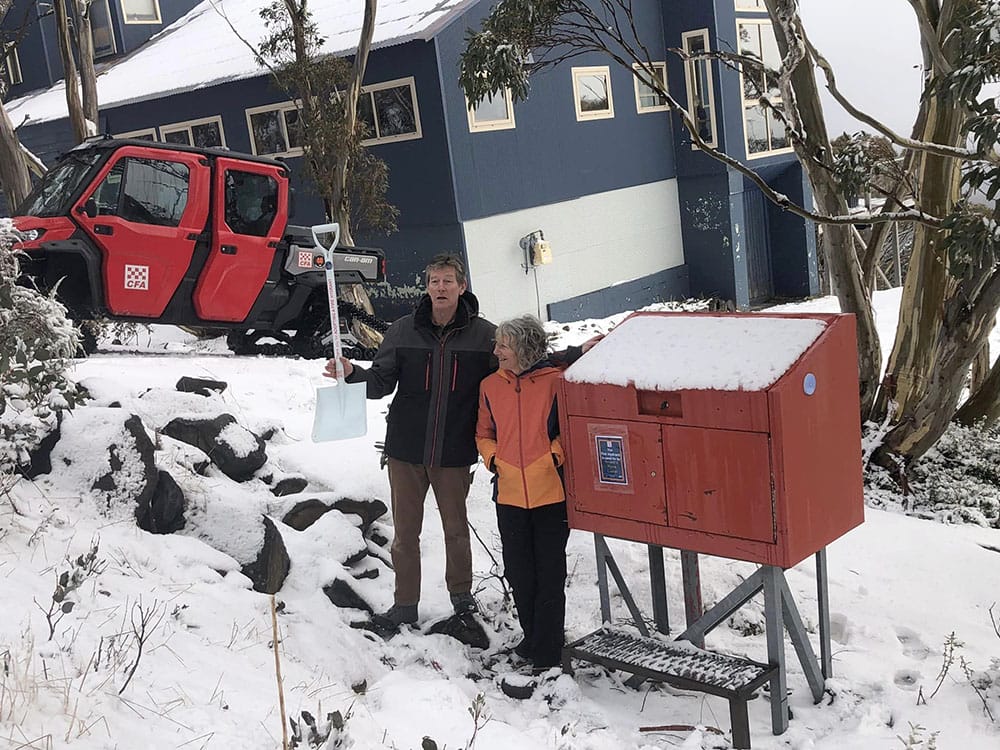
Managers of Asgaard Alpine Club on Mount Hotham, Mark and Missy, who have adopted their local fire hydrant, keeping it clear of snow ready for firefighters to use in an emergency.
Alpine fire trucks don't carry water, so they need to access water hydrants as quickly as possible when called to a fire.
If you adopt a local fire hydrant, you'll become responsible for keeping a clear path from the road to the hydrant and around the hydrant, and you'll receive a CFA branded snow shovel and a certificate. We will also be able to put out a fire at your accommodation more quickly.
Contact CFA about adopting a fire hydrant
Page last updated: Wednesday, 8 July 2026 10:49:20 AM